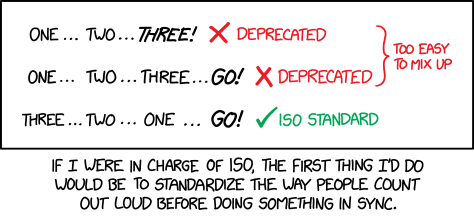
On three:
Five... Four... Three!
On three:
Five... Four... Three!

This, and standardizing what "this Thursday" and "next Thursday" mean. These terms have become functionally useless (to me) because of how they're used differently by different people. Whenever someone uses these terms to try to intimate a particular date to me, I just ask for the exact calendar date rather than the day of the week to avoid ambiguity.
Biweekly is another one. Two times a week, or once every two weeks (also called a fortnight)?
This is one of those ones that's a tragedy. Biweekly "should" always mean every two weeks. Twice a week is "semi-weekly", aka every half a week.
But regardless of what it "should" mean, people use it wrong often enough that you have to check every time, not because the word is ambiguous, but because people are often mistaken.
It's a shame, but it's part of human communication 😅
Human communication sucks. It should be illegal.
Tell me about it.
sorry that's illegal
There's also semi monthly, which is two times a month, as opposed to every two weeks, which is what biweekly is
Semi monthly results in 24 events per year while biweekly events happen 26 times
"upcoming Thursday" is the way I try to solve that
There is a rule but it's not really well known so people just follow whatever rule they deduced from usage. People have to qualify which one they mean almost every time. I usually say "this coming Thursday" (this week), or "Thursday next week" instead.
The rule makes perfect sense (and is how I’ve always used it), but this article actually misses a major point which I just learned last week when talking to some native Spanish speakers. In most English speaking countries, the week starts on Sunday. This isn’t the case for many, many other countries though. So saying “this Friday” on a Sunday really really confuses people. That’s exactly what happened to me last week because it was a Sunday and we were talking about a Friday and she got very very confused.
Starting the week on Sunday makes zero sense. Where does that even come from? Obviously Monday is the start of the week and everyone hates it for it.
A significant portion of the population thinks that “X times more” and “X times as much” mean the same thing. It drives me insane. I don’t think it’s ever formally taught because they use more rigorous language in school problems, but I’d like to think most people would agree “50% more” means 150%, and “50% as much” means 50%. 2X seems to cause confusion though.
So yeah, codifying that first chance.
Edit: What have I done, I knew better than to post a pet peeve in a comment chain.
"This thursday" is the thursday on this current week. It might be in the future or in the past, which will be obvious from the context.
"Next thursday" is the thursday on the next week after this current one.
"Last thursday" is the thursday on the last week before this one.
Edit: I've realized this definition was wrong and sleep-deprived and that the actual definition I use is: "This" refers to within this 7-day period of Su–Sa, "Last" refers to the last 7-day period, and "Next" refers to the next 7-day period. I was depriving myself of sleep to finish some work and came up with this. So "this" remains the same, but I just made up some definition of "next" that's inconsistent with how I'd describe months in years. Hopefully the work is okay.
Is this not universal? It seems so obvious.
"This Thursday" is the closest Thursday coming up, "next Thursday" is the next one after that. The exception is if you're already passed "Thursday" that week, then it's "next Thursday" until the new week starts.
“This Thursday” is for the Thursday contained within the Sunday–Saturday interval you’re currently in.
Except according to ISO 8601, Monday is the first day of the week, and it is the definition used in some english-speaking countries (Ireland, occasionally the UK). That means every Sunday there is a definite ambiguity as to which day is "this Thursday".
I know someone who would always say "we go on three" and then just shout "three!" Without counting or anything. I told him that was super confusing and he just didn't agree and moved on
I think he was making fun of you.
He was an EMT and it was about lifting someone in sync so they don't fall...
I think it's so the person being lifted doesn't tense, when ready for it. So you kind of surprised them but it's an acceptable surprise, as they are expecting a move.
These are usually either unconscious or screaming people, not the kind to care about what an EMT says.
Pretty good joke, to be honest.
Playing Let’s Go Eevee with my 6yo niece the other day, and when I counted trying to time our pokeball throws she would demand to be the one who counts. Her method was to try and surprise me, it seems. She would change the timing between each number independently every time, like “3, … ….. 21GO!” Sometimes, she would just throw on 1 but keep counting. Realized it was easier just to watch her arm.
Well, five is right out.
That's what I do. If you're ready, you're ready, no point in counting.
I just say "THREE!". It's the "ONE TWO THREE!" variant but I skip "ONE" and "TWO".
If you're not ready now, you won't be after the count down.
In Finnish we typically say "Än, yy, tee, nyt!", because our word for "now", nyt, is composed of letters N, Y and T.
The "y" is pronounced roughly the same way as "ew" in "new". "ä" in the same as "a" in "cat", and "e" is the same as "e" in "well".
How about translating this to English and using the following as the standard?
"Aehn, oh, double you, now!"
🙃
I've also heard people do "three... two... one!" and then do the thing on "one"...
Obviously for this case we need to add a signifier for the countdown so it's clear to the other parties that you are aware of the standard and adhering to it before you even begin the countdown.
Like "ISO three two one GO!"
This is semi-backwards compatible, but still confusing for normies.
Even better, just make up new words where the ambiguity never existed. No numbers at all, just "glarp dook peow" and we always go on "peow" and always have. No backwards compatibility, but you'll be guaranteed that a person who doesn't understand will need clarification, and won't go unexpectedly through imagined agreement.
Or, if backwards compatibility is required, we could count up from 1 to 3... and our signifier phrase could be something like "awnthree". As a label for the standard we're using! Like, "awnthree, one, two, three".
I think that could work 😛
Unconfusable:
Ready, Set, Go!
Ready, set, on your mark, get set, get ready, here, we …
I have been wanting to have this argument with david bowie but then he had to up and die so now i have to have it with his ghost. how inconsiderate.
"Feel the rhythm. Feel the rhyme..."
Same wifh rock paper scissors
Left out the Arthurian "One... Two... Five... No, Three... Go!"
What about 3, 2, 1, 0, segfault?
A community for a webcomic of romance, sarcasm, math, and language.