1089
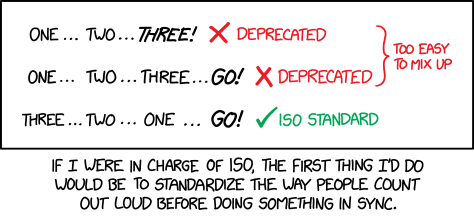
xkcd #3232: Countdown Standard
(imgs.xkcd.com)
xkcd #3232: Countdown Standard
Title text:
Anyone who is caught counting 'three ... two ... one ... zero ... GO!' will be punished with a lifetime of eating only ISO standard food samples.
Transcript:
Transcript will show once it’s been added to explainxkcd.com
Source: https://xkcd.com/3232/
Except according to ISO 8601, Monday is the first day of the week, and it is the definition used in some english-speaking countries (Ireland, occasionally the UK). That means every Sunday there is a definite ambiguity as to which day is "this Thursday".
(Funnily enough, if we're invoking ISO 8601, it also defines that weeks are anchored to a year by whatever year their Thursday is in.)
I used to go by Monday–Sunday, but I've grown into a firm believer of Sunday–Saturday. I'm going to start my own standards organization, and we'll have incredible tea, open access, and civilized boundaries for weeks. [relevant xkcd here]
Fair point that there's some ambiguity, albeit not caused by an inherent ambiguity between "this" and "next". I'd just invoke "next Thursday" in that situation because it's the same regardless of apostasy.
I'm curious as to why. Obviously it doesn't really matter. I can't think of any arguments for Sunday--Saturday, and the only argument I have for Monday--Sunday is that in that case the "weekend" is actually the end of the week, rather than awkwardly split up. But then the word for "weekend" is different in different languages, so it's a very English-specific argument.
That flaw in the "weekend" argument you point out is actually where I realized Monday–Sunday that I grew up with wasn't as obvious as I thought. I like Sunday–Saturday mainly for the structural symmetry. (This is also somewhat cultural, but I think most places nowadays would standardize around Sunday/Saturday being stereotypical "off" days.) Every week starts with one stereotypical "off" day and ends with one stereotypical "off" day with five "business" days sandwiched between (thus "Hump Day" too is the exact middle of the week rather than just the business week). It's not that big of a deal, but I think it's cleaner. Unlike 24-hour time versus 12-hour, I don't have a solid empirical argument. I'm wrong by ISO standards, but then then MDY and DMY are colloquially used much more common in most places than YMD, so I'm rarely abiding by ISO standards there.
That’s awesome, thanks for sharing. I did not know that.