1459


Ya
Ya
Hey, if you're interested in this topic, you may wanna read on historical examples of countries where that happened!
In the Soviet Union, for example, housing was guaranteed by the state, and homelessness was abolished. Everyone had a right to at the very least a room in a dormitory. Housing was for the most part obtained through the work union. Jobs were guaranteed and there was no unemployment, and the union at work was in charge of finding a flat for the worker and their family. Monthly rent was around 3% of the average family income by the 1970s, so it was very affordable too. If you're interested, there's a book called "Human Rights in the Soviet Union" by Albert Szymanski which goes into detail in these things!
In Cuba, housing is also guaranteed. A friend of mine (I'm Spanish so my friend speaks Spanish too) went to visit the country, and he had a conversation with some university students. On the one hand, the university students couldn't believe that my friend's family had two cars, they thought he was rich when in fact that's rather common for a middle-income family in Spain. On the other hand, they couldn't believe that my friend, at 22 years old at the time, was still living with his parents while studying at university. In Cuba, if you get a position as a university student, you get assigned housing for free while you study.
So yeah, just some perspectives of countries that actually managed to solve the problem of housing for everyone as a right
I find it interesting how in every single video game that involves fostering a population, it's up to you to make sure everyone is housed. Too logical and efficient for billionaires, I guess.
What I love about those video games is that they teach us very clearly that a command economy leads to prosperity (unless you suck as a player I guess), but then billionaires tell us no, free market capitalism and trickle-down are the way we have to go.
Funny, because it taught me that that task in reality is impossible, given real nations can't load an old save file to fix their fuck ups in a simulation far, far simpler than reality.
Of course you could certainly argue that one person wouldn't be in charge of doing literally everything.
with the resources of a real command economy, you could find the best player in the nation and put them at the wheel
weird take. video games have to have a command economy because they are designed to be played. a free market city builder would just be a screensaver.
I've had similar thoughts about the auction house in World of Warcraft. Since the game caps the amount of gold you can have at a small fraction of the overall economy, no one person can buy everything and then jack up the prices.
I mean, the moral is that free markets are a fiction when primary accumulation is illegal.
I can't simply claim a vacant property at the clearance rate. I need to bargain with a landlord at a cartel price. And thanks to public-private collusion, we routinely tax, trade, and subsidize properties at three entirely different figures.
Every economy is a command economy. The question you have to ask is who is in control.
Along those same lines, they didn't put parking lots in Sim City. They tried, but it completely fucked everything.
Might be wrong, but I think in Cities Skylines all you're doing is zoning the city, and it's up to the people to build houses and live (or have their house burn down)
The idea of ownership is kinda silly.
Right? "My ancestors beat up your ancestors, so I deserve to live in wealth and opulence, while you deserve to be my slave"
It really is pretty fucked up.
There's that poem(?) about that
"""
"Get off this estate."
"What for?"
"Because it's mine."
"Where did you get it?"
"From my father."
"Where did he get it?"
"From his father."
"And where did he get it?"
"He fought for it."
"Well, I'll fight you for it."
"""
https://www.goodreads.com/quotes/9358361-get-off-this-estate-what-for-because-it-s-mine-where
I mean this in good faith, what's the alternative? That anyone could enter anyone's house freely? Or that everything is shared (owned by the state, which would give it too much power).
Believe it or not, people on the left have been discussing this for centuries.
The general idea is recognizing a right to "personal property", which you get from using something, instead of the capitalist idea of "private property", which you get from buying something.
Currently in Western capitalist societies, if a rich person buys fifty houses, he owns fifty houses; he can live in one and collect rent from the other forty-nine, or leave the other forty-nine vacant, or tear them down to build one giant fortified survival compound, as he chooses. His property, his choice, whether it benefits the community or not.
In a society without private property, that rich person could only own one house - the house he lives in - because he lives in it and uses it. The people who live in and use the other forty-nine houses would own those. And the land underneath the houses would be owned by nobody, but belong collectively to the community, so no one person or company could accumulate land to the detriment of everyone else.
Landlords hate this idea.
Here's a really super basic summary:
https://www.workers.org/private-property/
And here's a long complicated discussion:
https://www.radicalphilosophy.com/article/anarchism-and-private-property
Part of the problem, I think, is that in common vernacular, 'landlord' also applies to people that are renting out a room of their personal house. The pro-landlord propaganda likes to hold them up as the gold standard we're attacking.
We need to be clear that we're absolutely not talking about the couple that's renting out their kid's old room to get through tough times. They're also victims of the same system, being forced to sacrifice personal property at the altar of capitalism.
As always, the poor are human shields for the rich.
Ain't no war but class war.
You don't own the stall of a public toilet and you can still expect to use it without having people walk on you. It's like we can all agree to distribute resources and keep rights like privacy without the need of property.
how about instead of restricting all ownership, you instead just limited it.
My idea is that basically once anybody hits 10 million in net worth (for example), then we just say 'well done, you've completed it mate'. Now fuck off down the beach and don't come back.
Basically tax any further income of any kind at 100%.
This. Then just put up a scoreboard of who’s excess revenue is providing the most tax revenue to the public, then they can play for first place and we can all benefit off of their sociopathic narcissism. Everybody wins.
https://en.m.wikipedia.org/wiki/Pierre-Joseph_Proudhon#Private_property_and_the_state
Some good reading to start with.
One of the main things to take away is that there's a difference between personal property and private property.
Personal property are things like your clothes, your home, the items you use regularly.
Private property are things you own but don't personally use, don't take real responsibility for.
For example, if you have the money, you can purchase a factory. But a factory is too large an item for one person to ever claim they personally run the whole thing and take full responsibility for. There's many people involved in running a factory, from cleaners to accountants, do they not also take responsibility for their part?
If the factory could never run without all of these workers, can the owner really claim that the factory is theirs? It is everyone who works there's. Why then does the owner get to keep all the money the factory produces? Because they stumped up some cash a few years ago?
The owners are smart enough to pay you for your labour. Maybe even a bonus for a successful year. Some benefits maybe when people start unionising and demanding more. But at the end of the day, the owner still gets the vast vast majority of the profits despite not putting in the vast majority of the work. How is this fair?
I've run out of steam now, it's been a long day, but if you genuinely meant your comment in good faith have a read of the links above.
Concepts of ownership aren’t going to stop you from walking into someone else’s house currently
Anarchists (including us) mostly talk about personal vs private property. For example in an anarchist society nobody is going to take your toothbrush or house, but you aren't allowed to own a house you don't live in (yet still charge for) nor a factory where other people work, those things would be communally owned and cared for, or given to someone in need (in the case of a house). So it's kind of a semi-ownership at least compared to how it is now, you get what you need, not more than that.
Ohhh I see, thanks for the explanation! In that case I agree that private property in the capitalist sense shouldn't exist.
Everyone gets their own home. The land is shared and distributed among the population according to their needs.
“Private property is the smallest unit of warfare.” — The Terraformers (2023) by ~~Becky Chambers~~ Annalee Newitz
Edit: author name
I could be in support of more regulation/taxation on inheritance. But straight up removing ownership as a concept seems way too flimsy.
Its not the concept of ownership its the concept of private property. Of owning property that you do not occupy. Of housing belonging to anyone other than who presently lives there.
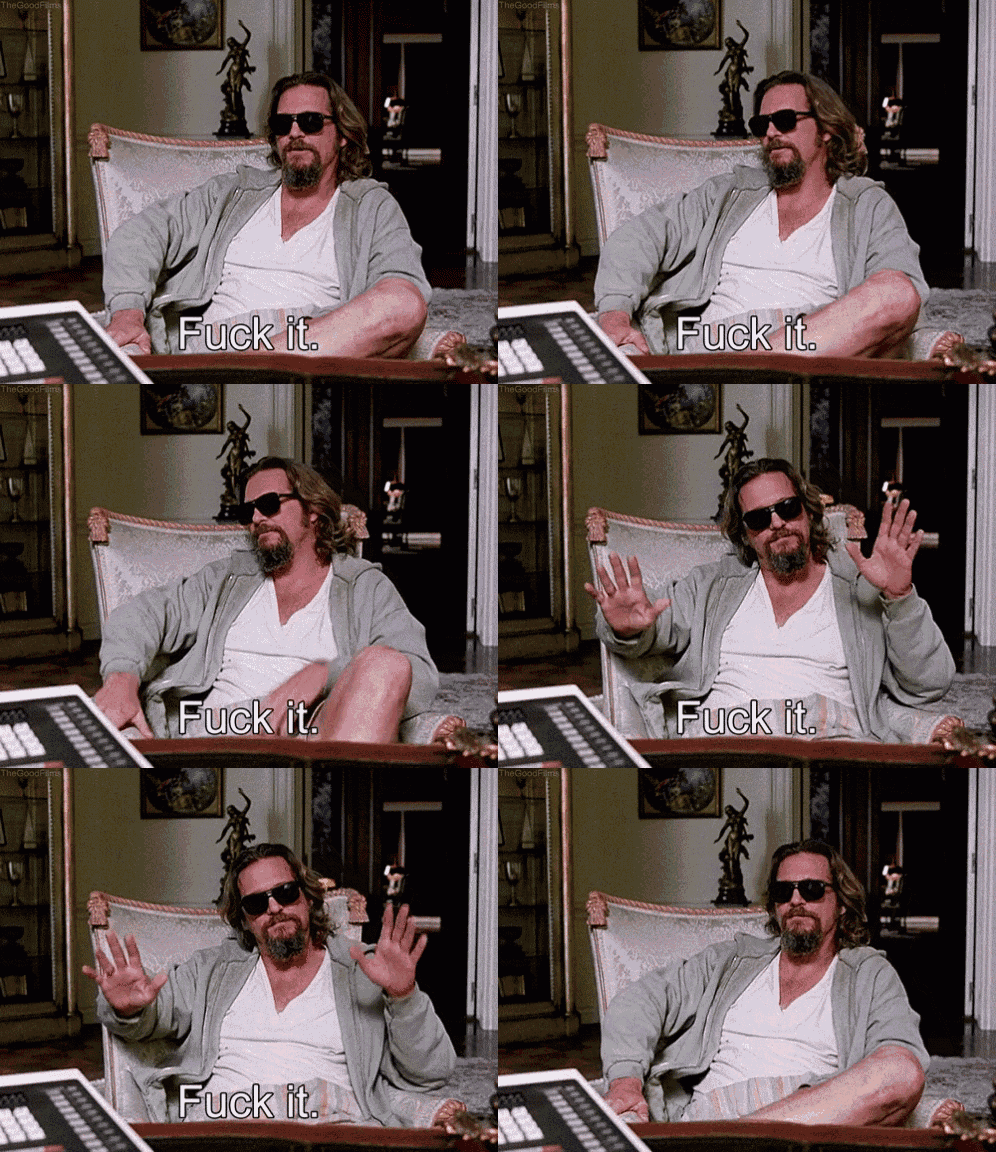
The Dude would just say fuck it and not even bother arguing and tell Brandt that the Big Lebowski told him to take any one of his rental properties as The Dude's own.
Ultimately it comes down to might makes right. That’s the final argument of kings (the barrel of a gun). For all the progress we’ve made we still can’t escape the account of Thrasymachus.
Hell I'd take the right to build my own at this point. But I don't trust the U.S. to be worth living in for any foreseeable future.
I mean we're staring down the barrel of total civilization collapse by 2050 if we don't get climate change under control, so I mean, I'm not sure anywhere is gonna be all that good.
However, your point stands.
I mean, better to have 25 more years of relative normativity than 4 or less
Even ants and bees give everyone a house, food, and a job (with the majority of the hive/colony population having time off and rest at any given time). These people are advocating for us to be less evolved than an ant. Per EO Wilson, the guy who studied these fellas
Relevant passage from The Dawn of Everything by Graeber & Wengrow:
Let’s begin by asking: what did the inhabitants of New France make of the Europeans who began to arrive on their shores in the sixteenth century?
At that time, the region that came to be known as New France was inhabited largely by speakers of Montagnais-Naskapi, Algonkian and Iroquoian languages. Those closer to the coast were fishers, foresters and hunters, though most also practised horticulture; the Wendat (Huron), concentrated in major river valleys further inland, growing maize, squash and beans around fortified towns. Interestingly, early French observers attached little importance to such economic distinctions, especially since foraging or farming was, in either case, largely women’s work. The men, they noted, were primarily occupied in hunting and, occasionally, war, which meant they could in a sense be considered natural aristocrats. The idea of the ‘noble savage’ can be traced back to such estimations. Originally, it didn’t refer to nobility of character but simply to the fact that the Indian men concerned themselves with hunting and fighting, which back at home were largely the business of noblemen.
But if French assessments of the character of ‘savages’ tended to be decidedly mixed, the indigenous assessment of French character was distinctly less so. Father Pierre Biard, for example, was a former theology professor assigned in 1608 to evangelize the Algonkian-speaking Mi’kmaq in Nova Scotia, who had lived for some time next to a French fort. Biard did not think much of the Mi’kmaq, but reported that the feeling was mutual: ‘They consider themselves better than the French: “For,” they say, “you are always fighting and quarrelling among yourselves; we live peaceably. You are envious and are all the time slandering each other; you are thieves and deceivers; you are covetous, and are neither generous nor kind; as for us, if we have a morsel of bread we share it with our neighbour.” They are saying these and like things continually.' What seemed to irritate Biard the most was that the Mi’kmaq would constantly assert that they were, as a result, ‘richer’ than the French. The French had more material possessions, the Mi’kmaq conceded; but they had other, greater assets: ease, comfort and time.
Twenty years later Brother Gabriel Sagard, a Recollect Friar, wrote similar things of the Wendat nation. Sagard was at first highly critical of Wendat life, which he described as inherently sinful (he was obsessed with the idea that Wendat women were all intent on seducing him), but by the end of his sojourn he had come to the conclusion their social arrangements were in many ways superior to those at home in France. In the following passages he was clearly echoing Wendat opinion: ‘They have no lawsuits and take little pains to acquire the goods of this life, for which we Christians torment ourselves so much, and for our excessive and insatiable greed in acquiring them we are justly and with reason reproved by their quiet life and tranquil dispositions.’ Much like Biard’s Mi’kmaq, the Wendat were particularly offended by the French lack of generosity to one another: ‘They reciprocate hospitality and give such assistance to one another that the necessities of all are provided for without there being any indigent beggar in their towns and villages; and they considered it a very bad thing when they heard it said that there were in France a great many of these needy beggars, and thought that this was for lack of charity in us, and blamed us for it severely.’
Biard did not think much of the Mi’kmaq, but reported that the feeling was mutual
Amazing. You go there to teach these heathen savages about the mercy of Christ, find that they practice the core virtues you want to teach them better than your own culture, and then you get irritated.
parasites ! weaklings ! your revolution is over ! the bums lost !
if society doesn't have enough homes then it should reduce birth rate, change my mind.
One in ten houses in the US are vacant.
https://usafacts.org/articles/how-many-vacant-homes-are-there-in-the-us/
"Society" has more than enough housing. We just distribute it poorly.
For when you need a laugh!
The definition of a "meme" here is intentionally pretty loose. Images, screenshots, and the like are welcome!
But, keep it lighthearted and/or within our server's ideals.
Posts and comments that are hateful, trolling, inciting, and/or overly negative will be removed at the moderators' discretion.
Please follow all slrpnk.net rules and community guidelines
Have fun!