this post was submitted on 24 May 2026
1586 points (100.0% liked)
Microblog Memes
11547 readers
581 users here now
A place to share screenshots of Microblog posts, whether from Mastodon, tumblr, ~~Twitter~~ X, KBin, Threads or elsewhere.
Created as an evolution of White People Twitter and other tweet-capture subreddits.
RULES:
- Your post must be a screen capture of a microblog-type post that includes the UI of the site it came from, preferably also including the avatar and username of the original poster. Including relevant comments made to the original post is encouraged.
- Your post, included comments, or your title/comment should include some kind of commentary or remark on the subject of the screen capture. Your title must include at least one word relevant to your post.
- You are encouraged to provide a link back to the source of your screen capture in the body of your post.
- Current politics and news are allowed, but discouraged. There MUST be some kind of human commentary/reaction included (either by the original poster or you). Just news articles or headlines will be deleted.
- Doctored posts/images and AI are allowed, but discouraged. You MUST indicate this in your post (even if you didn't originally know). If an image is found to be fabricated or edited in any way and it is not properly labeled, it will be deleted.
- Absolutely no NSFL content.
- Be nice. Don't take anything personally. Take political debates to the appropriate communities. Take personal disagreements & arguments to private messages.
- No advertising, brand promotion, or guerrilla marketing.
RELATED COMMUNITIES:
founded 2 years ago
MODERATORS
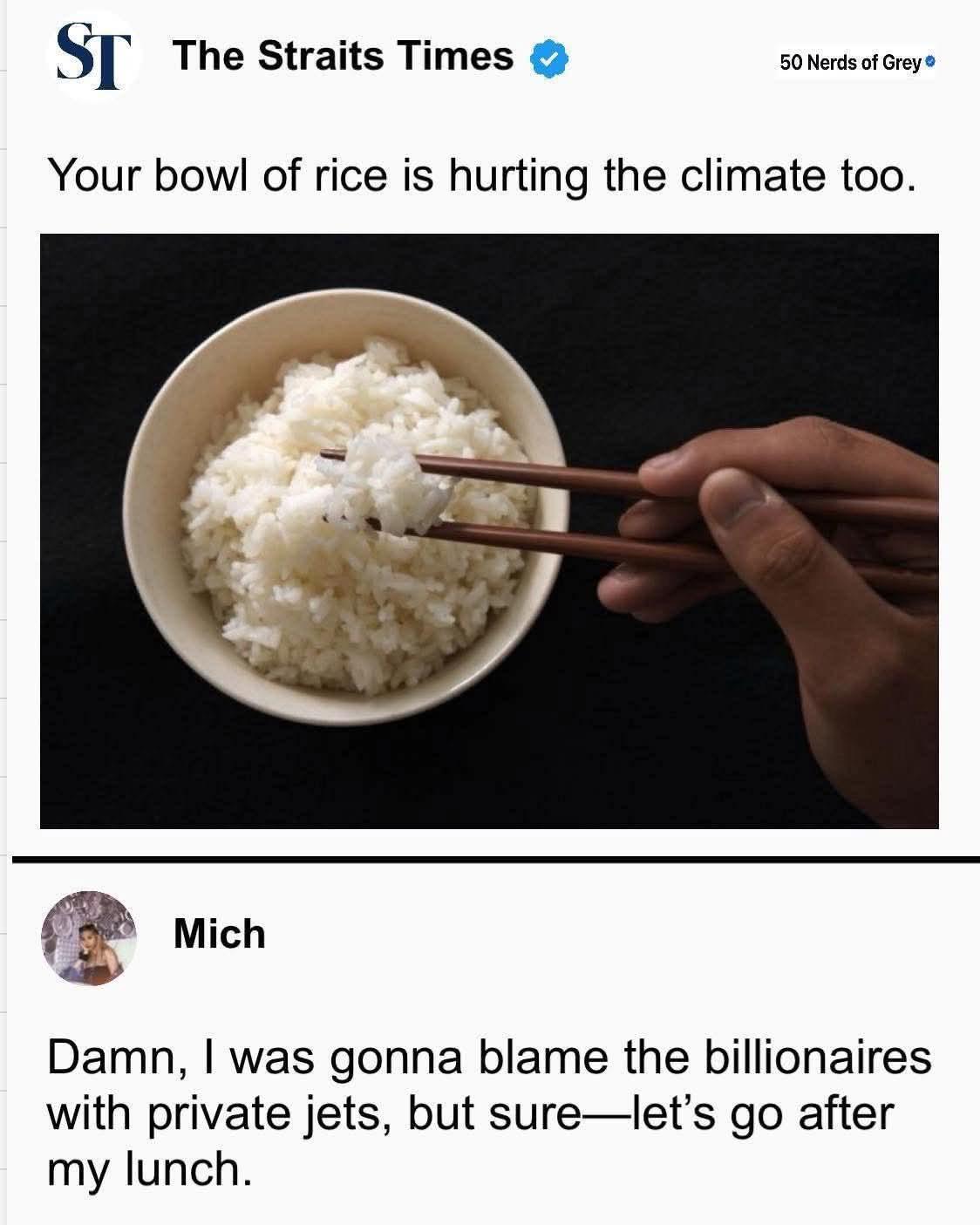
To anyone wondering, no, rice is not hurting the climate. Unlike many water-intense crops, people are not trying to grow rice in the middle of the American desert.
...unless there's a profit to be made. Hype rice into the next superfood and watch people grow it in the desert.
ricemaxxing
5/7
People (by which I mean extremely large agro-businesses) are growing soybeans and corn in the desert because it's the highest economic yield per acre grown. Almost nothing competes with it. So it's not just that a profit has to be made, but also that a larger profit than corn or soybeans has to be made. Which is unlikely, given how much bio-engineering and infrastructure capital has gone into both of those crops.
If Americans ever embrace rice I'll eat 4 pairs of vintage high top Doc Martens
Murican's eat a lot of rice, and beans, at least in the southwest
Maybe it's a regional thing.. in my area the supermarkets put rice in the "ethnic" aisle 🤦
US produces something like 7 million tonnes of rice every year, mostly for internal consumption. It's not anywhere near China or India, but the US does already eat a shitload of rice.
"Millions of lifelong rice-eaters suffer from starvation as rice prices skyrocket to unbelieveable historic highs as the US decides on its new micro-hyper-trend."
Preach. It's a far cry from almonds lol
I would love to see how this sort of online propaganda goes over in the East Asian part of the world. Or just Eastern part of the world in general.
SHHHH don't give them any ideas
Well it is hurting climate in one way and that's by methane emissions. Growing any crop in standing water is gonna create an anaerobic environment where methane is released. Rice therefore is expected to have larger environmental footprint than other grains because the carbon dioxide emissions should be similar as rice and other grains need similar amounts of fertilizer. Animal agriculture still has a larger share in the methane pie but rice's contribution is not insignificant
Given the number of calories per tonne of methane produced, no, no it's not hurting the climate.
This kinda complain is the same as 'well if we just eliminate humans we'll solve climate change,' like yeah, no shit. But the point is keeping humans alive and rice is uniquely good at just that.
And now together: Change your diet for the climate, eat the rich 👏👏
*with rice
capitalists really hate this one simple diet trick!
I swear, whenever someone talks about how "humanity" is killing the planet, or "humanity" is evil or something like that, I get so irrationally mad. It's not humanity, it's like less than 1% of people that are bringing this planet down
And here i was worried that we have to stop torturing animals.
Reread try again. I'm not commenting on animal agriculture; and rice fields are the least problematic mass produced crop for biodiversity given they act as wetlands and use no chemical pesticides or herbicides.
If more vegans used a rice based diet instead of corn, potatoes, lentils, or chickpeas we'd actually have fewer animal deaths given the ridiculous amount of pesticides needed for monocultures of those plants.
I'm just replying to the comment above mine that says rice is not hurting the climate. That's simply factually wrong. I'm also comparing rice to other grains, not rice to growing nothing at all. We could improve the climate impact of agriculture by switching to other carbs that are just as productive while having a lesser environmental impact, such as Maize and potatoes. However I don't think we should actually do that as some people eat rice for cultural reasons and the impact rice has, as many have pointed out, is dwarfed by animal agriculture. So switching away from rice while still eating beef would feel a bit hypocritical. However it's still true that rice is far from the most environmentally friendly carb source.
And I replied telling you you were wrong.
Rice is one of the most environmentally friendly carb sources, and in its native environments is an essential plant. Corn takes up more space and the production and refining creates more CO2 than rice. Potatoes are much more vulnerable to rot and much more likely to fail, not to mention the much higher fertilizer requirements.
Climate change is not one thing. Methane isn't the enemy. Hell CO2 isn't the enemy. It is taking out things out of balance. If we were to eliminate rice and just grow corn, yes, we'd drop 10% of methane production... except we wouldn't because corn requires 5x the fertilizer and fertilizer production is a larger contributor to GHG emissions than aviation and shipping.
Corn is also horribly space inefficient outside the US. Not just outside the Americas, but outside specifically the midwest in the US. Despite it now being attempted to be grown on every continent there is no place on Earth besides the US and Canada that corn becomes more productive per hectacre than rice. It simply cannot replace rice, which is more productive on every single other continent.
So that's 5x the fertilizer, at least 1.5x the space (up to 3x the space) which then logarithmically increase the amount of CO2 produced for transportation and production, all while destroying native ecosystems (or at least ecosystems that have adapted to rice farming over the last few thousand years), oh and we can't forget water management systems would need to change drastically so add 50 years of construction to any CO2 calcs.
'Methane bad' is true, sure, but we can't look at one single source, which provides HALF OF ALL CALORIES CONSUMED BY HUMANS, and say that's a thing that needs to switch. If we replaced corn with rice tomorrow the world would have a net negative GHG production from where we started. The same is not true in reverse, despite rice causing a minor amount of separate methane production.
Carbon release from biological sources are all net neutral. Every single atom released came from the environment in the first place. Every story about grain or cows ruining the environment is propaganda to protect the real culprit in fossil fuels. Every single atom from that source is extra material that had been sequestered for millions of years. That is the only additive source we have the ability to stop.
Is still looks like the world population could use rice as the main source of carbs and it wouldn't be nearly as harmful as cattle.
Yes. Roughly 1:5 calories consumed by humanity are rice, so based on the above chart we could, hypothetically, make all calories rice without increasing total methane. Though, it's worth noting, the "replacing cattle calories" part of that would be less than a 1% increase in rice's methane footprint resulting in a 30% overall reduction. Reclaiming several billion acres of cattle land would just be icing.
I love rice, but for variety let's keep some other calories in our mix, OK? Not beef, that's fine. But I like some sauce and maybe peanuts and veggies and some soy/pea/bean (in whichever variety)
No. My hypothetical statement concerning human methane release comparing different food production was meant to be taken as a bold new era of forced rice eating for everyone always forever. We'll make it a crime not to have rice in your mouth unless you're asleep or have a doctor's note.
Rice doesn't have to be grown in flooded paddies, that's just an ancient, chemical-free way to prevent weeds from growing. You could still grow rice the same way you'd grow wheat or corn and it can actually be less work to do it that way. It would, of course, require more reliance on herbicides for weed control, though, which is its own can of worms. The water also allows other means of food production to happen alongside the rice growing, such as raising fish or ducks. I wonder if symbiotic dual-use of the water would offset, or even directly reduce, the relatively higher methane levels that might be generated within the water. Bonus points if you hook up a turbine to the outflow when you go to drain your paddies.
Cool chart, but as other have noted it's more than a little misleading without context. Rice accounts for about 10X more of humanity's total caloric intake than beef. Weighted as such, Rice becomes a lot less significant.
I've known a lot of people that do this research for a living. You want to know how we could have a much bigger impact without worrying what people eat: grow food locally.
It's actually very simple. Shipping things around the world multiple times before they even get to our plates is absolute insanity.
Afaik Rice doesn't have to be submerged. It can be, so it's done for weed control. Now we can do weed control with lasers, so we'll see what the future holds.
Seems like they are trying to avoid saying "animal agriculture"
Water use and climate impact are two distinct issues (their connections notwithstanding). Californian almond farming is a catastrophe for regional water systems, but its greenhouse gas emissions aren't much of a concern. Conversely, rice farming on flooded fields has substantial greenhouse gas emissions despite its being rather unproblematic for regional water systems.
Substantial is severely overstated as any crop you would replace rice with where rice is grown in water would objectively destroy all local water cycles if not the entire local ecosystem. That would have a much greater impact on climate change than if rice accounted for 100% of all calories eaten globally.
A) Rice paddies are generally in wetlands and swamps, protecting these areas, any other grain you would grow here would destroy that wetland biome. Corn especially would essentially render the entire area sterile because
B) Domesticated rice grown in water does not use any pesticides or herbicides whatsoever. There's no need for it. Occasionally, in specific areas, you'll need scare crows, frequent human activity, or crabs/ducks depending on the exact pest you're getting rid of, but you don't need glyphosate. This has massive knock on effects for climate, fewer herbicides and pesticides means more carbon being sequestered. Fewer herbicides and pesticides in water means more microorganisms turning CO2 back into oxygen and sequestering the carbon in tasty tasty microscopic corpses. Which brings us to
C) Methane and the GHG cycle: While methane is a much more effective greenhouse gas than CO2, it also has practically no shelf life in the atmosphere. It is a natural part of the GHG cycle and even if all grains everywhere were converted to rice, we could not generate enough methane to effect the climate. It would decay to hydrogen within ten years in the upper atmosphere (versus 50 or more for CO2) but more importantly every single type of forest sequesters it more efficiently than CO2. Saying a natural source of CH4 that is easily accounted for by growing it upwind of a forest, like it almost always is, is a serious driver of climate change or even a risk for it is silly doomerism.
The truth is climate change is 100% a matter of fossil fuels. If we stop using fossil fuels, we will immediately stall climate change. Nothing else we can realistically do except burning fossil fuels will cause climate change, and even if we go full net zero on every other thing we do, without stopping fossil fuels, we will not make any progress whatsoever. Even if we used 100% ethanol fuel in ICE vehicles, we would stop climate change. Because we would not be introducing ancient sequestered energy back into the system, we would be taking energy from the system one year, and putting it back in the next.
Rice is the same. All methane renewed by growing rice will be sequestered or decayed in less time than it will take for properly dried and stored rice to decay, and none of whats generated would effect the total amount of methane circulating in the system.
Alfalfa has entered the chat