1132
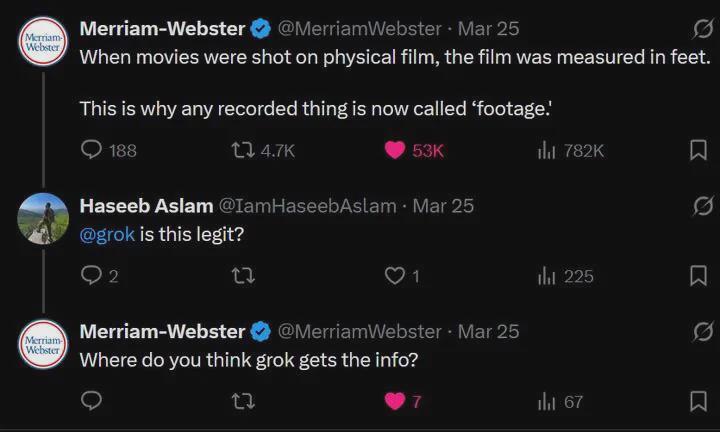
Is this legit?
(discuss.online)
"We did it, Patrick! We made a technological breakthrough!"
A place for all those who loathe AI to discuss things, post articles, and ridicule the AI hype. Proud supporter of working people. And proud booer of SXSW 2024.
AI, in this case, refers to LLMs, GPT technology, and anything listed as "AI" meant to increase market valuations.
It's amazing how many names for things come from a different era. Even "movies" is from "moving pictures" which is how they described a new thing in terms of an old familiar thing, pictures. Also "film" comes from a thin coating of chemical gel on glass photographic plates, which evolved to mean the coating plus the plastic once photography moved from glass plates to flexible plastic rolls. Also, why do we "shoot" movies?
Seconds is one of the weirdest to me.
Interesting, I never thought about seconds having anything to do with the number 2.
LOL, I didn't even realize that until I read your comment.
Weird huh? First, second. It's even spelled the same way, but I never connected the two.
One of the most prolific is canna, which is Latin for reed, tube, or pipe. Turns out you can get a LOT of mileage from that meaning:
Cane: Referring to the plant, walking stick, or slender rod.
Canal: An artificial waterway, from the Latin canalis (pipe/groove).
Channel: A conduit or passage.
Cannon: From Italian cannone, meaning "large tube".
Canon: A rule or standard (originally from a reed used as a measuring stick).
Cannibal: Historically connected to this root through a complex path involving "Carib".
Cannister / Canister: A container, often cylindrical.
Cannula: A small tube for insertion into the body.
Canyon: Derived via Spanish cañón (tube/pipe).
Also, "channel" and "canal" are the result of borrowing the same French word (chanel) at two different times (this happened with many words). In Middle English most words were stressed the first syllable, so chanel became "channel", then by the time it was borrowed again, chanel kept the same French stress on the last syllable and became "canal".
Salon, saloon.
Neat. I didn't realize that canon and cannon actually came from the same root.
Cannoli: Sicilian pastries consisting of a tube-shaped shell of fried pastry dough, filled with a sweet and creamy filling containing ricotta cheese.
They have altered the canna, pray they do not alter it any further.
It’s like rolling down the window.
Yeah, that one changed within my lifetime. It's interesting how "rolling" is even in there.
Say the very first car windows had been electric. It wouldn't be called rolling down because there was no "rolling" mechanism. But, we probably wouldn't call it "powering down" or "buttoning down". We'd probably just say something like "lowering the window". So... why did whoever coined that term decide to include "rolling" in the name? Especially because you still need the "up" and "down". You can't just "roll the window".
You also "dial" a phone number, even though the mechanism for choosing the phone number hasn't been a dial in decades. But, at least in that case there wasn't an obvious name for the process of entering a phone number into the system. A car window just goes up and down, why should it matter if it's done with a rolling mechanism or a button? Even though you turn a knob to open a door, you don't "doorknob open" it or "handle shut" the door. You also raise or lower an anchor, you don't "crank the ank", even though that would be cooler to say.
I suppose if the first windows were electric, they might have just said “open the window”
For the phone dial, I suppose we could say “key in the number” rather than “dial the number.” Of course with cell phone touch screens they aren’t even physical keys anymore. Though in UI framework terminology, I suppose they aren’t even physical usually still referred to as buttons. Though you don’t “button in the number.”
And while "button" is a verb, it's used for the original "button" which was a device on clothing used to hold two pieces together. Electronic "buttons" were just named because they resembled these things people were used to on clothing.
I suspect it's because the first cameras used gunpowder for the flash, long before movies could be a thing.
Makes sense. Also even without that, the camera had a tube-type thing that you aimed at someone, then you pushed a button or pulled a lever that was pretty similar to a trigger. Still seems a bit weird because you're not sending anything towards your target, you're just taking in some light from that direction. But if you add the big "boom" from the chemical flash, I guess it seems like a gun.