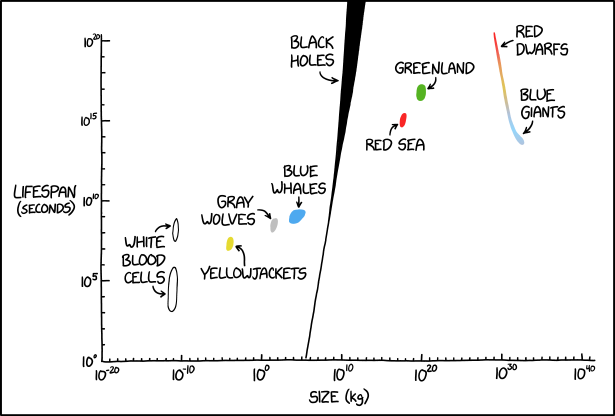
The linear pattern of the things plotted here weirds me out. Is there really such a clear life-time / size trend? Or were specific things chosen to be listed because they follow a roughly linear trend on the log-log plot?
Somebody already posted the famous phrase in another thread:
Everything is linear if plotted log-log with a fat magic marker
It's like the opposite of a smith chart.
You know, I was going to say that tetration or busy beaver numbers would counter that argument, but then again I guess they’d pretty much just look like vertical lines if the stroke weight of the marker was enough to cover the curved behavior around zero.
I can at least think of a few counterexamples:
- Cats live longer than dogs.
- Small stars live longer than large stars (by dramatic amounts).
- Black holes larger than the ~10^10 kg mark shown here live a lot longer than any other object with the same mass. A hypothetical moon mass black hole can most likely outlive every single star in the universe.
- Protons are smaller than anything in this chart yet are believed to decay over an extremely long time scale (>10^34 years).
- Even smaller particles like electrons likely live forever.
Those particles are exactly the kind of exception I was looking for. Tiny things that last a long time. The opposite kind of exceptions are probably impossible since making large things takes a lot of time. You would need to have something the size of a galaxy that lasts from Monday evening to Thursday morning.
The graph has a couple of those "counter examples".
he's only plotting things that fit on the trend, log log is very forgiving. but if protons were in there yhey would be far to the left and all the way up higher than stars
Oh, protons! I misinterpreted the typo as proteins.
Checkmate atheists
That's a versatile chart scale
Log scales will always be cool AF.
Everything is linear if plotted log-log with a fat magic marker
I dunno, man, I can chain a metric fuckton of !s.
Wait, I thought black holes were significantly more massive than that
Black holes can exist with any amount of mass, as far as we know. You can calculate the size of the event horizon for any given quantity of matter. IIRC, even the Planck Temperature is the limit to our current understanding that it is because a photon emitted by an object that hot would be energetic enough to form a little tiny black hole.
This graph shows a few things about black holes in a way that I love.
-
Black holes do have a lifetime and are not eternal. I think somebody already mentioned Hawking radiation.
-
Extremely small black holes actually have a pretty short lifespan. The math says they glow brightly and basically explode as they get close to fully evaporating.
-
Black holes with any appreciable mass last a REALLY fucking long time. A black hole with only the mass of the Red Sea or Greenland would last many orders of magnitude longer than the longest-lived red dwarfs, which themselves go for trillions of years. An online calculator tells me that the Schwarzschild radius for 10^20 kg (roughly greenland on the graph) is 1.4852e-7 m, so sub-micron in size. And though it will not last forever, it will still be virtually unchanged in trillions of years after every current star burns out.
I also hit up Wolfram Alpha's black hole lifetime calculator. For 10^20 kg it gives me 2.667 x 10^37 years. For one in the range of metric tons or less, you are looking at nanoseconds or faster. For a black hole to last longer than a second, you need to be up around a quarter of a million kilograms.
So when I said they are supposed to basically explode as they get tiny and evaporate? The most powerful hydrogen bombs convert a couple kg of matter to energy at most. A 250,000 kg black hole converting entirely to radiation in just a second must be some crazy shit.
The long lived ones are. Tiny black holes don’t last that long (on a cosmological scale) as shown in the graph.
their mass goes off the scale. you can imagine that line continuing not just straight up, but with a curve off to the right too.
Yeah this graph is weird. The axis is labeled size, but measured in kg which is neither mass nor size.
Kg is mass
:o
I stand corrected.
My understanding of it, probably not fully accurate but should explain the basic idea: A black hole is a mass so dense that it's own gravity will not let anything out, including light. If you make the mass small enough (like kilos or a few tons) you can theoretically achieve this by compressing it into a tiny volume (probably on the order of the size of an atom or something). That's gonna have that property, but it is also not going to be stable as it's own gravity can't actually hold itself so compact and compressed, hence the short life span (basically it explodes). Obviously the more mass, the longer it'll hold together, until it's enough mass for it to be stable, at which point it becomes unlimited in life time.
When you see articles that describe how they made a small black hole in a lab, that's what they mean: they compressed matter to an absurd degree, but probably only for nano seconds (if that).
Gravity must be able to hold it together for it to be a black hole. The limiting factor is Hawking radiation, which also applies to larger black holes, but the smaller they are, the faster they evaporate from that. To the point where it does explode if it's too small.
Black holes don't need to be dense. A black hole the size of the orbit of Jupiter would be less dense than water.
Black holes radiate energy like a black body with a temperature that increases fast the smaller they are. Small black holes radiate all their energy really quickly.
That's not what I was saying. What I was saying is that if they are light in mass (kilos, tons) they need to be dense. Didn't wanna write a book just for that one point, and it already got long-ish anyway.
Don't you mean the event horizon of the black hole? The actual matter of a black hole is in an infinitely small point, right?
The horizon is what defines the black hole. From the outside the mass distribution is not defined, as there isn't any experiment you can do that tells you about the internal structure. If you let a mass fall into a black hole you won't see it cross the horizon, just get asymptotically closer to it.
Very very small but not infinitely so. That would violate the Heisenberg uncertainty principle of quantum mechanics.
Red lives longer than blue and dwarves live longer than giants. That's why the Warhammer Dwarven Slayer is the best class.
So that's why there are no blue whales in the Red Sea. They don't want to swim over that line!
it's because they are BLUE whales, not red whales
Mass is life
Eat as much as I want? Got it.
I was expecting a lucky charms themed title text
I confused about greenland on this chart
Lifespan is in seconds, not years. Greenland is old.
For all complex life and most of simple life, Greenland was there. It was in different places and depths, but those rocks were there for most of the time. There's only a few other places on the planet that rival Greenland's age (or more specifically, certain rock formations in Greenland, though they make up a significant portion of it).
Though one thing about "lifespan" is that it's intended to be "age at death", not "current age", so I'd call that an inaccuracy, as Greenland will probably continue to exist for billions more years (though when the glacial lakes eventually form and break free, there will be a lot of sudden erosion).
Makes me curious what the future lifespan will be for the various continents. I wish our own lifespans were more geologically significant. Though at least I got to see the time since dinosaurs tick from 65 million years ago to 66 million years ago.
Play tectonics is pretty well studied, plus you got the whole part where the sun becomes a red giant and annihilates the planet. I bet Randall worked it out pretty well.
Back of the envelope it’s about 10^17 seconds, which works out a few billion years. He drew it with some wiggle area, so anywhere from hundreds of millions to several billions which covers the range of plate tectonics and the Earth being consumed by the sun.
So it seems pretty accurate
Oh right, it's logarithmic, so that wiggle area is much bigger than it would be on a similar linear graph. I also forgot about the sun swallowing the earth, which would prevent Greenland from getting into another order of magnitude, though there is always the possibility that earth will get flung either to a higher orbit or out of the solar system entirely before the sun swallows it and Greenland will last for trillions of years.
Ngl, for a minute I thought it was suggesting Greenland was about to end and it was some hot-topic political statement
xkcd
A community for a webcomic of romance, sarcasm, math, and language.