361
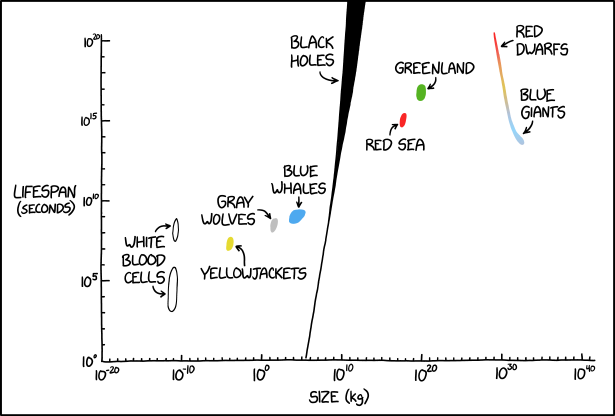
xkcd #3283: Size and Lifespan
(imgs.xkcd.com)
Title text:
With their 13 years recording and performing together and two humans worth of mass, the White Stripes are sandwiched neatly between gray wolves and blue whales.
Transcript:
Transcript will show once it’s been added to explainxkcd.com
Source: https://xkcd.com/3283/
Wait, I thought black holes were significantly more massive than that
Black holes can exist with any amount of mass, as far as we know. You can calculate the size of the event horizon for any given quantity of matter. IIRC, even the Planck Temperature is the limit to our current understanding that it is because a photon emitted by an object that hot would be energetic enough to form a little tiny black hole.
This graph shows a few things about black holes in a way that I love.
Black holes do have a lifetime and are not eternal. I think somebody already mentioned Hawking radiation.
Extremely small black holes actually have a pretty short lifespan. The math says they glow brightly and basically explode as they get close to fully evaporating.
Black holes with any appreciable mass last a REALLY fucking long time. A black hole with only the mass of the Red Sea or Greenland would last many orders of magnitude longer than the longest-lived red dwarfs, which themselves go for trillions of years. An online calculator tells me that the Schwarzschild radius for 10^20 kg (roughly greenland on the graph) is 1.4852e-7 m, so sub-micron in size. And though it will not last forever, it will still be virtually unchanged in trillions of years after every current star burns out.
I also hit up Wolfram Alpha's black hole lifetime calculator. For 10^20 kg it gives me 2.667 x 10^37 years. For one in the range of metric tons or less, you are looking at nanoseconds or faster. For a black hole to last longer than a second, you need to be up around a quarter of a million kilograms.
So when I said they are supposed to basically explode as they get tiny and evaporate? The most powerful hydrogen bombs convert a couple kg of matter to energy at most. A 250,000 kg black hole converting entirely to radiation in just a second must be some crazy shit.
their mass goes off the scale. you can imagine that line continuing not just straight up, but with a curve off to the right too.
The long lived ones are. Tiny black holes don’t last that long (on a cosmological scale) as shown in the graph.
Yeah this graph is weird. The axis is labeled size, but measured in kg which is neither mass nor size.
Kg is mass
:o
I stand corrected.
My understanding of it, probably not fully accurate but should explain the basic idea: A black hole is a mass so dense that it's own gravity will not let anything out, including light. If you make the mass small enough (like kilos or a few tons) you can theoretically achieve this by compressing it into a tiny volume (probably on the order of the size of an atom or something). That's gonna have that property, but it is also not going to be stable as it's own gravity can't actually hold itself so compact and compressed, hence the short life span (basically it explodes). Obviously the more mass, the longer it'll hold together, until it's enough mass for it to be stable, at which point it becomes unlimited in life time.
When you see articles that describe how they made a small black hole in a lab, that's what they mean: they compressed matter to an absurd degree, but probably only for nano seconds (if that).
Gravity must be able to hold it together for it to be a black hole. The limiting factor is Hawking radiation, which also applies to larger black holes, but the smaller they are, the faster they evaporate from that. To the point where it does explode if it's too small.
Black holes don't need to be dense. A black hole the size of the orbit of Jupiter would be less dense than water.
Black holes radiate energy like a black body with a temperature that increases fast the smaller they are. Small black holes radiate all their energy really quickly.
That's not what I was saying. What I was saying is that if they are light in mass (kilos, tons) they need to be dense. Didn't wanna write a book just for that one point, and it already got long-ish anyway.
Don't you mean the event horizon of the black hole? The actual matter of a black hole is in an infinitely small point, right?
The horizon is what defines the black hole. From the outside the mass distribution is not defined, as there isn't any experiment you can do that tells you about the internal structure. If you let a mass fall into a black hole you won't see it cross the horizon, just get asymptotically closer to it.
Very very small but not infinitely so. That would violate the Heisenberg uncertainty principle of quantum mechanics.