Campaign groups have voiced shock and outrage at the “biggest rollback of disability rights in a generation” following a Supreme Court ruling concerning individuals who lack the capacity to consent to their living arrangements.
In a joint statement, the charities Mencap, Mind, and the National Autistic Society warned that the regressive ruling could see hundreds of thousands of severely disabled people lose fundamental human rights protections. They added that:
By removing independent checks, advocacy, and automatic access to legal aid, the Court has closed the gateway to justice and support for many who need it most. Stripping away these safeguards makes it easier for abuse and neglect to go unnoticed behind closed doors.
A litany of previous wrongdoings demonstrates how closed cultures, lack of independent oversight and restrictive care can lead to abuse scandals and decisions like this fly in the face of everything we’ve learnt.
Supreme Court — Dismantling Cheshire West
The court’s verdict, delivered on 2 June, dismantles a landmark legal framework known as ‘Cheshire West’. The framework was established by another legal ruling back in 2014. The common understanding of Cheshire West held that:
an individual without such mental capacity is treated as unable to give valid consent to confinement.
As such, community care confinement would only be legal with a court protection order. Alternatively, the state could provide permission under the ‘Deprivation of Liberty Safeguards’ (DoLS) scheme. This necessitated a special “acid test” which, as the Mencap statement explained, meant that:
if someone lacks the mental capacity to consent to their care and living arrangements, is under continuous supervision and control, and is not free to leave, they were legally ‘deprived of their liberty’.
This triggered vital legal safeguards requiring an independent assessor to regularly inspect care homes, supported living arrangements, and locked units to ensure the placement is safe, justified, and in the person’s best interests.
Those vital legal guardrails were known as ‘Deprivation of Liberty Safeguards’ (DoLS). However, Tuesday’s decision “tears up those protections”.
Northern Ireland’s case
The attorney general for Northern Ireland, Tony McGleenan KC, brought the case which triggered the new UK-wide ruling.
Led byMinister of Health Mike Nesbitt, the NI government questioned the definition of “deprivation of liberty” under article 5(1) of the European Convention on Human Rights (ECHR) for adults lacking the capacity to consent to their living situation.
The attorney general submitted arguments claiming both that the original Cheshire West decision was incorrect, and that it created an undue administrative burden. That is to say, the NI government argued, successfully, that ensuring the liberty of the severely disabled cost too much.
The 2014 ruling meant that DoLS referrals rose from 13,700 to 322,455 in the decade leading up to 2024. In turn, this led to a 123,790-case backlog. As the Disability News Service (DNS) reported, this week’s ruling will likely see those referrals fall dramatically. Writing for *DNS,*John Pring added that:
Cheshire West led to the drawing-up of the Liberty Protection Safeguards (LPS) system, based on a report by the Law Commission.
The last government had originally planned to bring in LPS in October 2020, but its implementation was repeatedly delayed by Conservative ministers.
Care minister Stephen Kinnock announced last October that there would be a new consultation on the new LPS system “in the first half of next year”.
It is not yet clear where this week’s judgement leaves this consultation.
Supreme Court — Devaluing fundamental rights
The new ruling establishes that, for the purposes of the ECHR, a lack of legal capacity is not synonymous with a lack of valid consent. Instead, as the Mencap joint statement put it:
The Court implies that individuals with profound cognitive disabilities cannot be “deprived” of liberty because their condition limits their ability to experience it—a view that devalues their fundamental rights.
Meanwhile, in borderline cases, the Supreme Court would only consider a care facility to deprive an individual of their liberty if it closely resembled a prison.
Likewise, if the individual appears passive and unprotesting, the law will treat this as consent. This aspect of the ruling would apply even in situations where they are routinely restrained or sedated, whether physically or chemically.
In practice, this is likely to mean that the overwhelming majority of current independent DoLS inspections will be cancelled. As the three charities explained, the human impacts will be vast, across both the healthcare and social care settings. They gave practical examples, including:
If an autistic person with high support needs, someone with a serious mental illness, or a person with a severe learning disability is locked in a care setting and sedated, but does not actively protest, they will no longer be considered “confined” by the state. They will lose their automatic right to independent reviews, a legal advocate, and protection from closed care cultures.
For example, in psychiatric and crisis wards, if an individual experiencing a severe psychiatric crisis, acute psychosis, or clinical depression is admitted to a mental health hospital ward as an “informal patient,” they frequently lack the mental capacity to consent to their stay and therefore do not have any of the protections of independent reviews.
A plea to government
Mencap, Mind and the National Autistic Society also issued a plea directly the UK government. They called upon it to “act with urgency”:
to issue interim guidance to local authorities and health and care providers to prevent them being plunged into chaos by this ruling. It should urgently bring in new laws and guidance that strengthens protections for some of the people who are most at risk. This should include clearly explaining how disabled people and their families can challenge breaches of their rights and get the advocacy and support they need.
As always, as human rights continue to erode across the UK, it is the most vulnerable, those who can’t defend themselves, who become the first targets.
However, when a government — without any apparent show of remorse — can make an argument that ensuring liberty costs too much, we are all very much in danger.
However, the three charities ended their missive with a show of solidarity:
To the many people that will be affected by this ruling now and in the future, we stand with you and you are not alone. This decision devalues the rights and dignity of disabled people in this country.
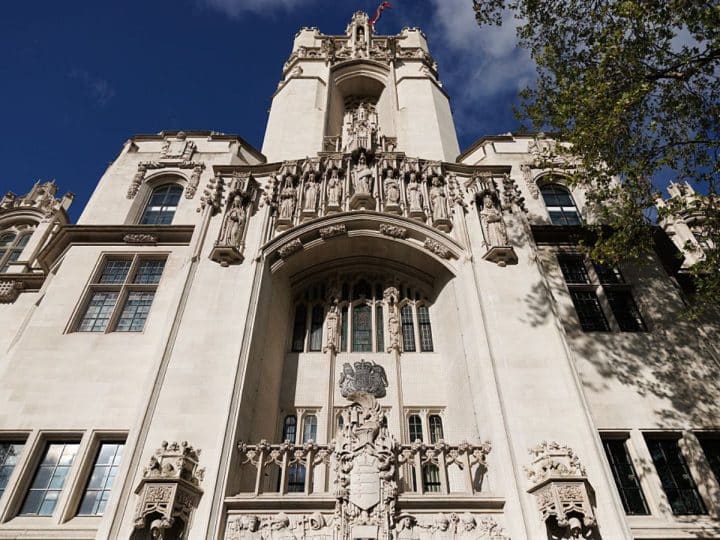
Featured image via Dan Kitwood/Getty Images
From Canary via This RSS Feed.