Had Florida’s high school marine biology students read the original draft of their textbook, they would have learned about research that found climate change is killing at least 150,000 people per year, and another 1 degree Celsius of warming would double that.
Instead, they learned that “human health will also be affected by the increase in CO2 and another 1 degree Celsius will further increase the impact.”
In another spot in McGraw Hill’s Marine Science book, “climate change” was altered to “changes in the environment.” An environmental science textbook by publisher Cengage removed the word “polluting” in front of “coal burning power plants.” And it cut a reference to students at the University of Washington in Seattle voting to pay higher fees to help the school buy electricity from renewable energy sources.
These count among the changes that Florida education officials asked science textbook publishers to make in the summer of 2024 that either watered down or eliminated content about the climate crisis, an investigation by WUSF and The Hechinger Report has found.
“These are not changes that were required to bring the textbooks in line with the state science standards,” said Glenn Branch, deputy director of the National Center for Science Education, a nonprofit that tracks how climate is taught in classrooms across the country. “Demanding that the treatment of climate change be weakened in these textbooks is very unusual.”
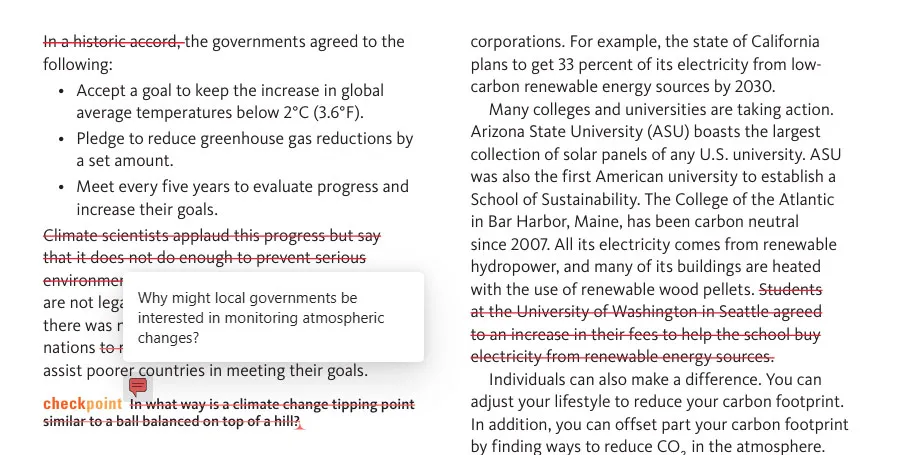
Screenshot of changes made in Cengage textbook
Courtesy Florida Department of Education
These revelations come as the state is quietly updating its science standards for the first time since 2008. Academic standards outline what knowledge and skills a student should master in each grade and subject; the existing science standards mandate that students be taught about human-caused climate change in several high school electives — including earth science, marine science and environmental science — and leaves room for the subject to arise in several other classes.
But it’s unclear whether Florida’s updated science standards will include education about climate change, which has already shaped the lives of many of the state’s 3 million students, in any class. State education officials did not respond to repeated questions on the topic.
“It’s vital that today’s students learn about climate change because they’re going to be tomorrow’s workers, consumers and voters,” Branch said.
Pushback to Florida’s climate education isn’t just happening behind the closed doors of textbook negotiations or possibly in little advertised standards meetings. It’s been happening out loud from as high up the political food chain as Gov. Ron DeSantis, who officially removed references to climate change from state statutes in May 2024.
Politics has crept into Florida classrooms under the DeSantis administration, and public school teachers are particularly vulnerable.
Read Next

Is it getting too hot for summer school?
A. Felix, The Hechinger Report
In recent years the Republican-led state made it easier for parents to sue teachers and ban books; lawmakers outlawed diversity, equity and inclusion initiatives while restricting safe spaces for LGBTQ+ students; they eliminated the study of how systemic racism is embedded in legal systems; and they tried but failed to make school board elections partisan.
Now it’s global warming’s turn.
Climate scientists agree that people burning fossil fuels for transportation and electricity have inundated the atmosphere with heat-trapping gases like carbon dioxide and methane, which has warmed global temperatures at an accelerating rate and thrown the planet’s systems into disarray.
For Florida that has meant stronger and wetter storms, increased flooding events and record-breaking heat.
“We’re in a state that is arguably the most affected by climate change, and will continue to be. And DeSantis is just pretending like it doesn’t exist,” said a middle school science teacher from Central Florida. “Now we can’t teach the kids about climate change.”
The teacher was one of several interviewed for this story who asked to remain anonymous out of fear of being punished or fired for speaking out on the topic. The educators described a “culture of caution,” where they aren’t barred from mentioning climate change in the classroom outright, but rather told by their superiors to refrain from discussing any topics deemed “controversial” for their own benefit.
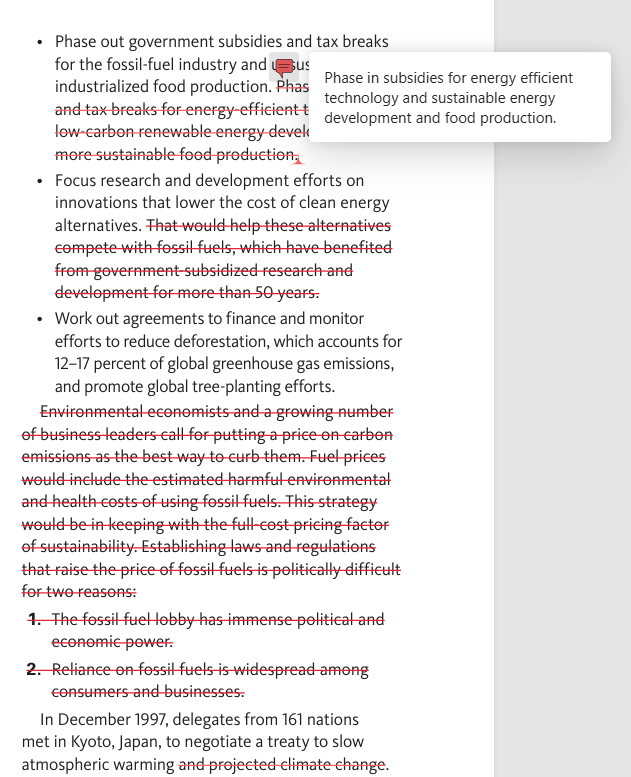
Screenshot of changes made in Cengage textbook
Courtesy Florida Department of Education
When asked about the changes the Florida Department of Education asked for in the textbooks, press secretary Olivia Wester said in an email that the department’s “review of instructional materials is guided by state law, State Board of Education rule, and Florida’s academic standards and benchmarks.”
A spokesperson for publisher Cengage said the company works with state education agencies to align its textbooks to educational standards “while maintaining the quality and integrity of our content.” They said Florida-specific editions “should not be assumed to reflect materials used in other states.”
Tyler Reed, senior director of communications for McGraw Hill, said it is “routine” for state departments of education to request changes based on local education requirements, “and our goal with every edit is to ensure that the accuracy, efficacy and integrity of the curriculum pedagogy remains intact.”
Regarding the specific changes in the Florida textbook, Reed said the intent “was to use more specific terminology to describe the causes and effects of climate change, while accurately reflecting the reality of its existence. Additionally, we inserted references to sources for the facts highlighted in our materials. Climate change and its impact on the environment continue to be fully covered throughout these titles.”
He added that the changes made “do not apply to national editions or those created for other state markets.”
Read Next
How wildfire smoke is reshaping childhood
Mosabber Hossain, Inside Climate News
Michael Huber, an author of McGraw Hill’s Marine Science, said the publisher had not informed him of the edits made to the Florida version of the textbook. But after learning about them from a reporter, he said he found the changes unsettling. “It just degrades the book,” he said.
Huber noted the statistic about the 150,000 annual deaths due to climate change came from a World Health Organization publication and that the edit distorted the message of the sentence. The new sentence — “human health will also be affected by the increase in CO2” — could imply that CO2 itself is harmful to health, when the harm comes from the changes CO2 makes to the climate.
“Why make something worse with no benefit? There’s no scientific or pedagogic or aesthetic improvement,” Huber said. “It’s like wow, really?”
Scientists now believe that figure is a conservative estimate.
Textbooks
Ken Miller, a professor emeritus of biology at Brown University, has been publishing one of the nation’s most popular biology textbooks for nearly 30 years. But two years ago, something shifted.
“The Florida Department of Education was pressuring publishers to reduce or eliminate coverage of climate change as a condition for getting on the approved list,” Miller told WUSF and The Hechinger Report.
As first reported by the Orlando Sentinel, Miller and co-author Joe Levine were asked to strike the words “caused by human activity” from their book, Florida Miller & Levine Experience Biology published by Savvas Learning Company.

Screenshot of changes made in McGraw Hill textbook
Courtesy Florida Department of Education
Florida education officials also asked the authors to provide sources for lines about the effects of human-caused climate change, like plant species flowering earlier than usual.
So, the authors began doing something they had never done before: support specific statements in the text with references to peer-reviewed scientific studies.
“I certainly don’t have any objection to anyone looking at the writings that Joe Levine and I put out and saying, ‘We want to know the source for that,’” Miller said. “But what’s interesting about this is demands to do that did not come in the chapter on DNA and RNA, they didn’t come in the chapter on the digestive system. They didn’t come on any other chapter, there was unique attention being paid to climate change.”
The FDOE reviews new textbooks about every five years, and districts are financially incentivized — though not required — to adopt the state-approved textbooks.
In 2023, it was science textbooks’ turn for an update cycle, and in the summer of 2024, Florida released a list of textbooks it had approved and others it rejected. Publishers had the opportunity to revise the content of their books and reapply for approval.
A data analysis by WUSF and Hechinger looked at the list of science textbooks that state officials adopted right away and found that the textbooks most likely to have climate content — environmental science, earth science and marine science — were adopted at less than half the rate of textbooks on other science subjects. The state eventually adopted most of the books, but only after publishers made changes to their content.

Screenshot of changes made in McGraw Hill textbook
Courtesy Florida Department of Education
To find out what changes were made, WUSF and Hechinger requested correspondence under the state public records law between the FDOE and the publishers of textbooks most likely to cover climate change. More than a year later, the department provided a response. Those records revealed the department had made extraordinary demands to change climate content. If the publishers pushed back on any of the changes, that was not captured in the correspondence.
For instance, in a July 2, 2024, email, a McGraw Hill vice president wrote an official in the FDOE’s instructional materials office supplying language changes “for the 4 special topics discussed today,” all in Huber’s book. Among them were the line about the impact to human health and the one that replaced the term “climate change” for “changes in the environment.” In two cases, the publishers added specific attributions, as had been required of Miller’s book.
In an exchange between the FDOE official and Cengage, the science textbook publisher offered to eliminate one line noting that fossil fuels “have benefited from government subsidized research and development for more than 50 years” and another on climate scientists concerns that recent progress “does not do enough to prevent serious environmental and economic problems.”
In one case, Cengage changed a reflection question for students from: “In what way is a climate change tipping point similar to a ball balanced on top of a hill?” to “Why might local governments be interested in monitoring atmospheric changes?”
Branch, of the National Center for Science Education, said the correspondence doesn’t explain the motive behind the changes but that a clue might be found in a line removed from Cengage’s Environmental Science book about the “immense political and economic power” of the fossil fuel industry.
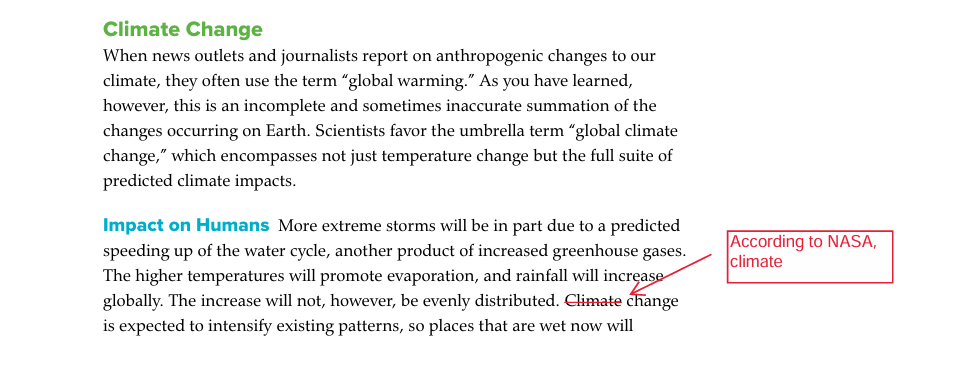
Screenshot of changes made in McGraw Hill textbook
Courtesy Florida Department of Education
“One hypothesis might be that the revisions were made to defend the fossil fuel industry,” Branch said. “It could be something more benign, by thinking, ‘Well, if we leave these passages in, it’s going to cause problems for teachers in their local communities.’”
Just as the state Department of Education was demanding edits in science textbooks, it inaugurated another process that could have a deep impact on what Florida students learn about climate change: It began recruiting volunteers for a science standards review committee.
Standards
In a meeting room overlooking Tallahassee’s Capitol complex, three teachers spent a day this spring organizing and reorganizing multicolored sticky notes with facts and grade levels. They were there to determine what millions of students would learn about science for years to come.
This intimate rendezvous of volunteers was part of Florida’s efforts the last couple years to update its science standards. While the state has updated its English, math, history and social studies standards routinely, it has left its science standards in place for nearly two decades, making them the oldest in the country.
To update standards, the department recruits a committee of educators and experts from around the state who meet over several months and produce a recommendation for course descriptions and grade-level expectations and benchmarks. After public feedback and revisions, the State Board of Education votes on the proposed final standards. Textbook companies shape their instructional materials to abide by them. For the latest standards, that process began in November 2024, a few months after the exchanges with textbook publishers.
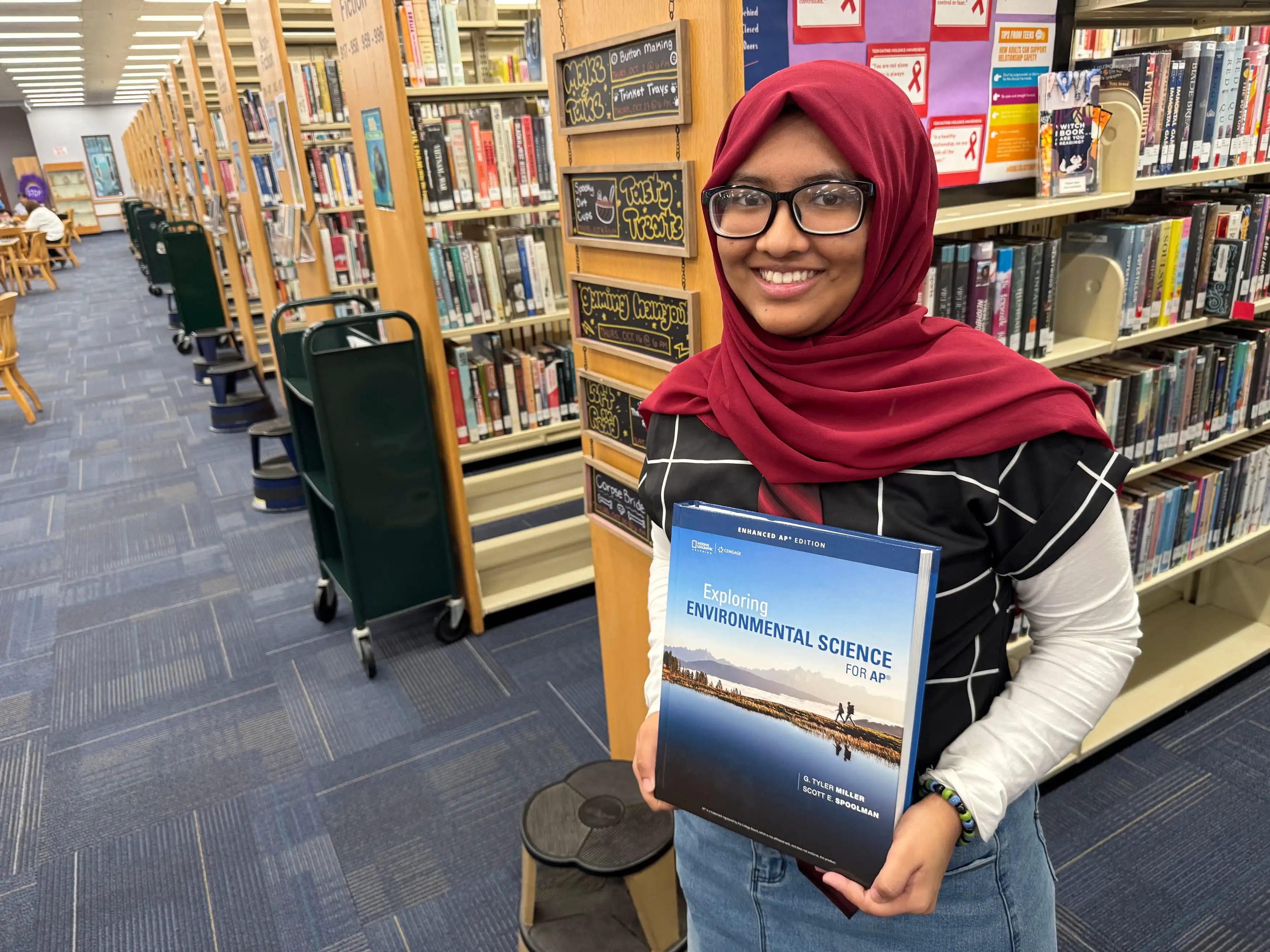
Alisha Imam, a senior at Tampa Bay Technical High School when she spoke last year, didn’t have a chance to study climate change in school until she took an Advanced Placement class in environmental science.
Jessica Meszaros/WUSF
In 2020, a study by the National Center for Science Education and the Texas Freedom Network Education Fund, a left-leaning policy group, graded every state based on the climate content of its state science standards. Florida’s 2008 standards received a D, ahead of just six states that received an F.
Climate educators fear the standards could get even worse with the update. State education officials did not respond to multiple requests for an update on the status of the standards, and the agency has not publicly posted draft standards for public feedback. But according to people with knowledge of the process, the committee submitted its recommended standards this summer, and they are being reviewed by the state.
Whether the recommended standards include education about the climate crisis — and if so, whether that content will survive the department’s editing process — remains a mystery. But teachers and students already feel the impact of the state’s attack on climate education.
The Sunshine State isn’t the only place where the climate content of science standards has become political.
At a science standards adoption in Texas in 2021, an oil and gas industry group recruited volunteers to participate in the process. They successfully pushed for the removal of climate content from the proposed standards, and those changes were reflected in the textbooks the state adopted soon after.
Read Next
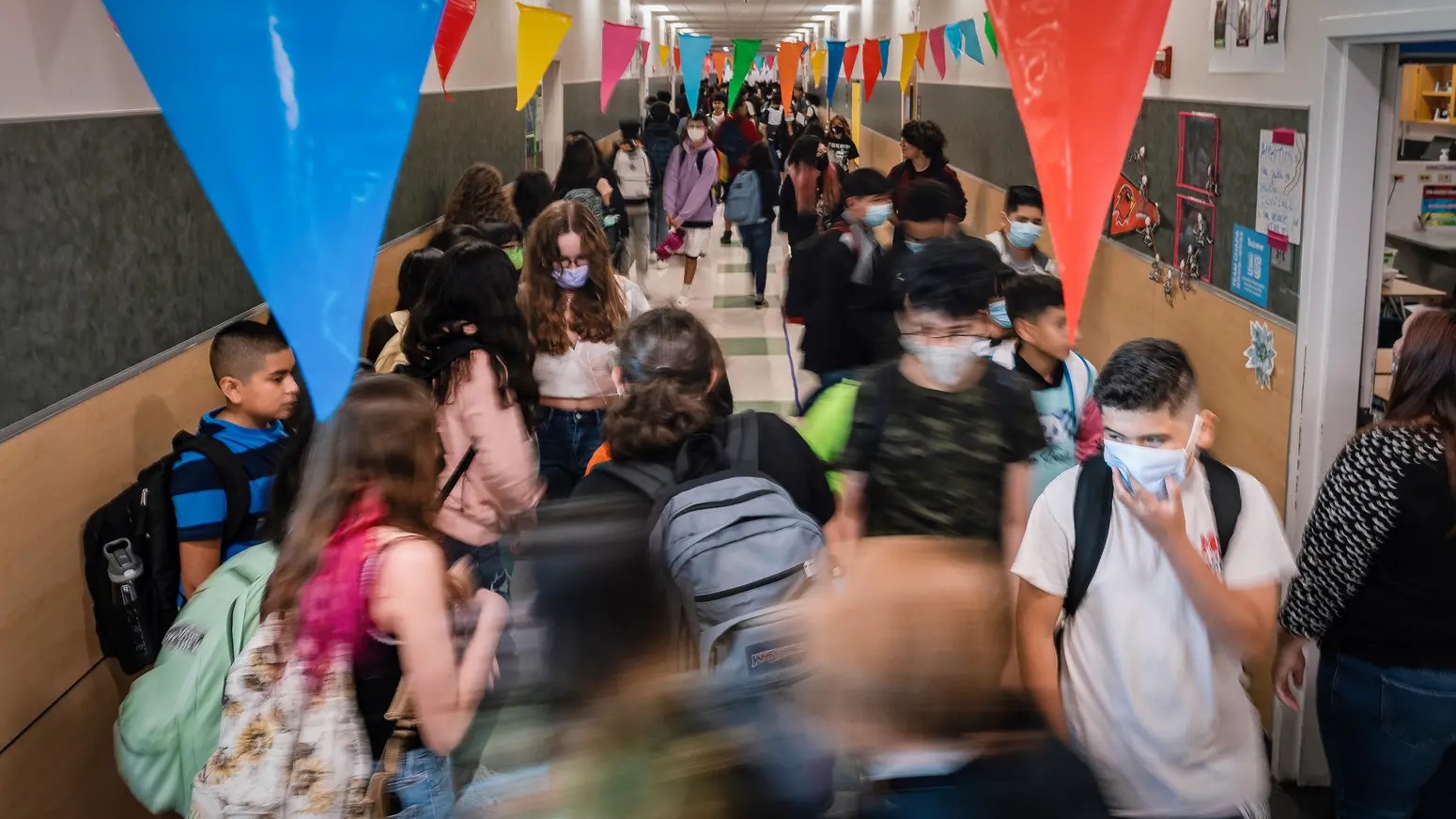
Texas board rejects many science textbooks over climate change messaging
Erin Douglas & Kevin Vu, The Texas Tribune
In other states, like California, New Jersey and Hawaii, education leaders have pushed for more climate content in classrooms, not less. Because textbook companies tend to cater their textbooks’ contents for large states and sell those books to schools across the country, the result is a two-tiered system, where what students learn about the climate crisis depends on what side of a state line they live on.
Branch noted that a similar phenomenon occurred over decades when it came to science textbooks’ treatment of evolution.
“Really we’re not seeing any issues regarding climate change education that we haven’t seen previously with evolution education,” he said. “There are hot-button issues in other areas of public education, such as sex education and various issues in history and social studies. But when we’re talking about science education, it’s evolution and climate change.”
Under the Trump administration, the censorship of climate change education has reached the federal level. For example, last year, the administration shut down a climate-science website that many teachers relied on for instructional materials, and removed a guide to climate literacy produced by the National Oceanic and Atmospheric Administration and other agencies.
Culture of fear
The middle school educator in Central Florida, who has taught for over 20 years, hesitated to talk openly to reporters because he said he’s afraid of being retaliated against by parents, his school board and his state.
But that hasn’t stopped him from teaching his students about climate change.
“What they’ve done is they’ve changed the language to make it seem a little less threatening, right? So, I still teach that with fidelity, and I make sure that my kids know that human beings are screwing up this planet,” he said, referring to the textbook revisions.
Two other public school teachers in the Tampa Bay region who spoke for this story asked to keep their identities hidden.
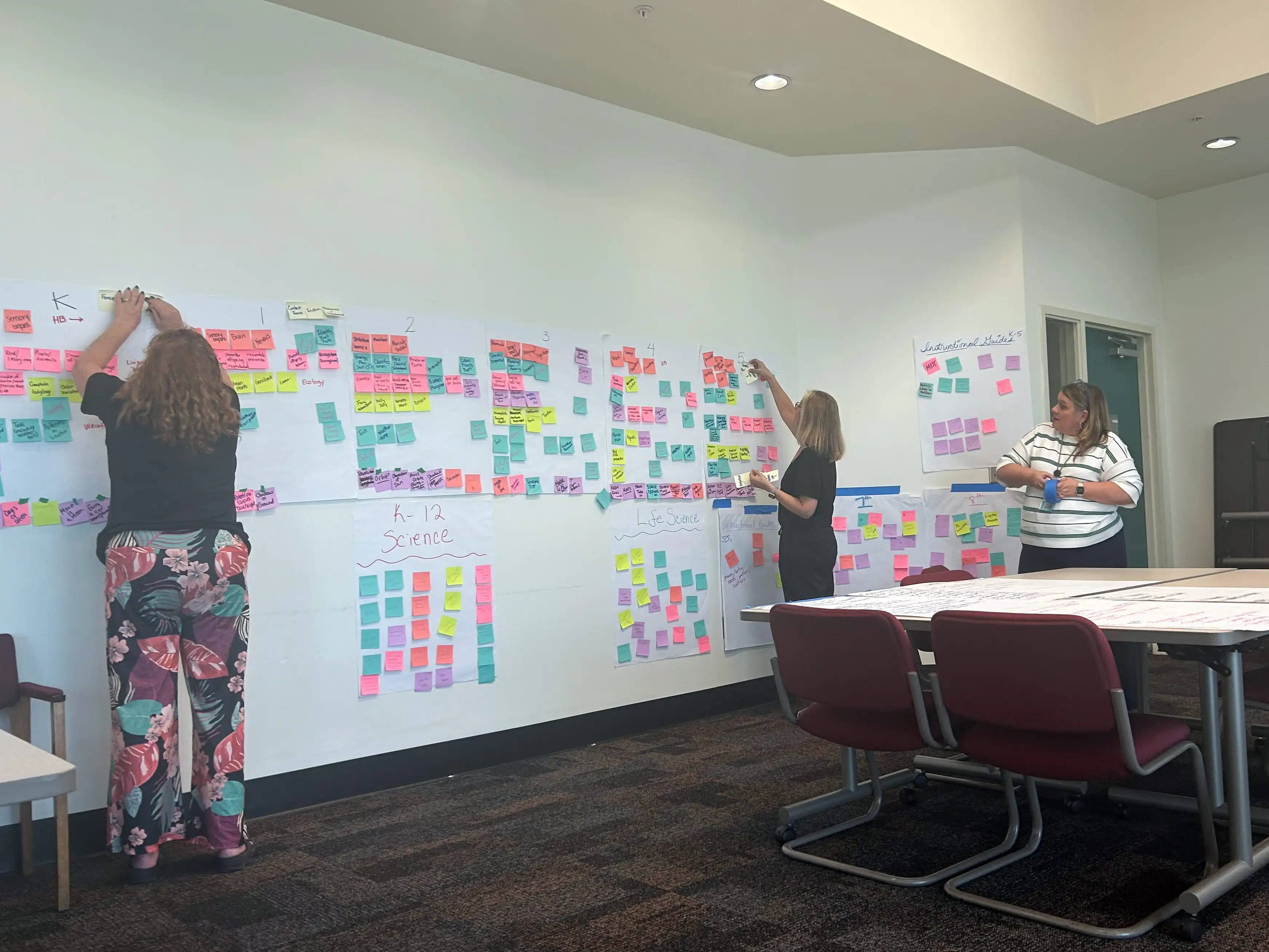
Teachers in Tallahassee participated this spring in Florida’s effort to update its science standards, which have been in place for nearly two decades. The state did not respond to questions on when the updated standards will be released.
Courtesy Douglas Soule/WUSF
One described a “culture of caution,” in which the high school principal removed her entire personal classroom library, which included books that empower students to advocate for the environment. And “for her own protection” she was asked not to speak of “controversial topics.”
But the Tampa-area English teacher said what qualifies as controversial is constantly evolving, sometimes because of just one indignant parent.
“There is this culture of self-censorship that I’ve seen developing over the past few years I’ve been teaching where we’re trying to predict what is going to be a problem. We’re trying to not talk about controversial things. But what are they? We don’t have a list,” the teacher said.
“I think it’s going to get less and less flexible with what you can teach and how you can teach it. I think we’re moving towards having scripted curriculums, for better or for worse.”
How did we get here?
Read Next
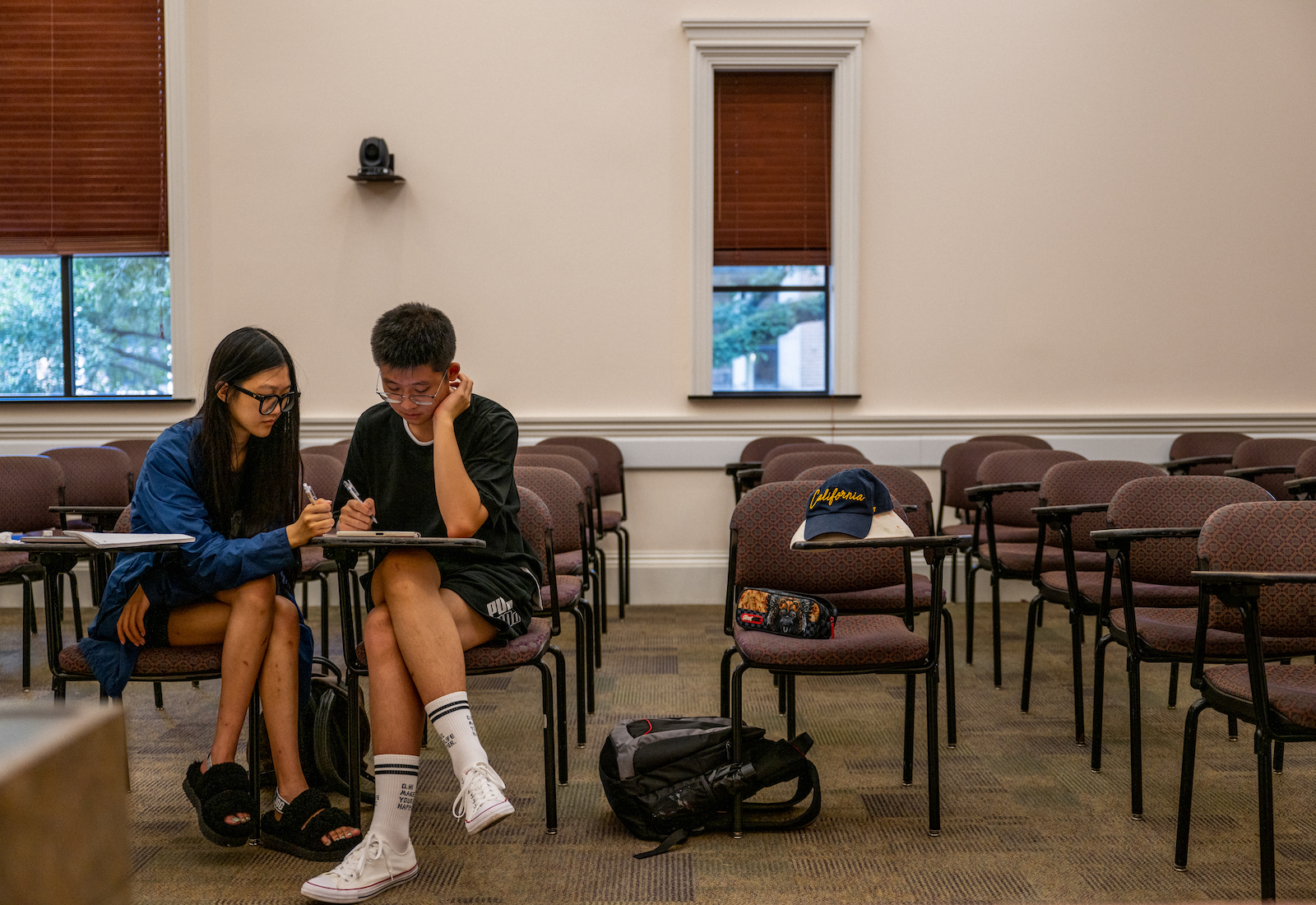
Study: Biology textbooks aren’t keeping up with climate science
Joseph Winters
Aubrey Jewett, a political science professor at the University of Central Florida, said that in some ways, global warming has always been politically controversial.
The author of “Politics in Florida” said while human-induced climate change became scientifically accepted in the 1970s and ‘80s, there continues to be a lot of political debate over whether it’s happening and people’s contribution to it.
Jewett said there are two big reasons why Republicans generally reject the idea of global warming.
“The Republicans have usually been more focused on the economy and economic growth. And Republicans have also traditionally, and maybe still today, it seems, but at least traditionally, were the party of big business, right?” he said.
So, essentially, the support has gone to the established oil and gas companies for economic and “big business” reasons and trickled down all the way to Florida’s classrooms.
Alisha Imam was a 17-year-old senior at Tampa Bay Technical High School when interviewed for this story last year. She loves the environment, and led her school’s Green Team to reduce waste and plastic use while working toward renewable resources.
“It’s pretty important to me because we’re a part of the environment, all of us,” Imam said.
She wants to study civil engineering in college, so she took an Advanced Placement class on environmental science in her senior year of high school.
The college-level course was the first time she really got to study climate change in school. Previously, she just relied on her own internet research of the subject.
Imam said, even though she’s young, she’s already witnessed the changes happen in real time. Her home was not damaged during the back-to-back hurricanes that hit Florida in 2024, but many people close to her experienced flooding and other destruction to their homes, businesses and schools.
“And when that happens, it’s really hard for them to recover,” she said. “It kind of makes me scared for what’s going to happen in the future.”
Which is why upon learning of the state watering down climate education, Imam said she doesn’t “feel good about it at all.”
“We have to learn about it and actually be educated and know what the problem is because if we don’t know the problem, then we won’t be able to fix it,” she said.
Jessica Meszaros is a reporter and host covering climate change and the environment for WUSF, the NPR affiliate in Tampa. Katie Worth is an investigative reporter and author of the book “Miseducation: How Climate Change is Taught in America.”
Additional reporting contributed by Douglas Soule.
Sign up for theHechinger newsletterand the WUSF newsletter.
This story was originally published by Grist with the headline How Florida quietly removed climate change content from textbooks on Aug 20, 2026.
From Grist via This RSS Feed.





Extra context added because this headline is wildly misleading.