2
3D Printed Guns | RollingStones
(tankie.tube)

on 18/07/26
I strongly believe there are entire companies right now under heavy AI psychosis and it's impossible to have rational conversations with them about it. I can't name any specific people because they include personal friends I deeply respect, but I worry about how this plays out.
Mitchell Hashimoto, of HashiCorp and Ghostty fame
Over the past year, I've run point on all of our company's sales, led the technical components of all but two of our engagements, and over the lifetime of this blog have had something like 300 catchups with professionals from around the world. This has ranged from people on the ground in niche service industries to executives at Fortune 500 companies.^1^ Because of this, I've had a front-row view to our collective institutions across both the private and public sector undergoing breath-taking mass psychosis. This essay is an attempt to describe the bizarre dynamics that are currently at play, as I am in the rare position where my wellbeing is not contingent on paying lip service to madness, and to reassure the people trying to survive amidst all of this that they are not crazy.
The reality is thus: the people in charge either have no plan, or see no path forwards other than keeping their heads down. Not at banks, not at hospitals, not in our government institutions. The world's organisations have been captured by people in the throes of frothing excitement, and saner people who now live in a state of constant commingled fear and frustration.
Reading this while working for a division that pivoted to provide interfaces for agentic workflows, only to discover that only ten users had ever touched the products we made for agents, only to pivot again to support for agentic workflows, which has a lot of competition because every company has to do something agentic now and there's only like four things you can do in that space, is bracing.
An editor of this essay
Are companies actually seeing massive productivity gains from their AI adoption? Does any of this sordid affair make sense?
This should be an easy question, but it is surprisingly hard to get a straight answer to it. Executives that tell the press that their company has gone insane will quickly find themselves removed from their positions. Employees who are honest will find themselves fired in short-order, or "randomly" selected for a round of layoffs. In fact, it is in the interests of almost every actor in the space -- boards, executives, employees, vendors, consultants -- to obfuscate and misrepresent the success rate of AI projects. Many publicly traded companies are putting out announcements about their AI productivity gains when I know for a fact that the businesses have done nothing other than purchase Copilot licenses and declare victory.
Yet we need to know if these projects are panning out -- if the total focus on AI as a core tenet of business strategy is succeeding at a reasonable rate, then a discussion about the relative risk and reward is warranted.
Unfortunately, we live in a dark timeline. All of the AI projects we have observed as a team are failing. Every single one -- we have seen 0% success in a year and a half, not only amongst projects we have been asked to participate in^2^, but even within projects that we have observed in passing while doing totally unrelated work. Even if you grant that AI tooling accelerates specific workloads, the method and scale of the current investments is senseless. Frequently the failure is not related to AI itself, but rather that companies are terminally bad at running software projects effectively, and as I have remarked previously, AI projects are subject to all the failure modes of normal projects plus you can get everything right and then still fail because of the method's novelty. Very few companies are so good at shipping software that they can afford the extra risk profile.
Often enough, though, it's an actual failure in what LLMs can accomplish. The most common version of this, being rolled out across businesses around the world, is the internally-facing chatbot, or for the more daring company, the customer-facing chatbot. The story is always the same. For the former, I've never seen substantial internal uptake from inside a business. Employees don't use internal chatbots because companies tend to have low-quality documentation and an LLM is not psychic -- it can only know things that have been written down and made accessible. For the latter customer-facing applications, I have rarely had a pleasant experience as a consumer, with perhaps the exception of live transcription during medical appointments -- hardly something worth pivoting an entire organisation around. In both cases, project leaders are very careful to avoid tracking basic metrics, such as whether the tools are being used at all, or they track metrics that are easily gamed.
For example, my last consumer interaction was attempting to get help from Mitsubishi following an automotive failure, where a very polite robot asked me to describe the problem and that I'd receive a call back as soon as someone was available. This was the single most competent implementation of such a project I've seen in the wild, in that the voice was natural sounding, responded quickly, was clearly "live" in production, and promised a swift resolution.
That was six months ago, and I did not, in fact, get a call back.
When Mitsubishi did not call me back, what happened? Did that request just go into the void, showing one less incident for the year? Does it appear that the phone bot resolved my query without the need for human intervention? All we know is that it didn't show up as an error, or I'd have received a call. I'm sure it looks great in all sorts of ways except the one that matters, which is that I was planning to buy a car and decided not to buy another one of theirs.
For this reason, our team has quickly learned while on an engagement not to ask anything about ongoing AI projects in any context -- by the time that project has started, it is too late for the management team, and intervention is not possible until a crisis point is inevitably reached. There is no conceivable positive outcome. The failure rate is so high that even basic inquiry leaves us in an untenable position. Any coherent question about how it's going, what the goal is, who is using it, constitutes an inadvertent attack on the chain of command responsible for the work because there are no good answers to anything. Even in rare cases where my interlocutor has stated that things are going well (usually while the project is still mid-flight and failure has not had a chance to manifest), it is generally obvious that they are doomed, but at least in these cases I can simply agree and then go home to scream into a pillow for six hours straight.^3^
All of this is to say that I am very confident that almost every report at a company about "massive AI productivity gains" is untrue as a matter of brute fact. Even if some companies are seeing clear gains, this is the exception, not the norm. With that assumption in place, we can talk about the dynamics at play, and how it has become impossible for many organisations to stay focused on things that actually matter to their long-term (or even short-term) health.
It has become outright dangerous to even raise the possibility that AI might not be the solution to a problem, let alone be the sole focus of a company's entire strategy.
In every sufficiently large business we have observed (say, with 500+ employees), we have noted that continued advancement, and increasingly continued employment, has started to require repeated professions of belief in the transformative power of AI for said business. I am not talking about providing ideas about how to use AI in the business -- I mean religious profession, declarations of faith. Overwhelmingly these statements are made by non-technicians, though it is not uncommon for technicians to emit deranged statements to curry favour.
There have been several occasions where I have seen someone, apropos of nothing, blurt out almost word-for-word "AI is changing everything", only to concede moments later that their organisation does not currently use LLMs for anything, and indeed, that they cannot name a single thing that has changed other than they get some use out of ChatGPT (frequently the free-tier). In one extreme case, I have seen an executive confess that they had never even used ChatGPT or any AI tool in their life, immediately after producing a technical strategy for an organisation with $2B+ in revenue which was entirely centered around AI.
Initially these statements were so absurd on their face that I thought it was some cynical ploy to achieve thought leader status, and there are certainly some people doing this -- I have had it admitted to me. But the broader reality is so much worse: people who have no background in the technology at all actually believe what they are saying. As a general rule you should avoid getting into business with a liar, but if you must, you can at least reason with them even if only in private. A true believer is much more threatening because they are impervious to even inducement by self-interest.
The turning point in my belief was watching someone with a spectacular amount of money on the line fire their highest performers because they were achieving that performance without LLMs. When an employer publicly talks about AI innovation, we have to ask ourselves if they're simply trying to manipulate the market or customers. When they privately commit to strategies like this with their own money at stake, with no attempt to communicate that strategy to external clients, I can only assume they really mean what they're saying.
A while ago, I wrote "Contra Ptacek's Terrible Article On AI", which was focused on the fact that many of Ptacek's points in his own essay "My AI Skeptic Friends Are All Nuts" were internally inconsistent.^4^ But on the crux of the matter, we are actually in total agreement, because he opens his essay with this:
Tech execs are mandating LLM adoption. That's bad strategy.
Which is to say that we can sidestep arguments about the precise utility of LLMs entirely and we're left in a very simple place -- it is entirely obvious to both myself and Ptacek, two people that are coming at this from fairly opposed views, that people are being really, really stupid about this, and that organisations are demanding bizarre workflow constraints from their specialist staff.^5^
These mandates have led to extremely strange places. Several of my peers now "AI-wash" their work, meaning that even when they can perfectly competently execute on their jobs to the satisfaction of their management teams, said managers are unhappy if the engineers haven't used AI in the work... so now they're lying about using LLMs even in contexts where their professional judgement is that they aren't the appropriate tool. They just do the work, the same way they have for decades, and say Claude did it. Others are being measured on their AI bills with "token leaderboards", where higher is better because I have evidently fallen into the pocket of Hell where the demons torment me by doing elaborate impressions of absolute fucking morons, so the people hired for their freakish ability to perform system optimisation do the obvious thing. They set the LLMs prompting themselves in a semi-plausible loop in case someone inspects the token consumption and then they watch Netflix. Not a single one has been caught, even when their own assessment of the output is that it isn't suitable for deployment.
Checking out a parallel copy of our Go repository and telling the AI to rewrite the whole thing in Zig while I work on something else just so I can keep my job. I hate this shit so much. My job has usage tracking and quotas. I don't use it for actual work, I just spin it up and disregard the output.
An actual software engineer
In fact, the only people I know of to be fired over this whole thing are people that have expressed visible doubt about this organisational strategy, which again, even Ptacek thinks is transparently dumb. The net result is that everyone has learned very quickly to praise executives on their visionary AI prowess, or they will be gunned down in the proverbial streets.
Bless me, Father, for I have sinned. It has been ∞ days since my last confession. I accuse myself of the following sins:
One of the main pieces of infrastructure we deploy at our clients is an analytics-focused database called Snowflake -- for a typical business, the bill is tiny because it's a pay-as-you-go situation and we can process all their data in one minute a day, you get a very hands-off deployment, and in short it has many characteristics that are very pleasant for our work. One of the features in Snowflake that we don't use is called Cortex.
Cortex is their AI chatbot layer, with the ability to plug into metadata (for non-nerds, descriptions of your data, like what a column in a spreadsheet means) and query a company's database autonomously. In theory, you can ask a question like "What was our revenue for last week?" and it will spit out an answer.
It is not really suitable for production usage. From memory, the last time I was given a presentation on it, by actual Snowflake staff, they reported that ideal configuration results in something like ~92% accuracy due to the complexity of data at a large business (see: probably best-in-class for these tools, but imagine your CFO having one in every ten of their numbers be outright wrong) and there were serious issues with managing deployments. Nonetheless, it can be used to produce some very flashy demonstrations.
On several occasions, we've been exposed to folks that have been sort of lukewarm on our main offerings, but they really, really wanted to use AI to perform a natural language query on their data. And we thought "Okay, if you really want to see it, maybe we can caveat this appropriately and show you what it might look like."
This was a terrible mistake. It backfired in the most predictable way imaginable -- every lukewarm client that saw the chatbot in action, even with us telling them that it was not going to accomplish what they wanted, wanted to buy it immediately. Every other consideration, including millions of dollars that we could plausibly help them achieve by non-AI means, was swept aside. It was like a dark and terrible force seized control of their limbs, plunged their hands into their own chests, and presented their still-beating credit cards to us in grim supplication. We were so mortified by the inexplicable shift in energy that we (wisely) declined to take the money and ended the sales process, and soon thereafter removed Cortex from our list of demonstrations. It would have been too irresponsible to exploit this gap in their reasoning, and frankly, it was already irresponsible to have even run the demonstration -- doctors don't walk around showing off cool pills that they'd never prescribe.
Watching the total 180°, that shift from ice-cold to red-hot buying frenzy, was a deeply unsettling experience. It was personally uncomfortable to see people that clearly didn't gel with us interpersonally suddenly dying to enter an ongoing relationship, but more broadly uncomfortable because for a brief moment I began to understand what is happening in sales meetings around the world. There was no warning I could have given that would have made them refuse to buy the damn thing -- their appetite was as large as their budget could stretch, and some part of me wonders if this is because they knew that their ravenous hunger would be present in their own customers. They'd just buy it from us, then pivot right to a larger company and mind control their leadership team until the buck finally stops with the loser that needs to justify the expense. The main protection against this seems to be that the median vendor is so bad at their jobs that we had presented the first even somewhat-working products these people had seen, and this included an ASX-listed company that was already bragging about their AI usage. It took our team two hours to produce something that was frankly not that good -- basically just typing text descriptions of data into a web browser -- and it was still better than anything the leads had seen because they had nothing to show for all the investment.
In fact, we have been forced to opt out of every sale where the lead has expressed anything beyond the most fleeting curiosity in the use of AI in their business. I don't mean that we've heard that they're interested in AI and elected to drop the contract on moral grounds. I mean that, over the course of the engagement, these people have exhibited a pattern of behavior that has made it near-impossible to sell to them without incurring reputational and legal risk, and are furthermore crafting management environments that I can only describe as cultish, ineffective, and "please dear God, do not let it be on earth as it is on LinkedIn".
The good news is, CISOs are used to having to protect the business from their hare-brained initiatives, and this one isn't really that different, except that there's a cult-like atmosphere to it that you didn't see with, say, the cloud. It almost doesn't matter whether you embrace the initiative or not; there's work to be done to manage the risk, so that's what you do. From talking to CISOs everywhere, I would say most of them are quietly skeptical but afraid to speak up.
Career CISO and well-known speaker that asked to remain anonymous
Despite the substantial prevalence of true believers, many of the people running large AI initiatives, or making public statements about them, do not believe what they are saying. There are "heads of AI" who read this blog, at companies with $1B+ in annually recurring revenue, who have written in to say they believe their job is totally fraudulent but it was the only promotion pathway remaining at the organisation.
On a trip overseas, I had the privilege of a meeting with one of the Fortune 500 executives mentioned at the beginning of the post, who will remain anonymous so that they are not executed by firing squad by their board. As we were chatting, it became clear that they were very switched-on and technically competent, and they also happened to be at a company that had committed to the usual battery of exorbitant claims about their recent innovations -- we've 100x'd our productivity, AI is the future of everything, I am but a vessel for OpenAI to make love to my wife. You know, normal things. But since I had them there without any microphones around, I asked why this was being repeated without opposition. Was it just sales fluff?
The answer was a lot more interesting. It was partially ridiculous sales material being delivered to an easily excitable audience, but this was not the dominant factor constraining honesty. Executives at their customers were saying absurd things about achieving 100x productivity, and this meant that if any executive at the vendor said that these gains were not plausible, it would undermine the credibility of the customer's executive, be perceived as an attack (or heresy), and possibly result in an enterprise contract cancellation. And getting enterprise contracts cancelled because you wanted to opine on something that doesn't really matter to your organisation's mission is a great way to get fired.
But this company was also a major player, of the kind that signs enormous enterprise contracts with other companies. So presumably there is another vendor that has sold to them, and their CEO is worried that saying something sane will contradict this executive, and very quickly we can see how we can have executives around the world nervously pointing guns at each other, not wanting to be shot first but also watching everything gradually spiral out of control.^6^ This is to say that we're facing a coordination problem around executives being honest around the AI gains they've witnessed -- if they co-operate, they keep their jobs. If they defect, they will possibly be fired by their embarrassed peers (who have now been implicitly called liars, cowards, or incompetents) and then replaced with someone that will toe the line anyway. If they could all admit the truth at once there might be some hope, but there is no way to coordinate that event.
This sounds deeply concerning, but it is worth noting that it means that some executives who are emitting nonsensical statements are not as dull as they might seem at first -- they're in a fraught political environment, where they are surrounded by many people that are gunning for their roles, and subject to the whims of a board that is undergoing similar pressure. Against all the dictates of reason, I have presented on navigating AI hype to people on S&P 500 boards^7^ and they are in exactly the same situation -- the main comments I remember from the session were board members admitting they were skeptical, but expressing anxiety that their positions were contingent on demanding AI investment. One of them commented "investing this early seems like risk without much upside". About two years later, I can see now that their decade-old multi-billion dollar organisation is now branded as "AI-native", whatever the hell that means.
All of the above converges on the state that we find ourselves in now, where effective decisionmaking has ground to a halt. Collectively, what started as a few people undergoing either destabilising psychological events or being caught up in hype has now resulted in an environment where leaders cannot speak honestly about their beliefs on how best to guide organisations, for fear of being removed, creating a sort of distributed government by assassination. This means that the least sensible recommendations are going totally unchallenged, resulting in employees being evaluated on totally gameable metrics such as "money spent on AI", and those employees must play along to avoid being terminated. This has also created an insatiable appetite for purchasing "AI" solutions, which target both true believers that will believe implausible claims, and also non-believers that cannot decline the purchases without having their commitment to the cause coming into question.
This means that all offers that are subject to internal politics at an ideologically captured organisation must include AI alignment, even if the value proposition is patently ambiguous. My assessment of the market so far is that a substantial component of the outburst of AI projects are actually non-AI projects with an AI element slapped on after the fact to pass the purity test.
For example, I recently witnessed an organisation handling a database migration from an Oracle database to Snowflake -- instead of handling the migration directly, the vendor bolted on a preliminary phase which involved trying to get an LLM to automate the translation of the Oracle-flavored SQL to Snowflake-flavored SQL. When the project failed (due to issues getting enough permissions to automate the work, not because an LLM can't do something that easy), the vendor simply started handling the translation by hand but the company billed it as an AI-driven success because some inconsequential portion of the SQL had been translated by AI before being pasted over.
What was actually purchased? A totally standard database migration to help an executive meet the strategic deliverable of decommissioning a system prior to license renewal. What was sold to their superiors? "I allocated a substantial percentage of my budget to AI and it helped me accomplish my mandate." True AI projects, of the kind that is driven by an LLM as the sole mechanism underlying it, where the project can clearly fail to deliver specific numbers, are actually very rare. We mostly see them in the context of startups, and frankly we have stopped engaging with them because we kept getting to the end of the sales conversation and finding out they wanted us to build the product that they were marketing as completed.
However, some projects simply do not have an easy way to tack on the AI label, or the person advocating for them either does not want to lie or has not understood that lying has become necessary. In all cases, this either kills the request for funding outright, or adds a pervasive and intractable drag on all communications, as every request must be worked and re-worked until it is "AI enough". Failure to comply will either result in denial or, in many cases, a demand from a true believer to know why the extra work "can't be done with AI". Many companies have actively publicized that this is their new hiring policy -- when a member of staff requests additional headcount, they must demonstrate that they have tried to use AI first. The part that's being left out is that if you say you used AI and still need the help, you will be labelled "bad at AI" and potentially laid off.
The net result of this is that almost every large organisation that I am aware of is no longer able to focus on anything important, unless they are one of the (very) few organisations where AI happens to address their highest priorities. They cannot buy sensible software, hire competent talent, communicate honestly with executives about the state of projects, or undertake any sort of sensible initiative.
An emptiness falls through you
As you realize what this means
You're starting to feel what I feel
Now you've seen what I've seenSo Sick, Domesticated Incels
This is an unfortunate situation to be in, but it will pass eventually. I've learned a lot about the latent insanity that we have inculcated in our leadership strata, and unfortunately those traits will persist long past the current bubble, merely awaiting another similar reactivation trigger -- and some organisations will stay captured until they have totally collapsed, in the way that not everyone has successfully moved away from the dreadful blockchain affair. That's something to write about for another time.
What I wanted to get to were some thoughts on surviving the immediate crisis, either by directly making systemic improvements or by holding onto your sanity. I'll start with the "making improvements" part, because that's the situation I find myself in the most frequently.
We're going to do a lot of sucking it up and smiling here. This section assumes that you are trying to achieve some goal that isn't repairing the organisation's manic stance, but either trying to course-correct a specific project (and possibly risk getting fired as either a leader or consultant) or achieve some totally unrelated goal.
This is for people that are just waiting for the bubble to burst and trying not to go nuts.
Fight the good fight, and don't let the bastards grind you down. Godspeed.
© 2026 Hermit Tech
cross-posted from: https://news.abolish.capital/post/61146
Independent leftwing media outlet the Canary has said it is unable to pay its staff after Lloyds Bank blocked access to “a substantial amount” of its money and refused to say why.
The outlet has accused Lloyds of “debanking” it, and suggested the move may be related to its anti-Zionist and pro-Palestine stance. “Whilst we do not currently know the reasons behind our debanking, we cannot afford to be naive about this,” it said in a statement on Tuesday.
“We do know that multiple other politically engaged people have suffered similar actions by other banks in recent times.”
The outlet has contacted the bank several times since losing access to its account, it said, but “Lloyds has not explained why it has taken this action. Despite multiple communications from us, the bank has not been forthcoming with its reasoning.”
“The immediate effect has been that we have been unable to pay any staff or contractors,” the Canary’s CEO, Steve Topple, told Novara Media.
“We have a large team, and all of them are now extremely distressed and in limbo. Many of them are marginalised people and it has hit them very hard. We are trying our best to mitigate the situation and have so far received much-appreciated support from members of the public.”
Lloyds Bank has not responded to a request for comment from Novara Media.
The Canary announced plans in May to launch a daily newspaper with a circulation of 25,000 across England and Wales, and began distributing copies to newsagents later the same month.
From Novara Media via This RSS Feed.
cross-posted from: https://news.abolish.capital/post/60878
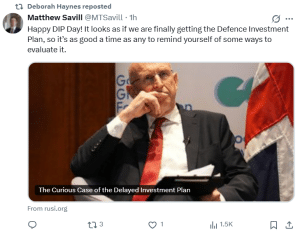
Keir Starmer announced his defence investment plan (DIP) today and while the media is welcoming it with open arms (pun intended), the Stop the War (StW) Coalition has rightly called out the BS.
The FT said the increase in defence spending of approximately £15 billion was recently raised by £1 billion in the wake of John Healey’s resignation as defence secretary this month. It has apparently been signed off by Starmer’s expected successor, Andy Burnham.
Stop the War: ‘Never mind the cost of living crisis…’
Stop the War (StW) Coalition posted on X that generals and arms companies have been all over the media today welcoming increased defence spending in the DIP. Meanwhile, completely ignoring the current cost-of-living crisis in the UK.
Generals and arms companies all over the media today welcoming increased defence spending in the DIP
Never mind the cost-of-living crisis or the collapsing services he leaves behind, Starmer wants to be remembered as the man who ramped up spending on weapons https://t.co/W5TPeqMD83
— Stop the War Coalition (@STWuk) June 30, 2026
Those being platformed today are:
- Lord Dannatt, an ex-British Army general
- Richard Barrons, Former director of operations at the UK Armed Forces
- Ross Exley, vice president for defence strategy at Hadean
- Shefali Sharma, chief executive of Oxford Dynamics, an AI defence company
- Tom Redman, CEO of British-based drone supplier, Evolve Dynamics
- James Cartlidge, Shadow defence secretary
- Tim Willasey-Wilsey, a senior associate fellow at the RUSI and Ukrainian drone unit commander Neo
Deborah Haynes, defence editor at Sky News, is reposting RUSI’s propaganda, a think tank that is a mouthpiece for the military-industrial complex.
Drone bonanza
The main beneficiary of Starmer’s DIP is expected to be drone companies.
UK watchdog, Drone Wars, said that drone companies were awaiting a spending bonanza and called the DIP, a “Drone Investment Plan”.
The “big number” in the DIP is the £5 billion earmarked for drones, according to Bloomberg. Meanwhile, LBC called it a “drone-building blitz”.
According to the MoD, Dan Jarvis, the new defence secretary, has spent the last two weeks “refocusing” the defence investment plan to ensure it learns the lessons from wars in Ukraine and Iran, BBC reported.
This includes how drones have been used to destroy high-value targets, with Jarvis saying the “character of warfare is rapidly changing”.
The Stop the War Coalition had also posted yesterday that wages, green jobs and welfare should be priorities instead of drones, and aded:
Security, defence and fantasy threats are now the main ways that the ruling class justifies attacks on welfare and social programmes.
The media is pulling out all the stops to ensure a good payout for the arm companies and keep the ruling class happy, it seems.
Featured image via BBC
By The Canary
From Canary via This RSS Feed.
cross-posted from: https://news.abolish.capital/post/60886
UK ‘counter-terror’ police have detained distinguished US human rights professor and international law expert, Dan Kovalik, at Liverpool’s John Lennon Airport.
Kovalik, a well-known author and activist, said on X that he had been grilled about his opposition to Israel’s Gaza genocide and to the illegal war on Iran.
In the height of irony, I was detained at John Lennon International AirPort in Liverpool, England by anti-terrorism police concerned about my opposition to the Genocide on Gaza and the war on Iran. They seized my phone, computer, fingerprints and DNA sample. More to come . . . pic.twitter.com/WOtXQLjjO2
— Dan Kovalik (@danielmkovalik) June 29, 2026
Human rights threatened under authoritarian war on speech
The Starmer regime extensively abuses anti-terror laws to detain — not arrest — journalists, activists and others who speak out against Israel’s crimes and the UK’s collaboration. By avoiding arrest and seizing victims at ports or airports, the state denies the detainee access to lawyers and the right to silence.
Refusal to disclose passwords is punishable by two years in jail. Devices are routinely seized, as in Kovalik’s case.
All these abuses are perpetrated by a regime seeking to protect Israel from scrutiny and criticism, despite wholesale condemnation from the UN, human rights groups and international law experts. None have so far been charged, but multiple UK journalists and authors have been targeted.
One journalist, Asa Winstanley, refused to disclose passwords to protect sources, but he was raided at home where protections are greater. Winstanley has not, so far, been prosecuted. A court ruled the seizure of his devices unlawful.
Liverpool stands with Kovalik
Scousers reacted furiously to the war on free speech on their ‘patch’ and were quick to express solidarity with Kovalik against the shameful detention.
Apologies@danielmkovalik
The people of #Liverpool have a proud tradition of welcoming our guests, unlike our government and security services who should frankly be prosecuted for not preventing a genocide. Hope the rest of your stay is filled with peace and love.— Liverpool Riverside Left (@LivRivLeft) June 30, 2026
National Security (State Threats) Bill
Not satisfied with abusing anti-terror laws to wage war on UK rights for Israel, the Starmer regime is ramming through further legislation allowing it to quickly designate any group it doesn’t like as ‘terrorist’.
Starmer is pushing the National Security (State Threats) Bill through Parliament in a single day without scrutiny. The bill puts the onus on its victims to prove they didn’t know a group the government later ‘designates’ was going to be banned.
Using information is included as a crime and there are no protections, even for journalists, who quote facts obtained from sources the UK government dislikes.
Craig Murray, himself a victim of an airport detention, pointed this out:
New Labour is rushing its new National Security State Threats bill through parliament in just one day.
It will be illegal to publish TRUE casualty information from Iran, from Hamas-run hospitals in Gaza, or IDF assault details from the resistance in Lebanon.
14 years in jail.
— Craig Murray (@CraigMurrayOrg) June 29, 2026
Britain is an authoritarian terror state. Shamefully, presumptive new PM, Andy Burnham, has given no indication he intends to end this reign of state terror. In fact, Burnham has accepted funds from the director of an arms firm involved in the genocide.
Featured image via AFPTV TEAMS/AFP via Getty Images
By Skwawkbox
From Canary via This RSS Feed.
cross-posted from: https://news.abolish.capital/post/60907
The UK’s politico-media class loves a bit of pearl-clutching over the phrase “from the river to the sea”. It’s treated as ‘hate’ and a ‘call for the destruction of Israel’. Except when it comes from the Israeli regime, of course. Then it’s fine and dandy. ‘Nothing to see here, move along’…
So with Benjamin Netanyahu’s latest, it’s far from the first time he and other colonisers have used it, but as shameless as could be.
I’m guessing this version of “from the river to the sea” will get zero media attention. https://t.co/It7Iz95eNt
— Assal Rad (@AssalRad) June 29, 2026
Israel’s chants not regarded as hateful
When Palestinians and their supporters chant, “From the river to the sea, Palestine will be free”, it’s a call of hope for liberation from oppression, land theft and genocidal colonisation, with equal rights for all who live there.
When Israel and its supporters say, “From the river to the sea”, they mean: “We’re going to keep stealing land until there’s nothing left to steal and if you get in our way we’ll kill you, you sub-human POS”.
But only the former is ‘hate’, or even worth mentioning, in the morally-diseased and collaborator-infested hellscape that used to be Britain.
Featured image via the Canary
By Skwawkbox
From Canary via This RSS Feed.
I don't think so. Who is going to over turn it, the Democrats? The Republicans?
I'm so fucking ready to vote. I'd vote right now if I could!
 They want violence so martial law can be declared. Sharing this article actually promotes their agenda.
This is disgusting... Absolutely sick and depraved.
Hell on earth, obviously.
How is this your outlook? I'm very confused.
In sorry, the idea that injunctions would prevent this is laughable. In many states the state police are directly collaborating with ICE. What procedure are you even imagining? You want the deportations so long as it's done so in a professional way? The legal system is dead, only it's ghost remains and this regime doesn't believe in ghosts.
This view provides an interesting detail. He walks around the car with the phone, documenting the plates and the bumper stickers, and then before he walks in front of it a second time (for what reason?) he switches the hand with which he is holding the phone to free up his right hand. In a video from another angle, you can see he starts reaching for his gun when she's still in reverse, or at least before she accelerates. So to me, it seems like he's performing the behavior that was mentioned in a 2013 paper on CBP use of force. In that report, they mentioned agents were standing in front of cars about to flee, and then shooting the drivers in frustration and then claiming self-defense. Here, Ross positions himself in front of a fleeing person (but just barely, so he can still step out of the way) and uses them hitting the gas as an excuse to use deadly force. The fact he says "fucking bitch" afterward and also flees the scene suggests he killed her with malice and knew it was unjustified.
Here is an article about the use of force paper from 2014 https://www.thenation.com/article/archive/us-border-agents-intentionally-stepped-front-moving-vehicles-justify-shooting-them/
This has been a great early Christmas gift!
Actually, he just pissed and moaned for, like, 30 min and didn't even hint at a war. Fantastic stuff.




Blaming "protest‑non‑voters" for ICE brutality misses why Kamala Harris lost the 2024 election, and why Democrats keep failing vulnerable communities.
Yes, Gaza cost Harris votes: about 422,000 Democratic‑leaning voters stayed home or voted third‑party, with roughly 122,380 directly linked to protest (Al‑Shabaka). But protest voters were a smaller factor compared to the 6.8 million former Biden voters who switched sides or stayed home due to broader campaign failures (Common Dreams).
The Democratic Party’s own autopsy points to larger failures: voter disenchantment as millions switched sides or stayed home, a chaotic primary process, abandoning the working class to court Republicans and donors, alienating young and minority voters over Gaza and the economy, and losing Black and Latino voters who shifted toward Trump (NPR).
ICE brutality isn’t a Trump‑only problem. Obama deported a record 2.7 million people (Migration Policy Institute). Biden’s Title 42 expulsions removed over 2.5 million migrants without asylum hearings (PBS NewsHour). The agency’s culture of violence was built by successive administrations.
When we blame individuals who refused to vote for a candidate supporting genocide, we ignore why Democrats offered such a candidate. The answer isn’t that voters failed the party, it’s that the party failed voters. A political machine funded by corporate donors cannot deliver protection for vulnerable people.
If we want to stop ICE brutality, we need to confront the system that produces both Republican and Democratic presidents who expand its powers. Focusing on “protest‑non‑voters” lets that system off the hook.
@andyburke@fedia.io
@Emotional@lemmy.blahaj.zone
@NaibofTabr@infosec.pub
@ajmaxwell@lemmy.world
@frustrated_phagocytosis@fedia.io
@Two_Hangmen@midwest.social
@CuddlyCassowary@lemmy.world
@cannedtuna@lemmy.world
@writingcheques@lemmy.world
@nohbdyuno@sopuli.xyz
@ohellidk@sh.itjust.works
@Darkassassin07@lemmy.ca
@BassTurd@lemmy.world
@cass80@programming.dev
@regedit@lemmy.zip
@CoolCat@lemmy.world
Curious if any of you could do a better job of explaining this persons position here.