290
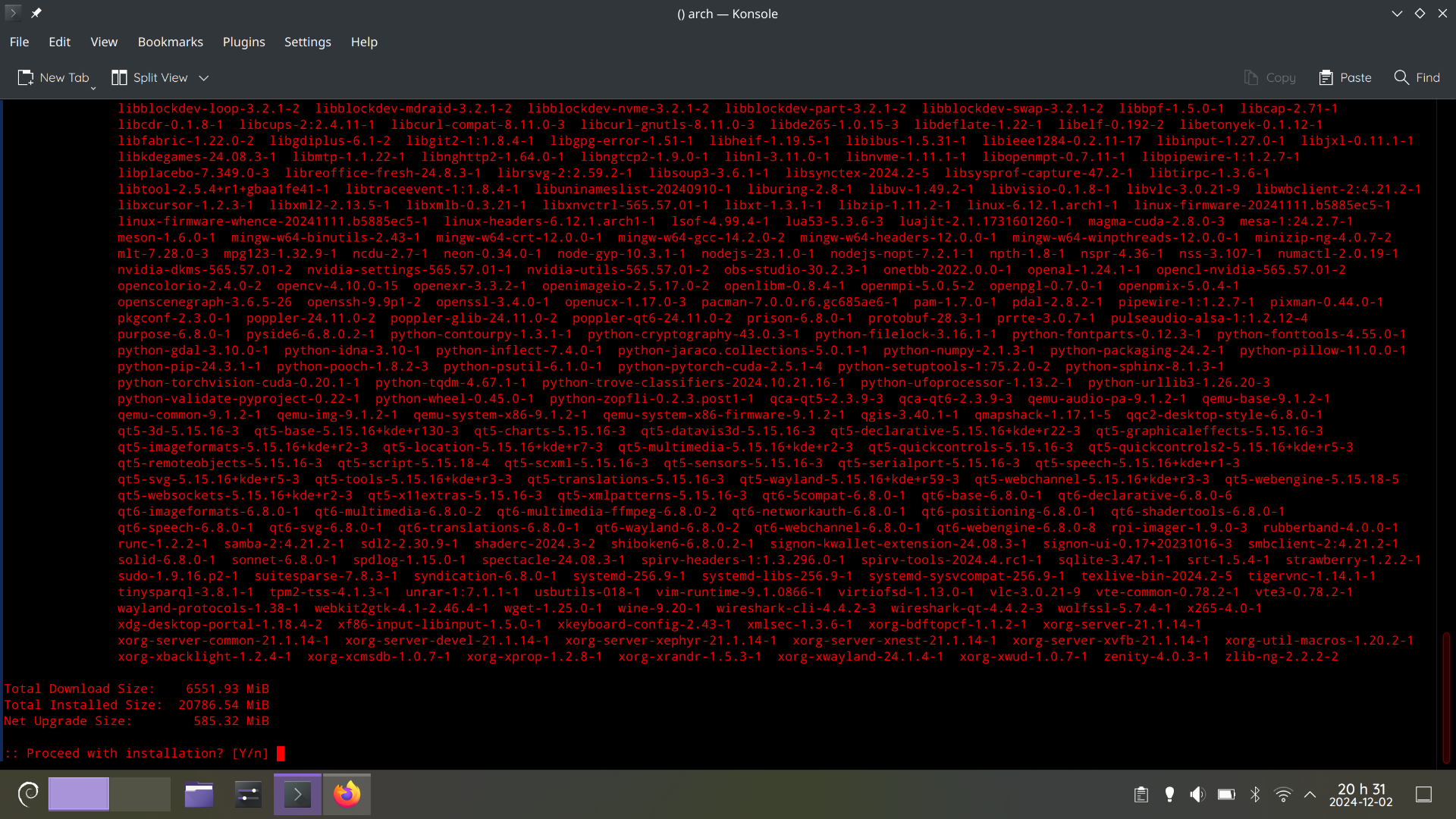
To be fair, arch could look like that after a few days.
To be fair, arch could look like that after a few days.
NixOS is like that every day for no reason
Oh, you updated one byte in your config? Better download the entire ducking Internet and rebuild everything!
staging rebuild cycles only happen every two weeks or so.
The reason is always that something changed and causes all dependent packages to change, requiring a rebuild of those too.
Read the Arch news before clicking "yes".
people laughed at me for choosing debian. they asked why i chose to have ancient runes running in my computer
who's laughing now?
Still we, dinosaur.🦖
We are still laughing, no worries.
p.s. Debian is great, I am just a "kind of new" void converted.
Sometimes I wish someone would make a an Arch box and come back to it years later to see the updates it has missed.
But that's assuming an Arch box would be reliable enough to stay alive that long lol.
Always heard of 20+ year old bsd and debian machines chugging along with no issue.
It won't rise much beyond that, since you only get one update per package. Whether it's upgrading Firefox from version 120 to 121 or to version 130, it doesn't change much in terms of download size, nor the number of updates.
At least, I assume, Arch doesn't do differential updates. On some of the slower-moving distributions, they only make you download the actual changes to the files within the packages. In that case, jumping to 121 vs. 130 would make more of a difference.
If you do want lots of package updates, you need lots of packages. The texlive-full package is always a fun one in that regard...
I have updated arch systems that had not been powered on for years before. It was fine. No issues what so ever. Arch is not some flaky distro that breaks if you look away for a minute. My main system has had had the same install for over 5 years now and I regularly forget to update it for months at a time. Again, no issues.
Yeah really the biggest issue I could see is pacman’s keyring being so out of date that it has to be manually refreshed with a new one
My arch install has been going strong for about 5 years now
I had that on a physical machine! It broke hardcore lol I had to reinstall the OS after trying to update
You see, this is why atomic desktops aren't a bad idea.
This has nothing to do with immutable desktops.
Well in an immutable distro, there is little to no chance for the system to end up in an unusable state (I guess it is the same for distros which apply the updates atomically). Traditional distros are far more likely to bork when so much shit is updated at once
I don't think this is true. The package manager is there for a reason to prevent that. If you have more updates to install at a time, then the chances are the same as if you would have installed the problematic update one at a time. Just read the manual intervention information from Arch and see if there is something to do, then it won't bork. If people don't know what they are doing and do not read the additional information (that is required to do so on Arch), well yes, then you could end up borking your machine. But not because so many updates are installed at a time. The package manager and operating system and their maintainer designed it in a way that you can install ton of updates at a time without borking. This is fine.
It's arch. There'll be no issue here.
This is why I Dont use rolling release Distros on Pcs i wont use often.
I used to care but with recovery tools being what they are and most apps being containers... my base systems tend to be a little more disposable.
That said, I haven't had problems, even if I am at risk for more of them. I have my snapshots and my backups.
Because you get updates and have an up to date system?
Because you get a update once a update for a package comes out, If you dont update for a very long time you need to download a very large update.
Haskell packages every other day...
Is it Debian Sid?
arch linux, i'm sshed from my debian machine.
And they're red, that means the offer is about to expire. Better act quick!
Better apt quick!
You wouldn’t believe the shit I’ve seen on internet connected production servers…
Nah, just update it.
welp, looks like you don't use python virtualenvs... well i guess jokes on you all your shit is probably broken now (and as a bonus, that's probably a big part of the donwload size as well) :p
Probably should, but this machine is already cluttered terribly. A good bit of the download size is likely Pytorch files.
Looks like a !!FUN!! time in Dwarf Fortress.
Those are rookie numbers.
6.5 gigs. "Proceed with installation? y/n"
Yeah, I guess. Fark getting any work done today.
Recently updated a nixos machine that was on the shelf for five years or so. A few options and packages had been renamed, fixed those, upgrade completed with zero problems.
Only issue with this update was a maintainer's keyring had expired and been replaced, so his packages didn't pass the signing check. After re-installing the keyring, the whole think works fine.
From Wikipedia, the free encyclopedia
Linux is a family of open source Unix-like operating systems based on the Linux kernel, an operating system kernel first released on September 17, 1991 by Linus Torvalds. Linux is typically packaged in a Linux distribution (or distro for short).
Distributions include the Linux kernel and supporting system software and libraries, many of which are provided by the GNU Project. Many Linux distributions use the word "Linux" in their name, but the Free Software Foundation uses the name GNU/Linux to emphasize the importance of GNU software, causing some controversy.
Community icon by Alpár-Etele Méder, licensed under CC BY 3.0