Assuming that most non-technical users (who wouldn’t research and enable it) are probably using Wine/Proton through Steam: yeah.
Y’all I think this guy might actually be Steve Wozniak 👀
From the article:
Futex2, often referred to interchangeably with fsync, did make it to Linux kernel 5.16 as futex_waitv, but the original implementation of fsync isn't that. Fsync used futex_wait_multiple, and Futex2 used futex_waitv. Applications such as Lutris still refer to it as Fsync, though. It's still kind of fsync, but it's not the original fsync.
So since Jan 2022, it’s been in the stable Linux kernel. For Debian and its derivatives, it would be included beginning with Bookworm.
From what I found online, Steam enables esync by default, and fsync if your kernel supports it.
Lutris has both options nowadays in the runner settings. Idk if they’re both enabled by default, but in my case they’re enabled. ymmv there.
Linus Torvalds, the creator of the Linux kernel, owns the Linux trademark. He is currently the lead developer, and he approves and merges the code contributions from each of the “areas” (idk the right term for them) into the main branch for release versions.
The Linux kernel is distributed by The Linux Kernel Organization, a “California Public Benefit Corporation”. It’s “recognized by the IRS as a 501(c)3 private operating foundation”.
They are managed by The Linux Foundation which is “a 501(c)6 non-profit”.
It’s not “sold” to big corporations, because none of these companies are publicly traded.
But companies do use Linux massively. It has a massive market share in the server space. That’s why the Linux Foundation has a board of directors with many people from big tech corps.
Like other FOSS projects, Linux couldn’t really exist (the way it does) without sponsors and contributors. Companies sponsor its development to help improve and maintain the kernel, and in return they can use it for their needs. That’s how maintainers are compensated for their work. Many contributions are also from companies who add code to help adapt the kernel for their needs.
But because of the project’s licensing and leadership, privacy and transparency are protected. The kernel doesn’t collect or send user data to any company or server. If someone writes code that does that, leadership would probably not merge it anyways, but even if, any person could check (more frequently, “audit”) the code and remove it or choose to not use the project. Anyone is free to “fork” the kernel to make modifications or go a different direction, assuming they follow the license.
Now for desktop Linux distros, like Linux Mint, there’s other software that you should also think about its features and management, and whether that is “safe” too. Out of the box, things like Systemd (init process) or Cinnamon (desktop environment) are maintained and distributed by different groups. IMO for Linux Mint: it’s safe and protects privacy. But that’s subjective, it’s always good to be critical and to form your own opinions! :)
This is about micro-transactions specifically. Tim Fortnite is arguing that games sold on Steam should be able to offer in-game purchases with payment options outside of Steam.
It’s very similar to Epic Games v. Apple, where Apple had required in-app purchases for iOS apps, notably Fortnite, to be handled through their app-store so they get a cut.
One big difference that I see here: On PC, a developer isn’t required to use Steam to distribute software. Players often prefer Steam because Valve has made Steam a great option and has lots of good-will with players. Still, Steam does dominate a massive portion of the PC market.
And a 30% cut is high. Especially for smaller games with less financial resources. As a developer, that’s a trade-off you’d have to choose. I think it’d be best to offer the game on multiple platforms.
For Steam-bought games, I think having an option to pay off-platform would be fair, but I think the option needs to remain available through Steam too. For many games, I don’t want to give my payment details to yet another developer, company or third-party.
Hehe they can poke through my hole if they want 👉👈
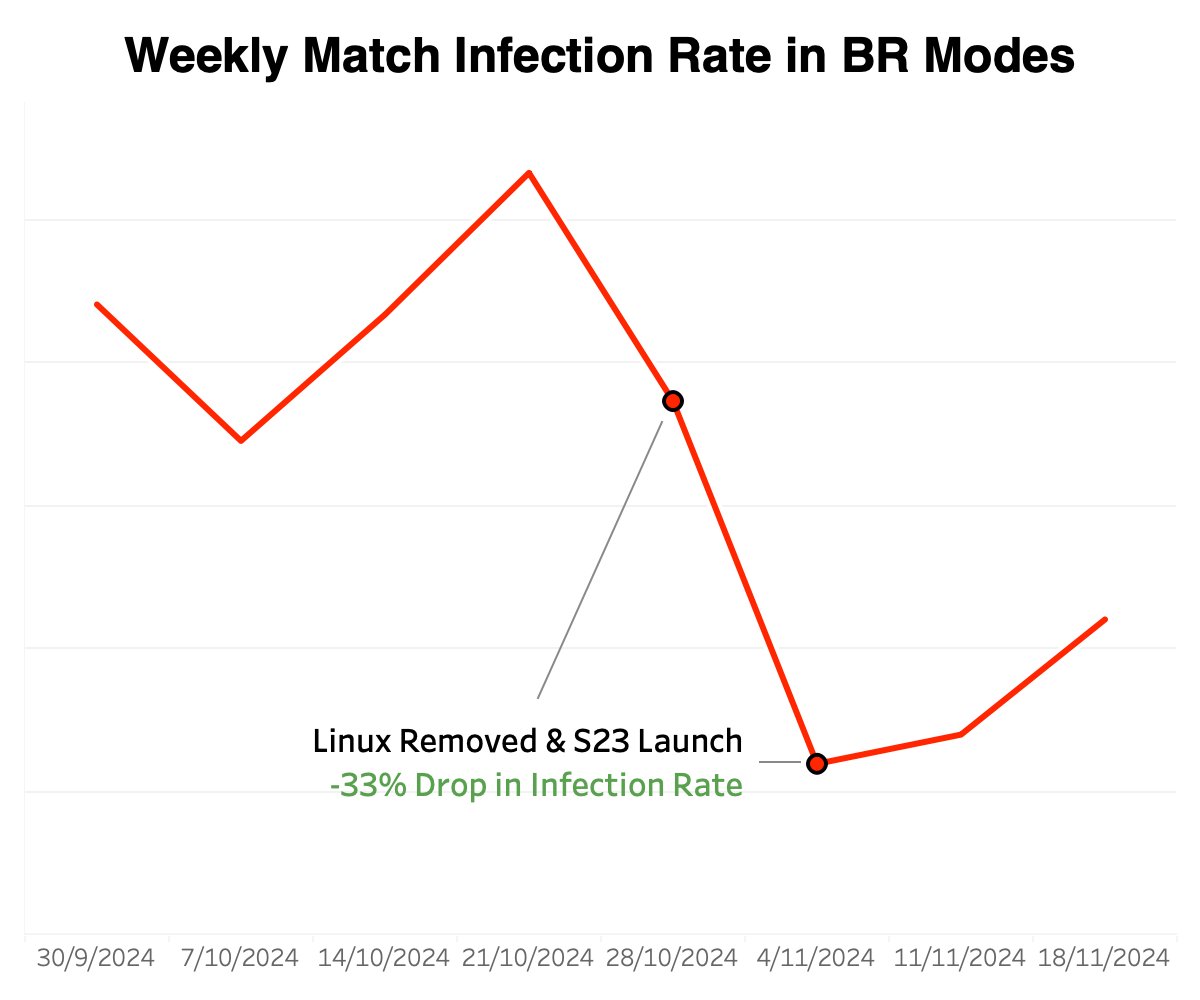
They tweeted this graph in early December:

[…] In this chart, we're displaying the infection rate, or the rate of matches that had a cheater present. […]
Note how the graph is missing labels and how neither it nor the tweet include information on how these metrics were gathered.
Yeah… the way they treat developers and monetization is super scummy. Not to mention their lack of action towards child safety concerns. There’s definitely better ways to spend my time.
I heard a lot of people in the community calling for Spitz’ firing both during and after the situation. I’m getting mixed signals, since this article seems to describe Spitz as more of an ally to the community in the situation.
Flashlight would like access to your contacts

I definitely see the similarity, at least in public response. I mean, I read that and thought, “$6 million? That’s life-changing money!” And when I read about what the victim experienced, I thought: “Addiction, anxiety, depression and body dysmorphia. That’s all like, pretty common for teens these days. And often because of social media, for sure, but why is she specifically being compensated that much?”
For the McDonald’s trial, the woman tried to settle and had to get lawyers to pursue damages. Even though public response was bad, that feels like less of a cash grab.
But what caused this girl to sue? The article didn’t mention a big event afaik. Did she just have lawyer money and decide to? And nothing here changes, social media will remain the way it is. It definitely comes off to me as someone looking for a way to get money, even though I am happy with the ruling.