18
Good thing they have loads of number one Star Trek fans in the building, whatever that means.
Is she implying that they're looking for other options than what Secret Hideout has to offer?
Good thing they have loads of number one Star Trek fans in the building, whatever that means.
Is she implying that they're looking for other options than what Secret Hideout has to offer?
Well, true. LDS played it well, though. Seeing how this is the second time that the SNW writers rip off old Joss Whedon episodes from the early aughts, I'm less forgiving.
Ah yes, I remember that Angel episode. That was a creative idea, 22 years ago.
I think Mark Gatiss is unduly criticised in some fan forums. He does fine little standalone scripts that stand out not for excellence, but for their atmosphere, attention to detail, and a good bit of quirk.
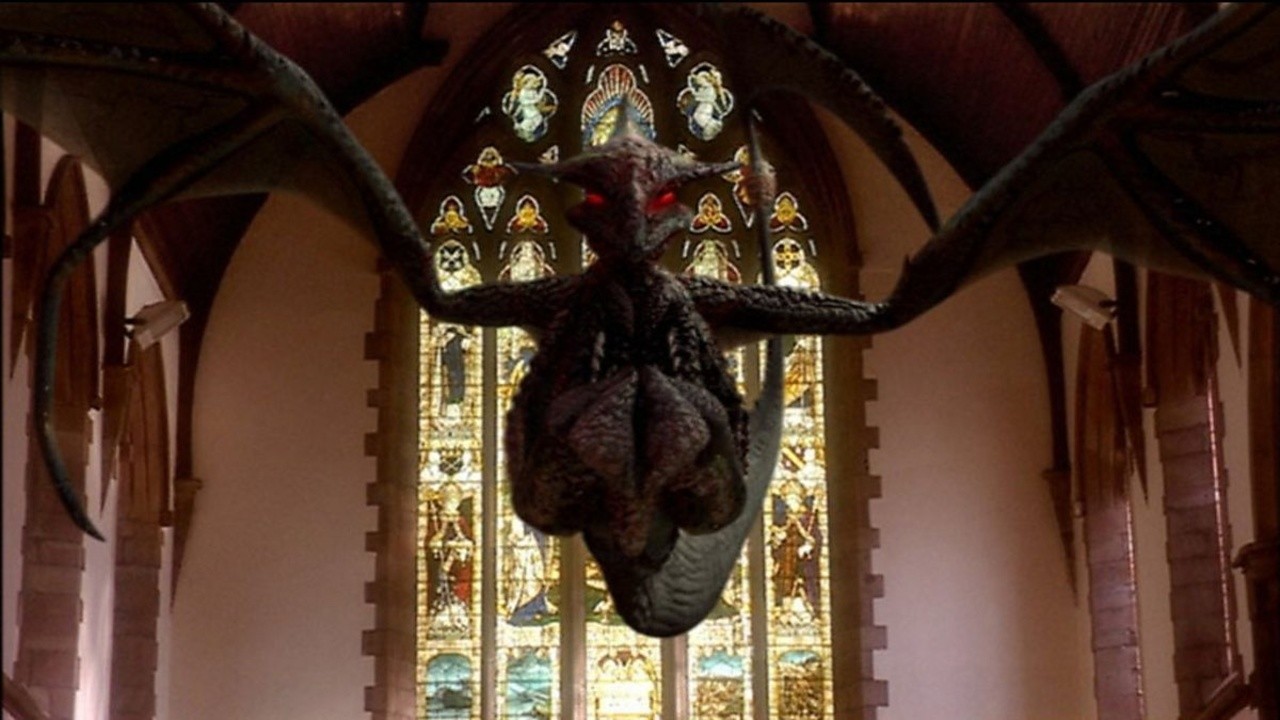
He's an old school fan, and here he clearly wanted to make a Classic Who-style historical. Ironically, the Coronation element is overshadowed by the Wire plot, the advent of television (which RTD swiped in "The Giggle"), and the terrible family dynamics.
[Edit: Duh, you're right. Moffatt also used the transmission thing to defeat the Silence in season 6]
Personal gripe, I preferred faceless Rose. They could have left her like that for a few episodes for all I care.
I will say this for the episode, the Wire is a memorable adversary for the Doctor. To this day, my family will imitate her "Hu-u-ungry-y!" part regularly. Mostly just before dinner.
Am I right in believing you're currently living your best life? 🖖🙂
In his case, photons.
It would be easy to just gesture vaguely at all of Sir Patrick Stewart's career. But your question was about better performances than in Trek, and I actually think he did an excellent Picard during the original TNG run. Not quite a hot take, I know.
However, for a double off-Trek billing, I suggest Green room (2015) where he plays against Anton Yelchin among others. It's a pretty taut little thriller about a punk band on the road that realise to their horror that their gig for the night is at a neonazi club out in the sticks. It goes downhill from there.
"I said, 'Well, you can cut that in half with no problem at all.'"
Next meeting, the engineering team showed up with 200 half tampons.
Big caveat up front, I have no illusion that this was ever planned out, or that it's ever going to be made. I just connected some dots from Eccleston's season to our current mess. I do think that if the BBC had Pete McTighe make a 15 minute special along these lines and put it on Youtube, the fans could rest easier and the next production team might start on a blank slate.
To summarise, the last couple of seasons had a convoluted arc concerning a companion's parent issues. She was saved as a baby through time travel intervention, but not without a lot of temporal disturbance in the process. In fact, babies have been a throughline in both Ncuti Gatwa's seasons, a pattern that culminates in the Doctor rupturing the Time Vortex in order to save one child's existence. For just a probable moment there, that child is his own. Succeeding in his mission, the Doctor is then replaced by somebody looking suspiciously like Rose Tyler.
Bring on the Time Reapers to sterilise the wound in time! That's why the Doctor regenerated into this face, à la 12 looking like Caecilius from "The fires of Pompeii". She needs to channel Rose as a catalyst to heal the reset 15 did to save Poppy. Besides, where Pete sacrificed himself to sort the timestream out, this time around the Reapers are attacking the Doctor and their police box. And the Doctor's current face has a very special relation to the TARDIS' living heart.
To be fair, the rest of the story doesn't really matter, this is only meant to resolve the Billie Piper twist of "The reality war". It doesn't fix fan quibbles over the Timeless Child or the Doctor being half human on their mother's side for a hot minute in 1996. Pretty much everything other than that latest regeneration cliffhanger can be ignored or picked up upon by future writers. So end this minisode on a regeneration without showing what happens next, or just leave it open ended.
Now, would I love for Susan to pop up for no other reason than to ease her "grandfather" into the credits crawl, and a future season where neither actress are seen again? Maybe an exchange to echo the Seventh's exit monologue to Ace at the end of "Survival"? Absolutely, but this could well be a one hander between Piper, some 2005 archive footage, and the janky old low-poly CGI monsters from back then.
[made a few edits for clarity(?)]
NGL, I preferred SFA s1 over Prodigy s2. Yes it was bumpy, but it was growing into its own (beard). You can't convince me the cancellation was anything but "we're not having a show teaching kids tolerance and that other DEI stuff".
I agree LDS was top notch, haven't watched Scouts so I'll reserve judgement 🙂
"Hey, now you have one more way to watch that show we nipped in the bud for political reasons! Aren't you excited for the next (also, last) season, coming on this platform next year?!"
Sorry, had to get that out.
This sent me down a rabbit hole, and I'll freely admit I only went as far down as I could still see the entrance behind me, because man, that is a rickety warren.
IRL there would be mind boggling complexities of calculating an objective system for marking time, when you have starships zipping about at faster than light speed. The subjective time of those crews would diverge from standard observed time, and between ships traveling in different directions, at different warp speeds, and for varying stretches of (subjective?) time.
The above is my dumbed-down understanding of time dilation. But the real real life explanation is that Gene Roddenberry and writer Samuel Peeples got tipsy and drew up their own galactic map with travel itineraries (presumably on napkins and backs of coasters 🙂):
"For the starship captain's log entry narrations, Roddenberry wanted to devise a futuristic measurement of time reference. He called (Sam) Peeples (whom Roddenberry had contacted early on for help in learning about science fiction, a subject he knew nothing about; it was Peeples who wrote "Where No Man Has Gone Before," the pilot that sold ST). The two men had a few drinks while brainstorming, and soon began chuckling over their imaginative 'stardate' computations. 'We tried to set up a system that would be unidentified unless you knew how we did it,' Peeples says."
"They marked off sections on a pictorial depiction of the known universe and extrapolated how much earth time would elapse when traveling between given points, taking into account that the Enterprise's warp engines would be violating Einstein's theory that nothing could exceed the speed of light. They concluded that the 'time continuum' would therefore vary from place to place, and that earth time may actually be lost in travel. 'So the stardate on Earth would be one thing, but the stardate on Alpha Centauri would be different,' Peeples says. 'We thought this was hilarious, because everyone would say, "How come this date is before that date when this show is after that show?" The answer was because you were in a different sector of the universe.'"
— Joel Engel, Gene Roddenberry: The Myth and the Man Behind Star Trek, cited in the Memory Alpha entry for "Stardate".
Yeah, the copyright says 2014, but this stinks of 1950s attitudes. "Women, amirite guys?!"