357 is not going to fare well long term with the current design. Everything should be good to go for 38 special, even using +P loads.

I have a couple of ideas to reinforce the action, but printing the hammer and breech in CF nylon may be all it takes. I will get around to it eventually.

As expected, the optional steel safety plates do not reinforce the action. I have tried them on the 327 with no change in results.

38 special is going well. The armorer is testing it and hasn't really had any problems. 327 magnum has proven to be a handful. I don't regret choosing the 327 fed chamber, but likely we will recommend people go with the 32 h&r magnum chamber in stead. 32 h&r still used magnum powders, so you can really utilize the rifle length barrels. It is a very capable round, and the slight shorter chamber will play nicer with 32 long, 32 short, and 32 auto. I really like shooting the 32 longs out of mine more than anything. No problems other than the hotter 327 loads hurting the brass. The gun holds fine but the brass is wrecked with the hotter 327 loads.

So, you seem like you are in the right track.

Use a 1/4" drill bit as a mandrel to hold the beginner shells for sanding.

For intermediate (or any upcoming load that uses small primers) you use a T25 Torx bit as the mandrel. I recommend a new one with crisp edges. You can also use the torx bit after smoothing the cases to ream out the primer pocket to size.

The beginner loads use a 209 primer. The 209 primers protrude out the back of the case because of the incorporated rim/flange. This makes up for the difference in headspace.

The headspace gauge is .2mm thicker than the shells (or beginner rim+209 flange thickness). This build with 43r Ammo is very forgiving with headspace. If you accidently used a beginner shell to headspace, you can just file some off of the breech end of the barrel, and file the extractor groove a little deeper. If you mess up and have too much headspace, you can sand some off of the front of the receiver to make up for it.

Baby barret is one of my favorite builds I've done. I recommend opting for a full size barrel. It's also one of my most accurate full DIY builds.

CCI standard velocity is subsonic as well.

Barrel length also plays a large role in how quiet a gun can be. My baby barret, m4gery, and sr722 all have barrels longer than 21" and are very tolerable with standard velocity ammo without using a can.

On the other hand, my 22lr builds with 1.5-4" barrels are some of the loudest pistols I've fired.

CCI quiet "semi auto" ammo helps a ton too, even with the shorter barrels. Aguilla sniper subsonic is really nice just harder to find and some guns don't cycle it well.

12
Esun matte PLA test (forum.guncadindex.com)

I recently ordered some Morandi green esun matte PLA for something not related to guns. I noticed that it seemed to have some really nice mechanical properties. It had to be printed at higher temps than most PLA variants that I've used as well. Skirts and purge lines coming off of a 60C bed were rigid, which leads me to believe that it will be pretty good even when it warms up a little.

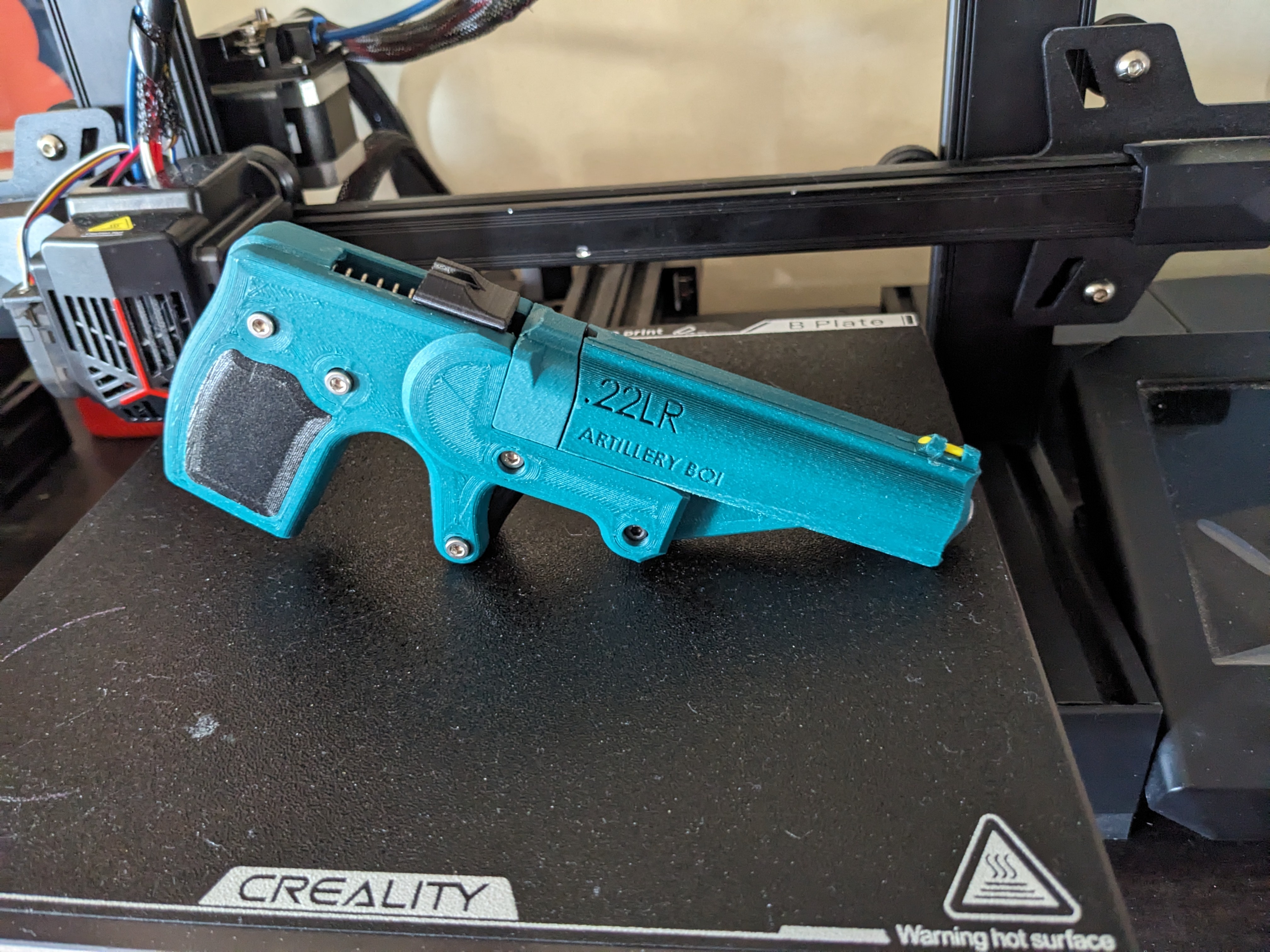
So, I fired up the ender 3, and wanted to see what this material would do. This is just a variant of the artillery boi that is easy to make UFA compliant. It's sporting a 4.5" barrel, using a solid printed breech, and had the striker fired FCG. The green parts are the matte pla, the sear is also matte pla. Just used black on the non structural parts for looks.

It does seem a bit too flexible. I managed to rupture a couple cases using high velocity ammo. My action could be a little tighter, but that probably wouldn't keep it from rupturing a case every now and then. Fired standard velocity and shorts just fine. Even with the case ruptures with high velocity ammo, the breech is no worse for wear. There is a tiny chip out of the printed barrel portion, but it is just cosmetic. I will end up making a brass bushing for the action and seeing if it will do better with the high velocity ammo.

But this material would probably be good for many things we use PLA+ for. I have to print it pretty slow for some reason, but it does print very well, with an amazing surface finish.

I don't recommend people use this to make guns, I just like to test new materials to see how they hold up. Last material was PLAF, which performed very well in the exact same test, although it isn't something that will hold up to heat as well as PLA+. Up next is a "High Impact" variant of PETG-GF.

If there is something weird and new that someone wants to see compared that is affordable and doesnt require more than 270C I let me know, I might try it out.
Probably the SY22. I've never built one, but many have with success. The NULL is supposed to be an improvement over the NAG, but I have yet to try one of those either.

It Is known to be an unfinished model. Although it contains some very intuitive design features, there are too many flaws to be worked out as it is.

I'm not saying that it's impossible to get one working, but it's not going to be a fun time, and will require overhauling many of the models.

Bushworked711

joined 1 month ago