83

From Texas Parks and Wildlife / Alayna Alvarez

As I saunter down a rocky hiking trail at San Marcos’ Purgatory Creek Natural Area, a swish of what looks like the long, bushy tail of a Madagascan ring-tailed lemur catches my eye from a bed of sand-colored rocks some 200 feet away, stopping me right in my tracks.

“What is that?” I gasp, entirely convinced I have just discovered a lemur on the loose.

As the black-and-white tail continues to flick, I search for what should be the rest of the lemur’s gray body and signature yellow-orange eyes.

But the suspected escapee suddenly lifts up its head and meets my bewildered gaze with gigantic but dark, round eyes. I notice its large, upright ears and tan, narrow body and realize this wickedly cute creature is not what I thought it was. One thing I am sure of, though: I know I’ve never seen it before.

Most Texans haven’t, as it turns out. The few who have seen it may have also mistaken this critter for a lemur on the run, just as I did, or a funky-looking raccoon.

Commonly known as a ringtail cat (Bassariscus astutus), this slender, cat-sized carnivore is surprisingly not a cat at all, but actually closely related to raccoons and coatis. The name “ringtail” comes from the seven or eight black rings on its tail. The animals are also referred to as miner’s cats (historically valued for hunting mice in mines), civet cats (because their musky secretion resembles the smell produced by African civet cats) and cacomistles (derived from an Aztec Nahuatl term that means “half mountain lion”).

Weighing in at three or so pounds, with an acute sense of hearing and exceptional night vision, this Texas native’s commonly mistaken identity is due in large part to its predominantly nocturnal lifestyle and shy, elusive nature. Ringtails are also expert at climbing, capable of crawling into almost any cranny and crevice or clinging to a cliff, no matter how steep. They are also impressively quick at running, skilled at jumping and particularly acrobatic in trees.

Despite their rare appearances, ringtails range throughout most of the state, more commonly so in their preferred rocky habitats, such as the Trans-Pecos, Edwards Plateau and Cross Timbers regions of western and Central Texas. Studies show that ringtails play an integral role in the Trans-Pecos ecosystem by providing food for large predators (such as owls or other raptors known to capture ringtails that rise too early or go to sleep too late), affecting arthropod and small mammal populations and aiding in seed dispersal by eating an omnivorous diet.

“My” ringtail finished up its foraging and slipped away seamlessly into a dark, tucked-away den.

As an Arizona newspaper once put it, sporting “Bette Davis eyes, Yoda ears and Greta Garbo’s aloofness,” ringtails exude features reminiscent of all sorts of creatures but manifest them into something that is entirely unique and rarely sighted.

Ringtail facts:

Smaller than a house cat

Native to the US southwest and Mexico, state mammal of Arizona

Nocturnal and change their resting place every 2-3 days to avoid being found

Kits cannot open their eyes for more than 3 weeks and aren't weened until 8-10 weeks old, so the mother has to move all the babies around with her as she changes spots every few days.

People used to try to domesticate them for rodent control. Over-trapping for fur led to them becoming protected.

top 20 comments
sorted by: hot top controversial new old
[-] anon6789@lemmy.world 7 points 4 days ago
[-] anon6789@lemmy.world 6 points 4 days ago
[-] anon6789@lemmy.world 6 points 4 days ago
[-] anon6789@lemmy.world 5 points 4 days ago
[-] quediuspayu@lemmy.dbzer0.com 3 points 4 days ago

I could confuse them easily with a genet. From what I'm reading on wikipedia they are even different suborders.

[-] anon6789@lemmy.world 2 points 4 days ago

Though they do look pretty similar, it doesn't sound like they have anything genetically in common. They both showed up about 20ish million years ago, the genets being feliforms (cat-like mammals, but not actual cats) in Africa, and these are offshoots of a caniform in, mostly likely, Central America.

Red pandas were until recently also lumped into family Procyonidae with both of today's raccoon relatives, but around 1998-2000 enough genetic testing was done to get them moved into their own family, Ailuridae, along with a few extinct red panda species.

Striped tails just seemed to be trendy around that 20 MYA period. 😄

[-] GrantUsEyes@piefed.zip 3 points 4 days ago

A Cacomixtle! Lovely critters.

[-] anon6789@lemmy.world 5 points 4 days ago

They look very charming!

I went looking to see how big they are and I found a clip from the Memphis Zoo with the keeper holding it. It looks like a squirrel and a housecat had a baby. 😆

[-] GrantUsEyes@piefed.zip 2 points 4 days ago

Perfect size, in my humble opinion :D

[-] anon6789@lemmy.world 2 points 4 days ago

Size looks good, but I'm wondering how hyper these little guys are before I put on in my house! They look like they enjoy mischief 😆

[-] prole 2 points 3 days ago

I imagine they smell too. Especially after reading the part about musky secretions

[-] anon6789@lemmy.world 1 points 3 days ago

Probs. Their raccoon cousins are certainly smellier than anything I try to let in my house.

[-] GrantUsEyes@piefed.zip 2 points 4 days ago* (last edited 4 days ago)

I'll hazard a guess...it's probably more sensible to get a plushie :P

[-] anon6789@lemmy.world 2 points 4 days ago

Hmm...that does really save on all those exotic vet fees... 🤔

There are actually a ton of results when I search for "ringtail cat plush"!

This one is really good (and priced accordingly)!

[-] GrantUsEyes@piefed.zip 2 points 3 days ago

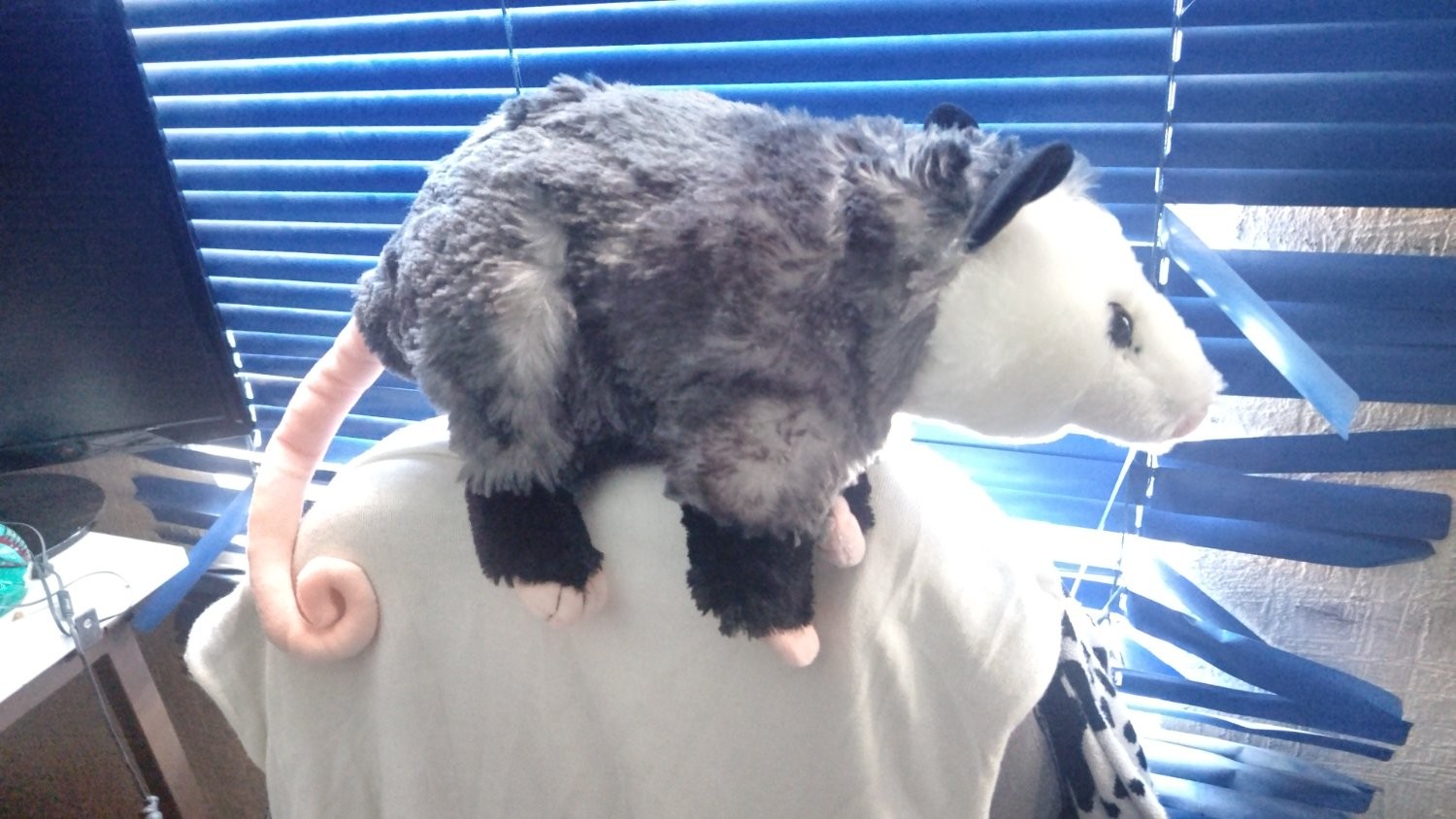
Now I want one! But I'll have to stay content with my glorious opossum plush.

[-] anon6789@lemmy.world 2 points 3 days ago
[-] GrantUsEyes@piefed.zip 2 points 3 days ago* (last edited 3 days ago)

Here it is, in all its fat glory

[-] anon6789@lemmy.world 2 points 3 days ago* (last edited 3 days ago)

Magnificent!

At the rehab conference, one lady had a decent sized plush opossum hair clip and I've been jealous ever since. She must have made it since all I mostly see are plastic ones, that are still cute, but it's not as convincing as her looking like she had a baby opossum reading her head like a real joey would.

Edit: I found a pic of it! I remembered it being more real, but it is actually more zany, which I still approve of.

[-] GrantUsEyes@piefed.zip 2 points 3 days ago

Awww that's lovely! I Might even try to diy one for myself. :D

[-] anon6789@lemmy.world 2 points 3 days ago

I want to see it if you do!

this post was submitted on 14 Jul 2026
83 points (100.0% liked)

Animals

370 readers
37 users here now

Anything and everything about non-human animals.

Rules:

  1. Posts should be relevant to non-human animals, including articles (news or just interesting facts), pictures (OC only but the animals need not be your pets), or text posts.
  2. Keep things civil. Don't insult other users or their pets. Do not post content that promotes animal abuse (this does not include content, like news, that portrays abuse in a negative light).
  3. Follow site-wide rules

founded 2 years ago
MODERATORS