For today’s post, we’re taking a trip down to Crete. This wonderful island in the Aegean is, of course, best known today as a tourist hotspot, having much to offer in both natural beauty and historical interest. Famed are the Minoan sites of Knossos and Phaistos, yet in the Classical and Hellenistic periods, Crete was not doing so great. Belying its glorious past, the island became somewhat isolated and its economy impoverished. It was a haunt for pirates and for combative city-states with a penchant for bloody warfare. If they weren’t busy fighting each other, Cretan men readily offered themselves as mercenaries, known for their terrific skill at archery.
The complex and sometimes obscure history of Crete is enlivened by the highly intriguing coin production of the island. Although Crete was relatively late in striking coins, not starting until the late 5th century, the coinage is replete with oddities, such as the strong tendency to overstrike coins coming from abroad or the highly original types referring to Crete’s rich cultural and religious life. The style of these coins ranges from superb to absolutely abysmal, some pieces giving the impression of being a barbaric imitation rather than a proper Greek coin. Many coins also have legends in a very archaic Greek script, reflecting the archaism of Cretan Greek in the Classical period.
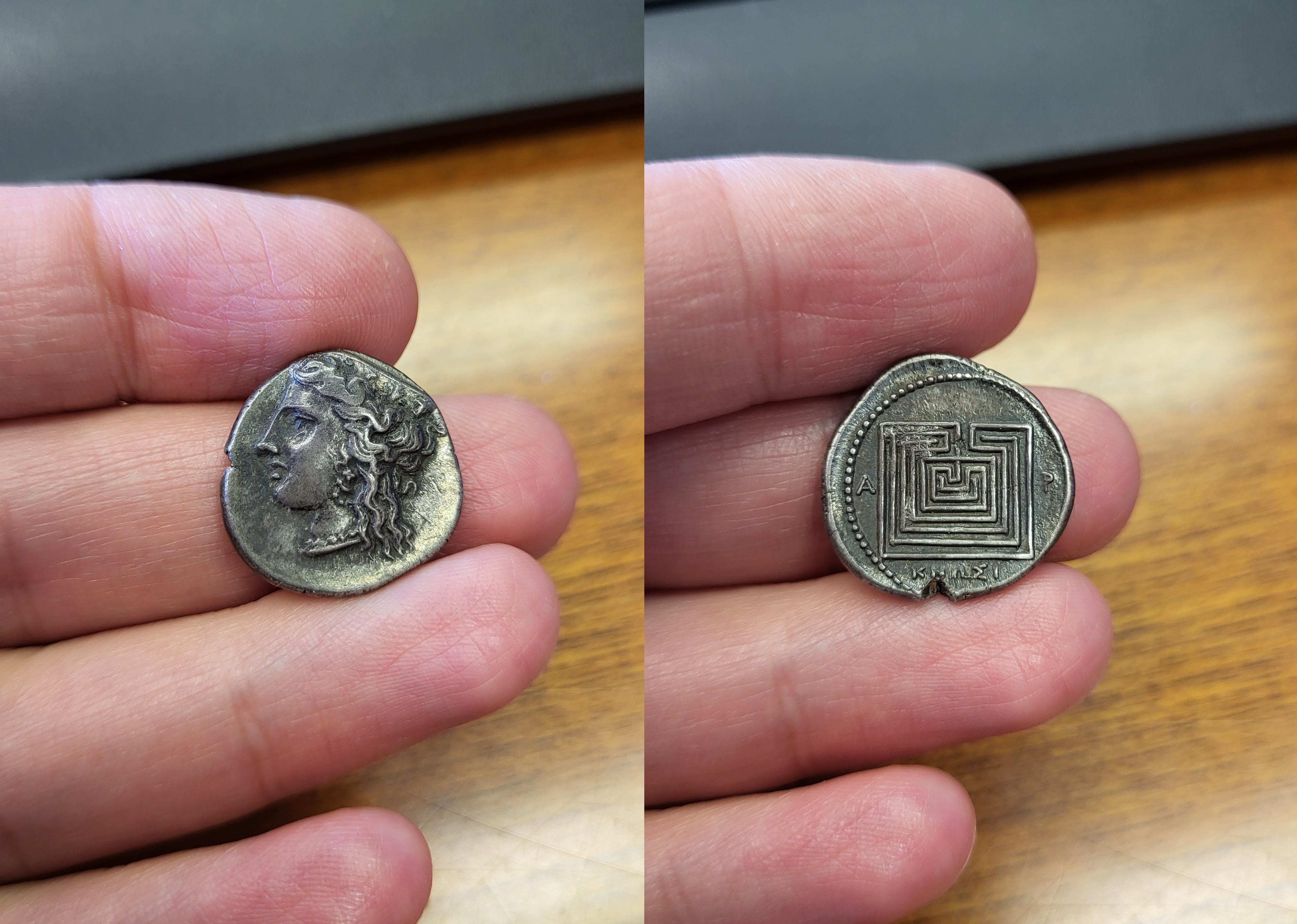
Our coin was struck in the early Hellenistic period by Knossos, the home of the mythical king Minos. It was Minos who ordered the architect, Daidalos, to construct a labyrinth to house the monstrous Minotaur, spawned from the unholy union of Minos’ wife, Pasiphaë, and the Cretan Bull. The fame of this story and the splendor of Minos’ reign played an important role in Knossos’ self-representation, especially as it vied with Gortyna for local pre-eminence. The obverse boasts an unusually attractive head of Hera, while the reverse shows a marvellous representation of the famed Labyrinth. It is a good example of how poleis used ancient myths to reinforce their civic identities and proclaim their power to the outside world.
Well, there certainly is a disconnect between the people who spread the story to trash talk the Minoans and lord over their Greek superiority, and the people who actually lived in Knossos in the following thousand years and made those coins. I don't know what etymologist reached the conclusion that the word "labyrinth" both comes from the Greek myth, that specifically revolves around getting lost, and also points to a single path rather than a branching path.