https://piefed.social/post/2215171/comment/12141440#comment_12141626
Many late-coming technologies are issues of concept. Slow-sand filters are incredibly simple, for example, but require an understanding that did not arise until the 19th century (some possible examples in Mesoamerica excepted). Gliders are not actually particularly difficult to acquire the materials or tools to make, especially in cultures that use kites, but require, again, an understanding of the principles involved to provide controlled flight (with gliders requiring precise balance of lift and drag, whereas kites primarily need only light weight and wind stability). Fire pistons are conceptually advanced and were not discovered in Europe until long after they were in Southeast Asia, despite some Southeast Asian cultures which produced and used fire pistons being literal stone-age cultures, in terms of available material tools.
Hot-air balloons, I would imagine, follow the same principle. If you lack the concepts behind the invention, the only way to discover it is by accident, which is generally unlikely. It’s why so much material development is concentrated in the modern and early modern period - we started to piece together how the world, on a fundamental level, works, beyond pure trial-and-error.
Also, hot-air balloons before plastics were often made of silk (and rubber), since most other materials are either too heavy (at least for practical purposes) or too thermally sensitive, and that’s an expensive experiment to be undertaking if you haven’t the first clue how it works.
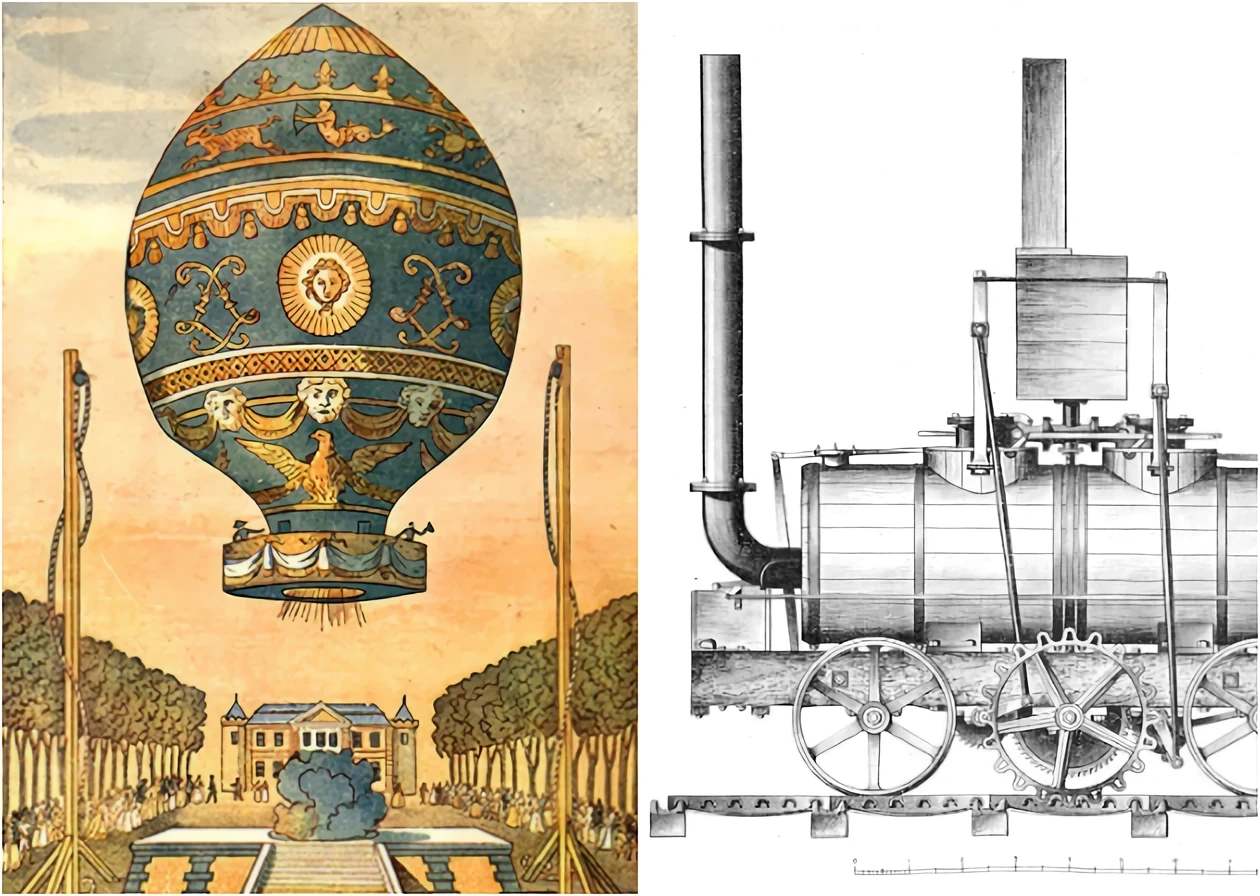
Is there a tendency to assume 'everything should have been possible in antiquity'? What is that supposed to mean?
Nonetheless:
There are plenty of examples of inventors through history with concepts and ideas that were not really practical in their time. Leonardo da Vinci's airship concept comes to mind as a well known example. Atomism is an another ancient concept across cultures east and west, which was conceptually used in the development of modern atomic theory. I think the Turks invented the steam engine based on Hellenic Greek concepts, but it was the English put it to state-level use and implementation.
So there's just a long history of technologies being adapted and improved for different purposes. Ballooning is a good example of something that has existed for many centuries in Asia. Lifting a person into the sky, instead of a message, is a newer concept that branched off an existing technology.
A great deal of technological advancements have been out of military necessity/value, such as with the balloons, but the prerequisite for innovative adaptations of technology have simply had to do with how well they were recorded and disseminated throughout populations. Militaries have been pretty good about learning a thing and getting a group to do that thing, and then recording itnfoebthe next time.
So with that in mind: Large scale education with writing and reading is a pretty late stage development. A chinese manuscript translated into English for someone who could read it occurred once every a few millenia for most of history, picked up to a few decades in the 1800s, and now that likely happens many thousands of times a day today.
Well said!
Correction: a weirdly recent development in Sapiens, but go for it..?
As opposed to...?
Other humans, other apes, other mammals?
What exactly are you trying to ask...?
Keeping the discussion exclusive to humans is typically just assumed, so to add a correction of 'Sapiens' felt a bit odd, is all.
No other humans than H. Sapiens existed in history, they all went extinct prehistorically.