https://piefed.social/post/2215171/comment/12141440#comment_12141626
Many late-coming technologies are issues of concept. Slow-sand filters are incredibly simple, for example, but require an understanding that did not arise until the 19th century (some possible examples in Mesoamerica excepted). Gliders are not actually particularly difficult to acquire the materials or tools to make, especially in cultures that use kites, but require, again, an understanding of the principles involved to provide controlled flight (with gliders requiring precise balance of lift and drag, whereas kites primarily need only light weight and wind stability). Fire pistons are conceptually advanced and were not discovered in Europe until long after they were in Southeast Asia, despite some Southeast Asian cultures which produced and used fire pistons being literal stone-age cultures, in terms of available material tools.
Hot-air balloons, I would imagine, follow the same principle. If you lack the concepts behind the invention, the only way to discover it is by accident, which is generally unlikely. It’s why so much material development is concentrated in the modern and early modern period - we started to piece together how the world, on a fundamental level, works, beyond pure trial-and-error.
Also, hot-air balloons before plastics were often made of silk (and rubber), since most other materials are either too heavy (at least for practical purposes) or too thermally sensitive, and that’s an expensive experiment to be undertaking if you haven’t the first clue how it works.
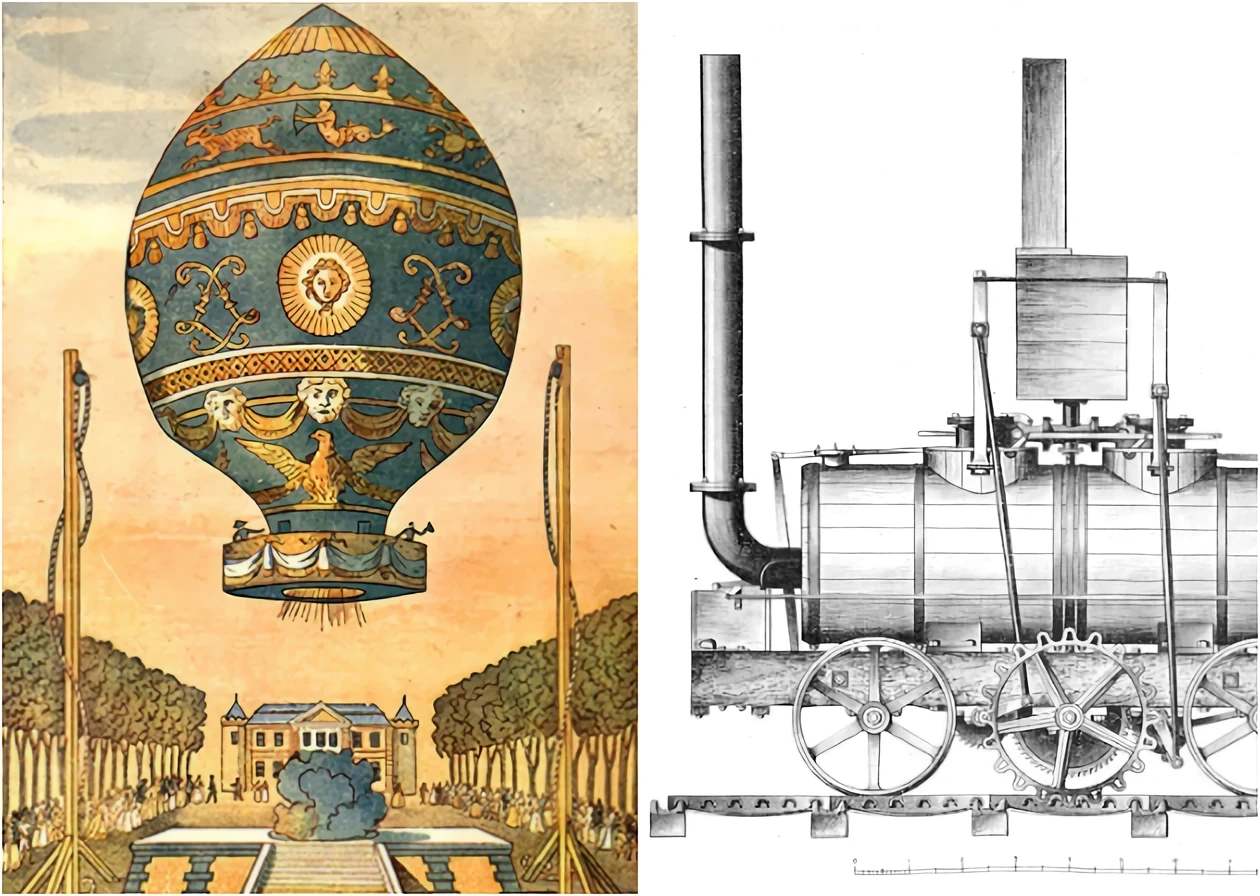
In my uninformed view I came to a different conclusion. Lack of technical development until recent history is more of a problem of materials science first and easily accessible/cheap energy second.
We classify ages of humanity by advances in material science. Prehistory is noting advances in humanity using ceramics as signs of advancement. "The Bronze Age" when humanity figured out that combining copper and tin produced a metal stronger than either alone. This lead to "The Iron age" where mining and refining metal produced even stronger tools and allowed humanity to access/create even stronger/lighter/cheapers materials. Refined Aluminum was more valuable that gold (I think) when it was first discovered and isolated.
Humanity advances with better materials unlocking yet more better material.
It may be worth pointing out that the metal ages are used primarily for old world archaeology. The Americas utilize a different system that isn't so bound to metallurgical ages.
Lithic > Ancient > Formative > Classic > Post-Classic
Each era is about mlre than material sciences, and specifically metallurgical ones, of the old world. (But let's be clear, the Bronze age is so, so much more than bronzeworking. Sometimes that gets lost in the nomenclature.)
Arguably one could apply the american measurements similarly to old world history too, since these are all approximations for coherent discourse.
In the 1800s you suddenly had a middle class where farmers, small business owners, and local artisans had access to a wide variety of tools and books, things their ancestors could have never afforded.
I mean... yeaahhh?