459
me_irl
(lemmy.radio)
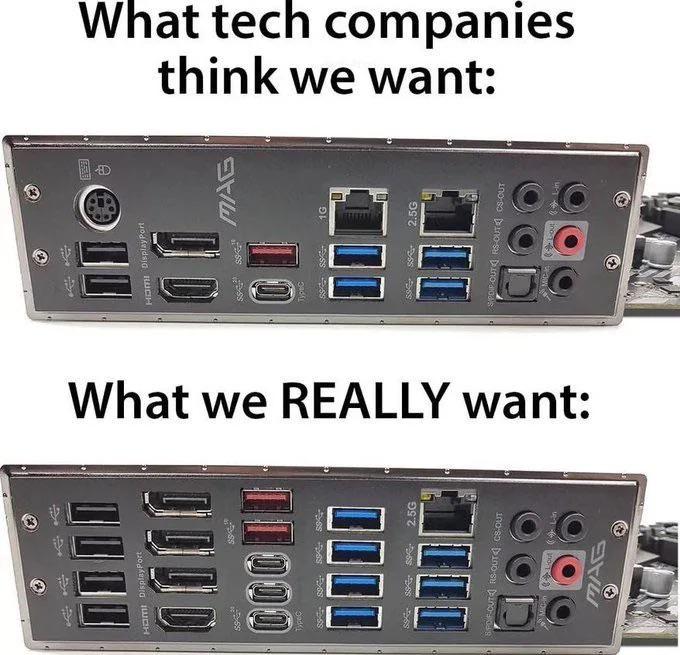
All posts need to have the same title: me_irl it is allowed to use an emoji instead of the underscore _
I've was recently looking into different ways to get audio from a secondary media PC into an Audio Interface. I decided I wanted to keep the signal digital to use the higher quality DAC in the Audio Interface and decided TOSLINK would be the way to go. It seems like TOSLINK would be a good one size fits all solution for connecting a PC, game consoles, AV receivers, and HDMI splitters because they all seem to still include TOSLINK out ports.
I'm aware of the drawbacks, namely lower bandwidth and jitter. From what I read as long as you're just doing stereo audio like I plan to, TOSLINK can handle an uncompressed signal no problem. For the jitter, it seems modern devices with TOSLINK inputs have ways of mitigating jitter.
You seem knowledgable on the subject. Is what I wrote above accurate or is there something I'm missing when it comes to TOSLINK audio?
For stereo, TOSLINK is fine. But so is the copper port right next to it. I removed it because it's basically unused fluff for more than 99.9% of all users. I used that port (on a dedicated sound card) once to connect a DTS 5.1 active speaker system (marketed at gamers like me) back in the 00s. It doesn't really have enough bandwidth for 5.1. But I'm no audiophile, so it was fine. Thing is: Just plugging in the copper cables works as well and provides the full bandwidth.\
And motherboard-integrated DACs are pretty good now. Even audiophiles can't hear the improvement in stereo in blind tests (they probably can hear copper sounding better in 5.1 though).
It's basically the Betamax of audio connection standards. Technically better, but market adoption is negligible.
toslink was cutting edge in, oh, 1985. Bit on the limited side for bandwidth now.
You're not wrong, but if it has the bandwidth for stereo 24 bit 96kHz lossless digital then why does it matter? The main problem is it gets the clock rate or whatever from the signal itself making it susceptible to jitter, but I think modern devices mitigate that.