743
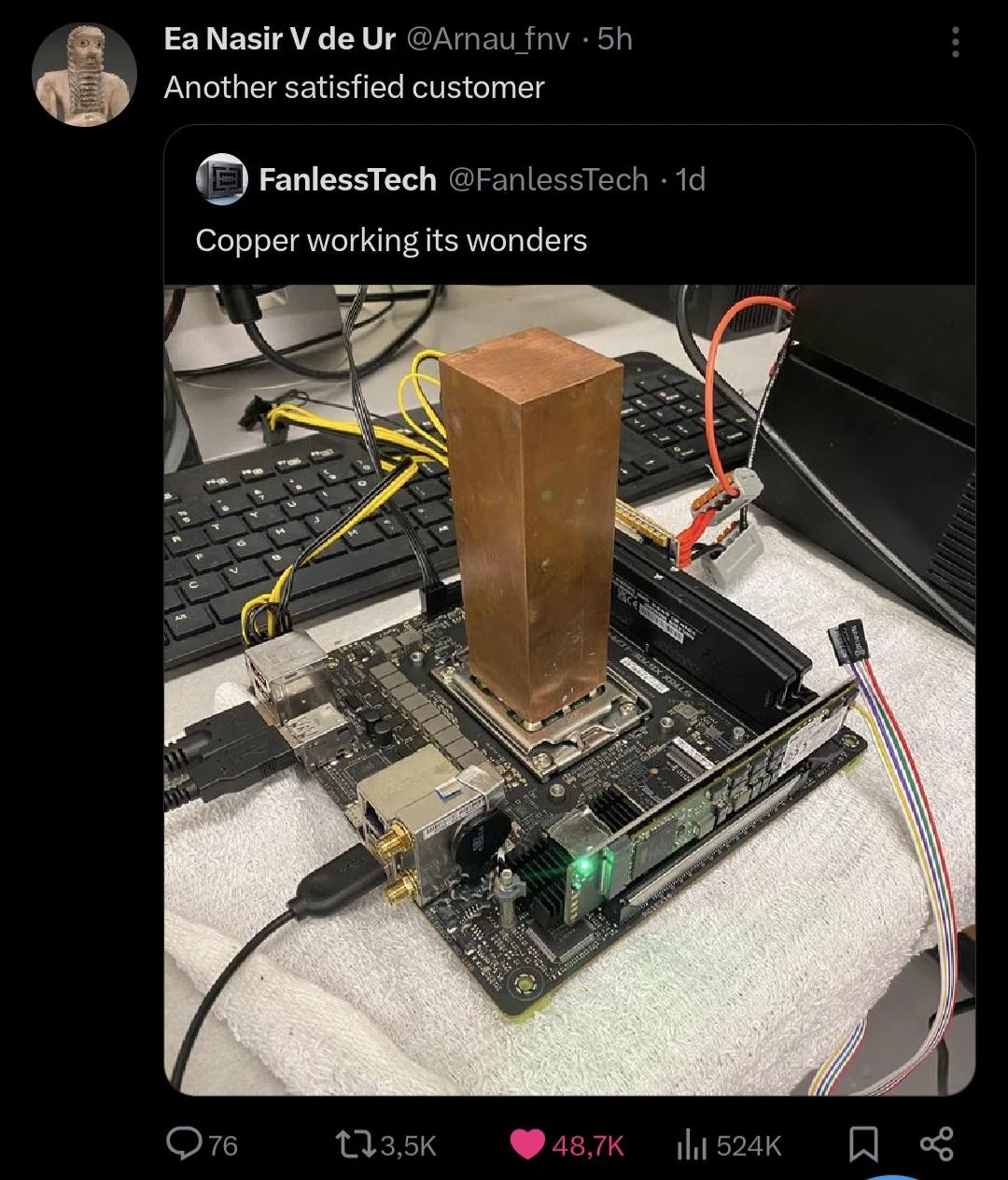
Copper
(media.piefed.social)
A place to share history memes!
Rules:
No sexism, racism, homophobia, transphobia, assorted bigotry, etc.
No fascism (including tankies/red fash), atrocity denial or apologia, etc.
Tag NSFW pics as NSFW.
Follow all Piefed.social rules.
History referenced must be 20+ years old.
Banner courtesy of @setsneedtofeed@lemmy.world
OTHER COMMS IN THE HISTORYVERSE:
Copper has more mass, heat capacity, and thermal conductivity per litre.
Is aluminium actually more effective as a dissipation surface? I hadn't heard that.
Copper is better conductor but it's worse at dissipation. Do the experience yourself, heat a block of each and then touch them afterwards.
Is that not because the copper holds more heat, so stays hot for longer at the same dissipation?
Maybe you're right, but I remember than in the 2000s I've had identical cpu heatsinks in both copper/aluminum versions, and the aluminum one had better performance. And then they started to make hybrid ones, stating that the copper part was to allow rapid heat transference and the aluminum parts to improve dissipation. But maybe it was all marketing.
Aluminium is significantly cheaper, that's why they make coolers with a copper base and alu fins. It's a good compromise.
Aluminium is cheaper and lighter.
This seems to suggest that the metal-air transmission is virtually identical between the two, and cites some sources: https://electronics.stackexchange.com/questions/255731/copper-or-aluminum-heatsink
Dissipation = thermal conductivity. Copper is better in both, it's just heavier and far more expensive. Are you sure you put the same amount of energy into both blocks there? A copper heatsink can generally be much smaller than an aluminium one.