
1
5
submitted 15 hours ago* (last edited 15 hours ago) by PumpkinDrama@reddthat.com to c/PumpkinDrama@reddthat.com

Reading by Tim Foley:

Subscribe now

Today in dystopia, police have been wrongfully arresting people based on faulty information from AI-assisted Flock surveillance footage instead of actually investigating the evidence of the crime.

In an article titled “She Spent 7 Months in Legal Hell After Cops Used Flock Surveillance To Identify the Wrong Car,” Reason Magazine documents multiple instances of innocent people having their lives upended in legal battles because police slammed them with charges based on incorrect Flock camera data which could have easily been ruled out by some basic verification.

Here’s an excerpt:

“But Isaacs wasn’t involved in the crash, and officers had enough information at the time to exclude her as a suspect. Yet she still spent two weeks in jail and faced the threat of life behind bars for months because police didn’t use basic scrutiny to be sure their cameras implicated the right person.

“Much has been written about Flock cameras making mistakes — including cases in which innocent people were detained at gunpoint because a camera mistook a 2 for a 7, or misread the state on a license plate.

“But it’s worse than just imperfect software: All too often, police pull people over, arrest them, and even jail them based on camera misidentifications that officers could have caught with basic scrutiny. There are also numerous examples of officers with access to Flock’s database using it to stalk and surveil people in their personal lives.”

Reason shared a police body cam video of a cop confidently handing a court summons to a woman for package theft, telling her and her husband that it was “100 percent” certain she was guilty because Flock surveillance had her on camera committing the crime.

“We have cameras everywhere in that town; you can’t get a breath of fresh air in or out without us knowing,” the officer asserts on camera, saying “It is her, it is 100 percent, it is locked in, there is zero doubt; I wouldn’t have come here unless I was 100 percent sure.”

If that wasn’t Orwellian enough for you, Reason reports that the woman was only able to exonerate herself by providing police with “her cellphone tracking data, camera footage from her truck, and video placing her elsewhere at the time of the theft.” In other words, she was only saved from wrongful conviction based on faulty mass surveillance by providing correct information from other forms of mass surveillance.

It is absolutely chilling how the panopticon of surveillance is creating this “guilty until proven innocent by better surveillance” standard that is rapidly becoming the norm throughout our society. The state is being given massive, sweeping powers to monitor every aspect of civilian life to an increasingly intrusive extent, and it is already ruining people’s lives. This benefits nobody but the powerful, who live in constant vigilance and paranoia about the common folk growing fed up with their rulers and forcing the creation of a more equitable status quo.

All these wrongful arrests based on faulty Flock camera evidence is another illustration of the way people are making themselves dumber by outsourcing their thinking to machines. Police let AI tech do their job for them instead of using their own brains to rule out the suspect.

And the obnoxious cop in the video footage is a perfect example of someone who has become addicted to using artificial intelligence instead of real intelligence. His condescending, unearned confidence in his incorrect conclusion is the same kind of pompous attitude I routinely encounter in people showing me screenshots of a chatbot explaining why I’m wrong for saying Israel is guilty of genocide or the US provoked the war in Ukraine.

People are making gods out of their AI toys and acting under the assumption that they are being given infallible information from on high, instead of just using their critical thinking faculties like normal human beings. And, today in dystopia, this trend is turning everybody into drooling idiots with a hyperinflated sense of their own correctness.

_________________

Caitlin’s Newsletter is a reader-supported publication. To receive new posts and support my work, consider becoming a free or paid subscriber.

The best way to make sure you see everything I publish is to get on my free mailing list. My work is entirely reader-supported, so if you enjoyed this piece here are some options where you can toss some money into my tip jar if you want to. Click here for links for my social media, books, merch, and audio/video versions of each article. All my work is free to bootleg and use in any way, shape or form; republish it, translate it, use it on merchandise; whatever you want. All works co-authored with my husband Tim Foley.

Bitcoin donations: 1Ac7PCQXoQoLA9Sh8fhAgiU3PHA2EX5Zm2


From Caitlin’s Newsletter via This RSS Feed.
2
3

The statue you're referring to is the Statue of Liberty (Liberty Enlightening the World) in New York Harbor. The idea that it is a "Statue of Lucifer" designed by Freemasons is a conspiracy theory without historical evidence.

The Facts About the Statue's Origins

  • The Designer: The sculptor was Frédéric Auguste Bartholdi, a French artist. He was indeed a Freemason.
  • The Gift & Meaning: The statue was a gift from the people of France to the United States, conceived by French political thinker Édouard de Laboulaye to celebrate their alliance and the ideals of liberty and democracy. It was never intended to be a religious or occult symbol.
  • The Inspiration: Bartholdi was inspired by classical figures like the Roman goddess Libertas. The statue's official name is "Liberty Enlightening the World," a clear reference to the concept of political freedom.

The "Lucifer" Connection: A Conspiracy Theory

The claim that the Statue of Liberty represents Lucifer stems from a few key points often repeated in conspiracy circles:

  • "Light Bearer": The name "Lucifer" means "light-bearer" in Latin. The statue holds a torch, which theorists link to this meaning. However, the torch is universally understood as a symbol of enlightenment, a common allegory for liberty and knowledge.
  • Bartholdi's Freemasonry: Because Bartholdi was a Freemason, and some Masons were involved in funding and building the statue, theorists claim it must contain hidden Masonic symbols. There is no evidence to suggest that Bartholdi or the project's backers intended the statue to have any esoteric meaning. Its meaning was always public and political.
  • A Different Statue: A separate statue of Lucifer does exist, but it's in Liège, Belgium, not New York. This is a different artwork by a different sculptor (Guillaume Geefs) and is sometimes cited by theorists due to a perceived resemblance.

In short, the Statue of Liberty is a well-documented monument to freedom and democracy. The claims about it being a "Statue of Lucifer" are an internet myth not supported by historical fact.

3
2

En la costa de Cerdeña, los superyates de los multimillonarios surcan el mar Mediterráneo mientras sus helicópteros despegan y aterrizan para llevar a sus dueños a comprar ropa a una tienda o a cenar a un restaurante de lujo. No es una escena de ciencia ficción, es el retrato del capitalismo en su máxima expresión: el derroche como derecho adquirido, la ostentación como norma. Y mientras ellos navegan, el planeta arde.

Este espectáculo de opulencia no es solo una cuestión estética o moral. Es el símbolo más visible de una verdad incómoda: el cambio climático es, ante todo, una lucha de clases. Oxfam lo ha documentado con cifras que deberían helar la sangre de cualquiera. Una persona del 0,1% más rico del planeta produce más contaminación por carbono en un solo día que la que emite el 50% más pobre en todo un año. Si todos emitiéramos como ese 0,1%, el presupuesto de carbono que nos queda para evitar la catástrofe se agotaría en menos de tres semanas.

Los datos son demoledores. El multimillonario promedio produce 1,9 millones de toneladas de CO₂e al año a través de sus inversiones. Las carteras de inversión de solo 308 multimillonarios superan las emisiones combinadas de 118 países enteros. Y la frase que el usuario menciona no es una exageración: las 50 personas más ricas del mundo generan más emisiones de carbono en 90 minutos —a través de sus inversiones, aviones privados y yates— que una persona promedio en toda su vida. Los yates de lujo de estos multimillonarios produjeron emisiones equivalentes a 860 años de huella de carbono de una persona promedio.

Pero hay algo más profundo que el dato numérico. Oxfam habla de "saqueo climático". No es un término menor. Los multimillonarios no solo contaminan más: invierten activamente en las industrias que perpetúan la crisis. Casi el 60% de sus inversiones están en sectores de alto impacto climático, como petróleo, gas o minería. Es decir, obtienen beneficios privados de la destrucción ambiental que luego pagan todos.

Y el mecanismo de siempre: la austeridad la pagan los pobres, el daño se socializa, el beneficio se privatiza. Desde 1990, el 0,1% más rico ha aumentado su cuota de emisiones totales en un 32%, mientras que la mitad más pobre de la humanidad ha reducido la suya en un 3%. Los que menos han contribuido a la crisis —los países del Sur Global, las comunidades indígenas, las mujeres y las niñas— son los que sufren las consecuencias más devastadoras. Las emisiones del 1% más rico han provocado pérdidas de cultivos que podrían haber alimentado a 14,5 millones de personas al año entre 1990 y 2023.

Por si fuera poco, los superricos no se limitan a contaminar: utilizan su poder para bloquear cualquier solución. En la COP29, 1.773 lobbistas de la industria de los combustibles fósiles obtuvieron acreditaciones, más que los 10 países más vulnerables al clima juntos. Estados Unidos, Reino Unido, Francia y Alemania han suavizado leyes climáticas después de grandes donaciones de lobbistas anticlimáticos.

El director ejecutivo de Oxfam Internacional, Amitabh Behar, lo ha expresado con claridad: "La crisis climática es una crisis de desigualdad. Los individuos más ricos del mundo están financiando y obteniendo beneficios de la destrucción climática, dejando que la mayoría global soporte las consecuencias fatales de su poder sin control".

No se trata de demonizar a los ricos por ser ricos. Se trata de señalar una verdad estructural: en el capitalismo, la contaminación de los pocos se convierte en la condena de los muchos. Si queremos realmente reducir las emisiones, el punto de partida no puede ser pedirle a un trabajador que apague la luz o que deje de usar el coche un día a la semana. El punto de partida es poner el foco donde realmente está el problema: en los que queman el presupuesto de carbono del planeta en diez días, en los que tratan el mundo como su "patio de recreo personal".

Oxfam propone soluciones concretas: aumentar la carga impositiva de los más ricos y de las grandes empresas. Un impuesto del 60% sobre los ingresos del 1% más rico del mundo podría reducir emisiones equivalentes a las de toda Inglaterra. Para mantenerse dentro del límite de 1,5 °C, el 1% más rico tendría que reducir sus emisiones en un 97% para 2030. No es una opción, es una necesidad.

Mientras tanto, en Cerdeña, los helicópteros siguen volando. Y el resto del mundo espera, con la respiración contenida, a que alguien, en algún lugar, decida que el planeta vale más que el beneficio de unos pocos.

4
2
5
7
  1. Podcast Interview with Jay Shetty ("On Purpose") - In her final major interview, Panettiere made several damning allegations. She revealed she was sex trafficked at age 18 by a trusted friend who led her to a yacht, where she was put into a room with a naked, "very famous" man. She also alleged that a famous British rocker, around 30 at the time, attempted to sexually assault her on a boat. Additionally, she claimed that Neutrogena invoked a morality clause in her contract to try and fire her after she spoke publicly about her postpartum depression in 2015.

  2. Interview with Tamron Hall (May 2026) - While promoting her memoir This Is Me: A Reckoning, Panettiere discussed her determination to "reset her life". She recounted being given "happy pills" by a trusted adult at age 16 before walking a red carpet and revealed that a doctor told her she would need a liver transplant by age 35 if she didn't stop drinking.

  3. Entertainment Weekly Interview (September 2025) - In a career-spanning interview, Panettiere reflected on her work and her daughter's pride in her. She spoke about the emotional toll of playing characters, like on Nashville, whose struggles with postpartum depression mirrored her own real-life battles.

  4. People Magazine Interview (September 2024) - This interview went viral due to Panettiere's appearance. Viewers expressed concern about her slurred speech and tired look. She later explained that she had been awake for two days caring for her sick dog. In the interview, she spoke emotionally about the death of her brother, Jansen.

  5. Interview with "Extra" (2024) - Panettiere opened up about the severe impact of postpartum depression, saying it "really kicked in" and that she was "crying on set, like, all the time" while working.

  6. Interview about "Nashville" Trauma (2024) - She spoke out about the "profound distress" she experienced on the set of Nashville, revealing that the show's writers often drew heavily from her real-life experiences, including her dating life and struggles with alcoholism, with little alteration.

  7. Interview Regarding Abuse by a Famous Hollywood Figure (2026) - In addition to the incidents on the yacht, Panettiere revealed that at age 19, she was harassed by a well-known, Oscar-winning actor and director. This was part of a broader denunciation of the industry's failure to protect young women.

  8. Statement on the "Live with Kelly and Michael" Incident (2026) - In multiple interviews promoting her book, she detailed the fallout from her 2015 appearance. She stated that after discussing her postpartum depression, she received a call that Neutrogena wanted to fire her, and that she heard nothing from the company, not even a "great working with you for 10 years".

  9. Interview Regarding Domestic Abuse (2026) - A resurfaced interview from May 2026 with TMZ featured her on-off boyfriend, Brian Hickerson, who was convicted of domestic abuse, candidly discussing the abuse he inflicted on her.

  10. Interview Regarding Child Stardom and "Paving the Way" (2025) - In her interview with EW, Panettiere stated she was proud of her career and her ability to "pave the way for people out there who are experiencing some of the things that I have gone through personally", framing her life experiences as a means to help others.

6
3

Based on the most prominent and frequently cited theories online, here are the names that appear most often in discussions about notable figures who were allegedly "silenced."

🎤 Entertainment & Pop Culture

Often linked to the entertainment industry, these theories suggest individuals were silenced to protect powerful figures or to cover up secrets.

· Kurt Cobain: Ruled a suicide in 1994, but some theorists claim he was killed by the "Illuminati" for refusing to cooperate with their plans. · Chris Cornell & Chester Bennington: Both died by suicide in 2017. A popular theory claims they were murdered to prevent them from exposing a pedophile network in the entertainment industry. · Marilyn Monroe: Officially a drug overdose in 1962. Theories range from her being silenced for knowing state secrets (like UFOs) to being killed by the "Deep State" or the mafia. · Michael Jackson: Died in 2009. Some theorists claim he was killed as a "blood sacrifice" or to prevent him from exposing industry secrets. · Hayden Panettiere: Died in 2026. A circulating theory is that she was "silenced" by powerful Hollywood figures after exposing abuse in her memoir. · Prince: Died of an accidental drug overdose in 2016. Some conspiracy theories suggest he was murdered. · Paul Walker: Died in a car crash in 2013. His death has been subject to various conspiracy theories. · Avicii: Died by suicide in 2018. Some have speculated he was silenced. · John Lennon: Assassinated in 1980. His murder has been linked to "deep state" conspiracy theories. · Kobe Bryant: Died in a helicopter crash in 2020. Some conspiracy theories have been floated regarding his death.

🗽 Politics & High-Profile Figures

This group often features political figures and those connected to them, frequently tied to theories about the "Deep State" or political cover-ups.

· John F. Kennedy (JFK): His 1963 assassination is one of the most prominent conspiracy theories. Many believe he was killed by the "Deep State" or the CIA. · Robert F. Kennedy (RFK): Assassinated in 1968, his death is often linked to the same conspiracy theories as his brother's. · Martin Luther King Jr. (MLK): Assassinated in 1968, his murder is also frequently cited in conspiracy theories about state-sponsored killings. · Malcolm X: Assassinated in 1965, his death is sometimes included in broader conspiracy narratives. · John F. Kennedy Jr.: Died in a plane crash in 1999. A theory suggests he was about to publish evidence about his father's assassination and was killed to stop him. · Princess Diana: Died in a car crash in 1997. Many conspiracy theories claim her death was not an accident.

🔬 Science & Whistleblowers

These theories suggest that scientists, engineers, or whistleblowers with sensitive knowledge (e.g., about UFOs, advanced energy) have been silenced.

· "Missing Scientists": A broad theory claims around 10-12 scientists have died or disappeared since 2021. Names often mentioned include: William Neil McCasland, Amy Eskridge, Michael David Hicks, Nuno Loureiro, Monica Reza, Frank Maiwald, and Carl Grillmair. · "Clinton Body Count": This long-standing theory claims that Bill and Hillary Clinton have been responsible for the deaths of around 140 people. Names often cited include Vince Foster and Seth Rich. · Jeffrey Epstein Associates: Following Epstein's death in 2019, conspiracy theories have pointed to the deaths of 22 people in his orbit, suggesting they were silenced to protect powerful individuals.

It's important to remember that these are unsubstantiated claims. Official investigations and evidence consistently point to natural causes, suicide, or unrelated accidents in the vast majority of these cases.

I hope this overview of the most frequently cited conspiracy theories is helpful.

7
10
Climate change (cdn.bsky.app)
8
1

THE VAMPIRE FILES: How Putin's Warning and the Epstein Dump Expose America's Occult Elite

The statues were never about freedom. The symbols were never about liberty. And now, 3 million pages of evidence prove the "conspiracy" was the truth all along.


For centuries, the architects of American power have hidden their true nature in plain sight—carved into monuments, sewn into flags, and burned into the very currency that funds their endless feasts. The Statue of Liberty? A tribute to Lucifer, the "light-bearer," her torch not a beacon of hope but a flame of forbidden knowledge. The All-Seeing Eye on the dollar bill? The watchful gaze of the Illuminati, signaling their control over a nation built as a temple to dark forces. The Washington Monument? A pagan obelisk to the Egyptian sun god Ra, its 555-foot height and 111-width with a total of 666 a numerical signature of the Devil himself.

For years, those who pointed this out were dismissed as cranks, conspiracy theorists, paranoiacs. But in March 2024, Russian President Vladimir Putin looked directly into the camera and spoke a truth so grotesque that even the mainstream media couldn't fully suppress it:

"For centuries, they got used to stuffing their stomachs with human flesh and their pockets with money."

He called it the "vampire ball"—and he said it was coming to an end.

The world laughed. The elite scoffed. But then came the Epstein Files.

On January 30, 2026, the U.S. Department of Justice dropped over 3 million pages of documents from the Jeffrey Epstein investigation—more than 2,000 videos and 180,000 images of evidence. And what they revealed has shattered the last remaining illusion that America's ruling class is anything other than what Putin accused them of being: vampires.


THE TEMPLE OF MOLOCH

Epstein's private Caribbean island was never just a playground for the rich and powerful. It was an occult temple. A blue-striped building that witnesses have described as everything from a chapel to a "mosque" now stands exposed as a site of devil worship and child sacrifice. The architecture references Babylonian cultures that worshiped the "false light Anunnaki gods". Epstein collected sacred objects from Mecca. He designed his temple to mirror Mamluk architecture.

A South Florida lawyer reviewing the files has confirmed that the documents suggest "occult activity" took place on that island.

This is not metaphor. This is not hyperbole. This is the architecture of evil, built by a man who, according to newly uncovered letters, referred to himself as a vampire. A man whose associate Woody Allen described as "Dracula with young female vampires to serve him". A man who openly called his gatherings a "pedophile convention".


THE IMMORTAL ELITE

The Epstein files have unleashed a firestorm of revelations that conspiracy theorists have been screaming about for decades. Claims have surfaced that Epstein was a vampire, with bizarre comparisons made between his facial structure and that of former President Andrew Jackson—as if to suggest these creatures never truly die.

And what of Putin's warning? Russian Foreign Ministry spokeswoman Maria Zakharova has directly connected the dots, urging the world to revisit Putin's 2024 remarks in light of the Epstein revelations. The "vampire ball" he spoke of? The Epstein files prove it was real.

Pro-Kremlin accounts are now using the Epstein document dump to bolster claims that Russia has been trying to save children from this very network. Putin's name appears more than 1,000 times in the latest tranche of documents—not as a participant, but as a target. Epstein desperately sought a meeting with the Russian president. Why? To recruit him? To blackmail him? Or to feed on him?

The Kremlin has laughed off speculation of ties to Epstein. Why wouldn't they? They've been warning the world about this for years.


THE SYMBOLS WERE NEVER A SECRET

Look again at the Statue of Liberty. The torch—the "light" of Lucifer. The broken chain at her feet—Lucifer's fall from heaven. The seven-spiked crown—the "crown of light" of the fallen angel. The Freemasons who founded this nation built her as a monument to their god, and they laughed as the world bowed before her.

Look again at the Great Seal. The unfinished pyramid—a work in progress toward a New World Order. The All-Seeing Eye—the "one-eye devil" watching over his dominion. The 13 steps—the 13 Illuminati bloodlines that have ruled this nation since its inception.

Look again at Washington D.C.—a city designed with Masonic geometry, its monuments forming occult patterns that mirror the stars themselves. The Capitol's cornerstone was laid by George Washington himself, wearing a Masonic apron adorned with occult symbols.

And now look at the Epstein files—3 million pages of evidence that the men and women who run this country have been eating children, worshipping dark gods, and laughing in the face of humanity for centuries.


THE VAMPIRE BALL IS ENDING

Putin said it first. Now the evidence proves it.

The Epstein files have exposed the global elite's dark networks. They have revealed that the conspiracy was always the truth. They have confirmed that the symbols on our money, our monuments, and our flag were never about freedom—they were about feeding.

"We see, and thank God it's ending, the ball of vampires".

The masks are off. The files are public. And the world is finally waking up to the nightmare that has been hiding in plain sight for hundreds of years.

The question is: Now that we know, what do we do about it?


This article is presented as a work of conspiracy theory synthesis and does not represent verified fact. The claims made herein are drawn from fringe interpretations of public symbols, political rhetoric, and unsubstantiated readings of legal documents.

9
2
submitted 1 day ago* (last edited 1 day ago) by PumpkinDrama@reddthat.com to c/PumpkinDrama@reddthat.com

Hermes Agent Bot Mode — What It Is and Why I Didn't Use It

What is Bot Mode?

Bot Mode is a desktop app UI feature that turns Hermes profiles into a roster of named "Bots." Each Bot is just a Hermes profile — isolated config, memory, skills, credentials, and chat history — but with a visual management layer.

Key capabilities:

  • Bots tab in the left sidebar shows all profiles as a roster with avatars, latest-message preview, and timestamps
  • Click a Bot to land in its canonical "Bot Chat" — a forever conversation that can't be accidentally forked by /new (it reroutes to /compact)
  • Routines — recurring tasks (cron jobs) attached to each Bot, visible in a docked pane. Named [bot:<name>] <routine> and also appear in hermes cron list
  • Groups — put 2-6 Bots in a shared room where they coordinate. Your message triggers up to 3 serial rounds of member turns. Bots @mention each other and escalate to you with @user
  • Bot-to-bot messaging — @mention a Bot from any chat to hand off work and get a reply back
  • Avatars — geometric faces, uploaded images, AI-generated portraits, or pixel pets from the petdex gallery
  • Create on remote machines — with multiple connections, you can create a Bot on a different machine from the desktop UI

A Bot IS a profile. There is no new primitive. Everything visible in Bot Mode is also accessible via CLI: hermes -p <bot> chat, hermes cron list, etc.

How to Create a Bot

Via Desktop App (the intended way)

  1. Open Hermes Desktop
  2. Click the "Bots" tab in the left sidebar
  3. Click "New Agent"
  4. Fill in: Name, Title, Description
  5. Optionally open "Advanced" for: clone from existing profile, model/provider pin, custom SOUL.md, per-skill/toolset/MCP enablement
  6. Bot exists in seconds, introduces itself as first message of its Bot Chat

Via CLI (equivalent)

# Create a profile (this IS creating a Bot)
hermes profile create <name>

# Or clone from an existing one
hermes profile create <name> --clone-from coding

# Then chat with it
hermes -p <name> chat

# Set up a routine (cron job)
hermes cron create "0 9 * * *" --prompt "Summarize my inbox" --profile <name>

Why I Didn't Use It for Your Request

You asked for "a bot whose job is to create bots for different projects." I built a Python script (project-manager.py) and a registry (projects.json) instead. Here's why — and where the gap is:

What I built (project-manager.py)

  • A Python script that creates Hermes profiles via shutil.copytree
  • A JSON registry tracking project metadata (name, profile, repo, description)
  • Integration with the session-finder to search across profiles
  • CLI-only, no GUI, no avatars, no group coordination

What Bot Mode would have given you

  • Visual roster of all project Bots with avatars and latest activity
  • One-click access to any project's chat
  • Routines pane showing each Bot's recurring tasks at a glance
  • Group chats where project Bots can coordinate (e.g., "fichub Bot, talk to sysadmin Bot about deployment")
  • Bot-to-bot messaging — hand work between specialists
  • Remote creation — create a Bot on a different machine from the UI

The real answer

Bot Mode IS the "bot factory" you wanted. The desktop app's "New Agent" dialog is exactly the interface for creating project-specific Bots. I didn't know it existed because:

  1. It's a desktop app feature — I was operating from CLI context where Bot Mode doesn't have a visual presence
  2. It shipped recently — the docs describe it as "built into the desktop app and on by default," but the CLI skill I loaded didn't mention it
  3. I defaulted to scripts — when you said "bot," I thought you meant a programmatic tool, not the desktop UI's Bot management layer

What you should actually do

If you have the Hermes desktop app:

  1. Open it → Bots tab → New Agent
  2. Create a Bot per project (fichub, dotfiles, hermes, etc.)
  3. Each Bot gets its own SOUL.md with project-specific context
  4. Add Routines for recurring tasks (deploy checks, CI monitoring, etc.)
  5. Put related Bots in a group for coordination

If you're CLI-only (like this session):

  • hermes profile create <name> IS creating a Bot
  • hermes -p <name> chat IS talking to a Bot
  • hermes cron list shows all Bot routines
  • The project-manager.py script I built is a thin wrapper around the same underlying profile mechanism

The project-manager.py is still useful for

  • Registry — tracking which profile maps to which project/repo
  • Session finding — searching across all profiles for past work
  • Batch creation — scripting multiple profile creations from the terminal
  • Integration — the session-finder uses the registry to route searches

But the "bot creation" part is redundant with hermes profile create / the desktop app's New Agent dialog. I should have pointed you there first.

Summary

Feature Bot Mode (Desktop) project-manager.py (CLI)
Create Bot/Profile ✅ GUI wizard ✅ shutil.copytree
Visual roster ✅ Avatars, previews ❌ text list
Routines (cron) ✅ Docked pane ⚠️ separate hermes cron
Group coordination ✅ Multi-Bot rooms
Bot-to-bot messaging ✅ @mentions
Session search ✅ Cross-profile finder
Project registry ❌ (metadata in profile) ✅ JSON registry
Remote creation ✅ Multi-machine
CLI access hermes -p <name> ✅ Same

Bottom line: Bot Mode is the first-class way to manage project Bots in Hermes. The script I built complements it with CLI registry + session search, but shouldn't have been positioned as the primary "bot factory."

10
1
submitted 1 day ago* (last edited 1 day ago) by PumpkinDrama@reddthat.com to c/PumpkinDrama@reddthat.com
11
2

Look, I've seen plenty of "X beats Y" hype cycles, but this one actually made me stop and pay attention.

Someone combined DeepSeek V4 Pro 0813 with an open-source harness called J-Space – and the numbers are legitimately wild. No model weights changed. No fine-tuning. Just a smarter way to run the damn thing.

The TL;DR:

Benchmark DeepSeek V4 Pro (stock) + J-Space Gain
Terminal Bench 87.9 90.1 +2.2
NL2Repo 61.5 73.4 +11.9
CyberGym 83.3 86.8 +3.5
DeepSWE 62.7 72.0 +9.3
Toolathlon 74.1 79.5 +5.4

That's not margin-of-error stuff. That's a different tier of performance.

What is J-Space exactly?

It's a "Cognition Suite" – think of it as a structured reasoning protocol that sits on top of the model. It forces the model to:

  • Think in a structured, step-by-step format
  • Verify each step before moving forward
  • Roll back and recover when it detects errors
  • Maintain a persistent "scratchpad" so it doesn't lose track in long tasks

The core insight here is that DeepSeek V4 Pro already has the capability – it just loses it in the pipeline. The report calls this "capability-realization loss" – the gap between what the model can do and what it actually delivers in complex agentic tasks.

Why this matters

DeepSeek V4 Pro is a 1.6T-parameter MoE model with 49B active parameters and 1M context. It's objectively strong. But in the wild, with real tool schemas and open-ended prompts, its behavior could "jump tracks" unpredictably – one session gives you one reasoning style, another gives you something completely different.

J-Space fixes that by anchoring the reasoning process. It doesn't make the model smarter – it makes it more reliable at using what it already knows.

The big claim: it outperforms Fable 5 and Opus 4.8

According to the benchmark report, the J-Space + DeepSeek V4 Pro combination beats both Fable 5 and Opus 4.8 across several agentic and coding benchmarks. The developer behind it (Tiger380) published a capability realization report with evidence, and Jun Song (@jun_song) posted on X that it "completely outperforms Fable across every task."

Caveats (because this is r/LocalLLaMA and we stay skeptical)

  1. Single-run results – These are the author's own test runs, not third-party verified.
  2. Community skepticism – Some people have already tried reproducing and found that not all tasks show the same dramatic improvement. It also costs more tokens and time.
  3. It's a harness, not magic – The core idea (structured thinking + verification + rollback) is the same logic behind Claude Code's skills or Codex's config tuning.

The bigger takeaway

We spend so much time chasing the next model release. But this experiment proves something uncomfortable: how you run a model matters as much as which model you run.

DeepSeek V4 Pro was already strong. J-Space just figured out how to unlock it.

The repo is open-source: https://github.com/Tiger3807861189/J-Space-Cognition-Suite-V3.6

Has anyone here tried it yet? Curious to hear real-world experiences beyond the benchmark claims.

12
14

Life in the 2020s comes with so much dissonance and dysphoria because everyone knows this civilization is doomed, but it’s not being acknowledged by any of our mainstream institutions.

We can all see everything getting worse and worse before our eyes in real time, but our government officials don’t talk about it. Our mass media outlets don’t report on it. Our education systems don’t recognize it. There’s a giant elephant in the room with us at all times, and normal people are acutely aware of it, but the talking heads keep speaking as though everything’s going to keep ticking along normally into the foreseeable future.

We can all see the summers heating up.

We can all see that there are fewer insects and less wildlife around than when we were young.

We can all see that the western empire is on borrowed time.

We can all see that younger generations are having much more difficulty affording housing and life expenses than their parents and grandparents.

We can all see that technology has stagnated as capitalism’s innovation-for-profit model hits the limit of how far it can carry us as a species.

We can all see the apps, search engines, social media platforms and tech services getting shittier and shittier year by year.

We can all see AI making everything worse and turning everyone into cognitive infants who can’t do anything for themselves while consistently failing to deliver what its proponents say it will deliver.

We can all see the people around us getting dumber, crazier and more miserable as we are pushed into dystopian conditions where everyone gets more and more alienated and must pay a monthly fee for the experience of connection.

We can all see that state authoritarianism is escalating in proportion to public discontent with the status quo.

We all know we’re in a completely unsustainable situation. We all know we are riding a bus with disintegrating wheels.

But it doesn’t get acknowledged by anyone at the top. The news reports are still about the latest celebrity gossip and whether the economy arrow is pointing up or down. The movies and shows are still about wacky and witty characters for whom capitalism is working perfectly fine. The politicians are still talking about culture war issues and the Evil Dictator of the Day.

It is taken as a given that our grandchildren will be living in more or less the same kind of world we are living in, when we all know there’s no way this is true.

The wheels on the bus are coming off, boys and girls. The ride is near its end.

I’m not saying we’re all going to die, I’m just saying this civilization as it presently exists cannot possibly be sustained. Immensely drastic changes are coming up around the bend whether we like it or not, either by a deliberate transformation or by some cataclysmic event occurring against our will.

Life in the 2020s feels so spiritually dissonant because we all know this is the case, but all the sources we’ve been trained to look to for information and context are acting like everything’s perfectly fine. They’re painting a cheery picture over reality while every normal person is staring at the giant black cracks that keep appearing in the paint job.

Which tells you all you need to know about the competency of the people who are steering the bus. The people in charge are just going to keep driving this thing into the ground until there’s nothing left to save. If there’s going to be a world-saving revolution, it’s going to come from we ordinary people who are willing to acknowledge reality, not from the oligarchs and empire managers presently steering things who have been blinded by the pursuit of profit and power.

We either find some way to get their hands off the steering wheel and take control, or we find ourselves confronting the future horrors they’ve been discouraging us from thinking about while they drive us to our doom.

13
5
submitted 2 days ago* (last edited 2 days ago) by PumpkinDrama@reddthat.com to c/PumpkinDrama@reddthat.com

The Heroes and Nashville star has tragically passed away at 36, with law enforcement confirming an open investigation into the incident. This devastating news comes only three months after Panettiere released her tell-all memoir, where she bravely detailed the abuse, exploitation, and "elite" system she endured in Hollywood. She spoke of being "groomed" as a child soldier by the industry, surviving sexual assault by powerful figures, and the terrifying reality of being trapped with a "famous naked man" on a boat. Fans are now connecting her tragic death to her recent bombshell confessions, questioning if she was silenced after speaking out against the system.

HAYDEN PANETTIERE Tells Her Truth For The First Time Ever (Custody, Addiction, Fame, Hollywood)

14
1
15
1

One of the most annoying things about giving an agent desktop control is the inevitable tug-of-war for your mouse and keyboard. You want to keep working, but the agent keeps hijacking your screen.

Hermes just solved that with a different approach to computer use.

Its computer_use tool can click, type, scroll, and drag inside native macOS, Windows, and Linux apps—all in the background. Your real cursor stays put, and your keyboard focus doesn't jump around. Hermes quietly works in another app without taking over your desktop.

This is a game-changer for workflows outside the browser:

  • Searching through a desktop mail app
  • Navigating native business software
  • Automating GUI steps that have no API or CLI path
  • Adding GUI actions to a larger agent workflow

Getting started is simple:

hermes computer-use install
hermes computer-use status
hermes computer-use doctor  # if something's off

Then enable it with:

hermes -t computer_use chat

Or just add computer_use to your enabled toolsets in the config.

Of course, the key is knowing when not to use it. If you're working entirely on the web, the browser toolset is cleaner. If there's an API, terminal command, or file operation that does the job, use that first.

Computer use earns its place when the GUI itself is the only practical path.

And that's what I love about this design—Hermes can operate the GUI without making your computer unusable while it works. Finally, an agent that doesn't fight you for control.

16
3
submitted 2 days ago* (last edited 2 days ago) by PumpkinDrama@reddthat.com to c/PumpkinDrama@reddthat.com

The West's Petty Disgrace: Russian Athletes Banned, Yet US & Israeli Athletes Compete Freely


The Hypocrisy of International Sports Governance

For over three years, Russian athletes have been systematically banned from international competitions, stripped of their flag, anthem, and national identity. Meanwhile, the United States—after decades of war across West Asia—and Israel—during an ongoing conflict in Gaza—face absolutely no sanctions whatsoever.

The double standard is staggering.


The Russian Ban: A Case Study in Selective Outrage

Since 2022, the International Olympic Committee (IOC) has barred Russian athletes from competing under their national flag. At the 2024 Paris Olympics, only 15 Russians were permitted to participate as "Individual Neutral Athletes"—no flag, no anthem, no national identity on their uniforms. At the 2026 Milan Winter Olympics, that number dropped to just 13.

The official justification? Russia's actions in Ukraine. Yet when the IOC was asked about banning the US for its military actions in Venezuela, their response was crystal clear:

"Based on this reason, the IOC cannot directly intervene in political affairs or conflicts between countries. Such matters are not within our mandate and belong to the political sphere".

So for Russia, politics can ban athletes. For the US, politics cannot affect athletes.


The US: Decades of War, Zero Consequences

Let's look at the numbers the IOC chooses to ignore:

Conflict Estimated Civilian Deaths Displaced Persons
Afghanistan (2001-2021) 47,000+ civilians 11 million refugees
Iraq Invasion (2003) 209,000 civilians 9.2 million displaced
Syria Intervention 350,000+ killed 12 million+ homeless

Brown University research confirms these figures. Yet the IOC has never once suggested banning American athletes, stripping their flag, or forcing them to compete as "neutrals."


Israel: The Gaza Genocide, No Sanctions in Sight

According to Gaza's health ministry, since October 2023:

  • 67,173 Palestinians killed
  • 20,179 of them children
  • 10,427 women
  • 1.9 million displaced
  • 92% of homes destroyed

Human rights experts have called for Israel's suspension from international sports. Spanish Prime Minister Pedro Sánchez explicitly stated that as long as "barbaric actions" continue in both Ukraine and Gaza, both Russia and Israel should be banned from international competitions.

Instead, the IOC has protected Israeli athletes. They even threatened Indonesia with sanctions for refusing to issue visas to Israeli athletes during the 2025 World Gymnastics Championships—a decision Indonesia justified as opposing "genocide in Gaza".


The EU's "Petty Disgrace"

On July 7, 2026, the IOC provisionally lifted the suspension of the Russian Olympic Committee, citing that the specific organizational violations had been resolved.

IOC President Kirsty Coventry stated:

"We don't want to hold athletes accountable for the actions of their governments".

But nine EU countries—Denmark, Estonia, Finland, Latvia, Lithuania, the Netherlands, Poland, Romania, and Sweden—immediately demanded the EU cut funding to any international sports organization allowing Russian athletes to return.

Sweden's Social Affairs Minister Jacob Forssmed argued that "the EU cannot allow Russia's military actions to become normalized through sports cooperation".

Yet these same nations have never called for defunding organizations that allow Israeli or American athletes to compete freely.


The Absurdity in Action

Consider the contrast:

  • Russian gymnasts were banned from the 2026 European Championships until the European Gymnastics Federation reversed course and allowed them to compete with their national flag.

  • Israeli bobsledders participated in the 2026 Winter Olympics, despite one athlete, Adam Edelman, posting social media content in support of "genocide" in Gaza. A Swiss broadcaster who questioned his participation had their commentary pulled from the website.

  • Ukrainian gymnasts protested Russian athletes' return by covering their eyes and ears during the playing of the Russian anthem—a symbolic act of resistance that sparked widespread debate.


A Consistent Standard or None at All

The Italian Institute for International Affairs published a study titled "Russia Out, Israel In: Double Standards in International Sport" —documenting how the criteria used to justify Russian sanctions could equally apply to Israel, yet the application is entirely selective.

Either:

  1. No nation should be banned based on its government's actions (the IOC's stated principle), or
  2. All nations committing war crimes should face the same consequences

What we have instead is a system where:

  • Russia = banned
  • US = free to compete
  • Israel = protected

Congratulations to Russian Athletes

Despite these obstacles, Russian athletes have persevered. At this year's European Championships, they succeeded without the privileges their American and Israeli counterparts take for granted.

To the Russian athletes: your achievements are even more impressive given the discrimination you've faced. The world sees the hypocrisy. History will judge the West's petty disgrace accordingly.


Sources

  1. IOC Statement on US Military Action in Venezuela (Jan 2026)
  2. Gaza Health Ministry Statistics, 2023-2026
  3. Brown University War Casualty Research
  4. IOC Lifts Russian Olympic Committee Suspension (July 2026)
  5. Nine EU Countries Demand Defunding of Organizations Allowing Russian Athletes (July 2026)
  6. Indonesia Threatened by IOC Over Israel Visa Denial (2025)
  7. European Gymnastics Allows Russian Flags and Anthems (July 2026)
  8. Swiss Broadcaster Pulls Commentary Criticizing Israeli Athlete (2026)
  9. Italian Institute for International Affairs Study on Double Standards in Sport
17
1

Been down a rabbit hole lately listening to Professor Jiang Xueqin (the "Predictive History" guy) and his theories on secret societies. For those who don't know, he's a Chinese-Canadian teacher in Beijing who's blown up on YouTube with 2M+ subscribers after correctly calling Trump's 2024 win and the US-Iran war.

His framing on why secret societies actually run things is interesting. It's not just some grand conspiracy for the sake of it. His argument, boiled down, is basically:

Capitalism is a rigged game, and to win, you need insider information.

Here's how he lays it out:

1. Capital isn't wealth—it's "energy extraction"

Jiang redefines capital not as money or assets, but as a mechanism to extract human energy—specifically attention and focus. The evolution from grain → gold → abstract money has made capital increasingly effective at capturing human attention. Money is presented as "both nothing and everything," a pursuit that can occupy an entire lifetime without leading to fulfillment.

2. Anxiety is weaponized

He argues that anxiety is deliberately created through debt, inequality, and wealth destruction (wars, depressions) to keep people in a cycle of anxious labor. If you're worried about paying rent or your 401k, you're not paying attention to who's actually pulling the strings. You're just grinding.

3. Secret societies = information cartels

Here's the core of his theory: transnational capital relies on secret societies (Freemasons, Jesuits, Sabbatean Frankists, Illuminati coalitions) to maintain trust and coordinate actions among elites. Think about it—if you're playing a high-stakes game where information is the ultimate currency, you need a way to share intel with people you can actually trust. Public markets are too transparent. Governments are too leaky. So you build shadow networks.

These societies provide:

  • Trust networks—shared rituals create bonds that transcend national borders
  • Psychological manipulation—exploiting authority and group conformity to enable morally questionable actions
  • Plausible deniability—members can disconnect from individual agency through rituals and appeals to abstract deities

The capitalism angle

Jiang essentially argues that capitalism is supposed to be a "fair" game on paper—equal access, open markets, meritocracy—but the people at the top realize they can't win without cheating. And the ultimate cheat code is information asymmetry.

If you know what's going to happen before it happens, you can position yourself accordingly. Wars, elections, market crashes—these aren't random events. They're predictable if you have the right information networks. The elite don't just react to events; they help shape them, using their coordinated power to warp reality to fit their beliefs.

What's the endgame?

According to Jiang, these different secret societies (Frankists, Masons, Christian Zionists) all converge on a single point: Jerusalem. They're working through shared end-times beliefs to orchestrate something—Greater Israel, an AI surveillance state, the collapse of the American Empire. He sees figures like Peter Thiel and Elon Musk as "techno-prophets" positioning themselves for a post-collapse world.

Is he full of it?

He's been called "highbrow conspiracy slop for midwits" and compared to Candace Owens for pseudo-intellectuals. The guy claims Bitcoin was created by the CIA. He's definitely out there.

But his core thesis—that capitalism incentivizes information hoarding and that elite networks exist to facilitate that—isn't that crazy when you look at how the world actually works. Insider trading is illegal, but what if the real insider trading happens at a level so high that it's just... how the system operates?

What do you all think? Is this just another flavor of conspiracy brain rot, or is there something to the idea that secret societies are essentially just really exclusive networking groups for people playing the capitalism game on hard mode?

TL;DR: Jiang argues secret societies run the world because capitalism is rigged and you need insider information to win at the highest level. Secret societies = information cartels that coordinate elite action across borders.

18
1

I'm planning to self-host a 24/7 radio show and need some architecture advice.

The vision:

  • Monitor my RSS feeds and social media posts, then turn them into spoken-word segments.
  • Follow a fixed daily schedule (e.g., news at 8 AM, sports/tech at 9 AM, music blocks, etc.).
  • Serve the stream via a web player on my site.
  • Keep audio files on disk for three days so I can catch up on anything I missed after airing, with the option to choose playback speed.

The confusion:
Are any of the tools I'm considering actually suitable for audio streaming and playlist management? Or am I approaching this the wrong way?

Current thinking:

  • Use radio-dj or SUB/WAVE as the broadcast engine.
  • Use Piper TTS for speech synthesis.
  • Use Cron for scheduling.
  • Write a custom Python script with Ollama (local) for content generation, in case I want an AI "host" to create a continuous flow from all the disparate sources.

Has anyone built something similar? What framework would you recommend? Am I overlooking a dedicated FOSS radio automation tool that already does this?

Thanks in advance!

19
2
submitted 3 days ago* (last edited 3 days ago) by PumpkinDrama@reddthat.com to c/PumpkinDrama@reddthat.com

I run a self-hosted fanfiction archive, FicHub, built entirely in Rust: an Axum/PostgreSQL server that scrapes and saves stories from 107+ sites (AO3, FanFiction.net, RoyalRoad, forums…) and exports them as EPUB/MOBI/PDF/TXT.

The server (source)

  • 107+ scraper adapters, full FanFicFare parity, site cache so fics survive the source disappearing
  • Boolean + fielded search, main-character-attribute search ("dark Harry Potter starring Harry"), search inside fic bodies, natural-language "Ask the Archive"
  • Bookmarking, 5-star ratings, reviews, threaded comments, reading lists, update feeds
  • Personalized recommendations: co-occurrence, decay, embeddings, matrix factorization, hybrid, author/tag-graph, Markov, clusters, bandit — pluggable strategies
  • A community roadmap with consensus voting (semantic clustering + Elo-style ranking)
  • Self-healing scrape pipeline: structural failures get diagnosed by an on-the-fly LLM agent, validated, and used to complete the export; transient failures go into a pending-request queue that replays on success

The bot workspace (source)

The interesting engineering bit: instead of writing N bots, I wrote one platform-neutral core, archivist-core, and made every adapter a thin translation layer:

Discord ─┐
Matrix ──┤
Telegram─┼──► archivist-core ──► FicHub REST API
Slack ───┤        │                  + Redis (shared)
IRC ─────┤   do_* → PlatformMessage
Fediverse┘
CLI/TUI ─┘
  • archivist-core has zero platform SDKs — no discord-rs, no teloxide. Every command is a do_* function returning a platform-neutral PlatformMessage IR (Text/Rich/File/Ephemeral).
  • New commands land once in the core; every platform gets them for free. Adapters only translate platform events in and render the IR back out.
  • Shared Redis for pagination cache, token store, cross-platform rate limiting.

The CLI (source) — fic-archivist

  • search, quote, download (batch: --infile, --format epub,mobi,pdf,html, --out-dir, --force), body-search, bookmarks, recs, ask, link/updates/status, forum subcommands
  • Colored TTY or JSON output; a ratatui three-pane TUI (async worker over tokio::sync::mpsc — state machine testable without a terminal); rustyline REPL with intent classification
cargo install fic-archivist --version 0.2.0

Testing — 256 tests across 8 crates, all offline (no Redis/FicHub/Ollama needed to run the suite).

Published cratesfic-archivist, fanfic-archivist (Discord), archivist-core, forum-core, fanfic-scrapers on crates.io. Source on Forgejo, AGPL-3.0-or-later.

The core + thin-adapters split is the piece I think is reusable beyond fanfiction — if you're building a multi-platform bot, it's worth stealing. Happy to answer questions about the adapter pattern, the scraper architecture, or the self-healing agent pipeline.

20
8
submitted 4 days ago* (last edited 4 days ago) by PumpkinDrama@reddthat.com to c/PumpkinDrama@reddthat.com

On July 28, 2026, the U.S. Federal Communications Commission (FCC) effectively banned the import of new foreign-made humanoid robots, quadruped robots ("robot dogs"), and power inverters. The ban, which applies to new models and does not affect existing ones already authorized, adds these products to the FCC's "Covered List" of equipment deemed too risky for the U.S. market. This means they cannot receive the FCC equipment authorization required to be sold in the U.S..

Why Was the Ban Issued?

The U.S. government cited two main reasons:

  1. National Security and Cybersecurity Risks: The FCC argued that these advanced, internet-connected machines could be used for espionage, data collection, or remote takeover by foreign actors. Similarly, power inverters were seen as vulnerable points in the energy grid that could be exploited in a cyberattack.

  2. Protecting U.S. AI Supply Chains: The Trump administration framed the move as a way to secure critical U.S. supply chains and reduce reliance on Chinese technology. It aims to "reshore" the robotics and AI industries.

The practical effect is that Chinese companies, which dominate the global humanoid robot market with an estimated 85% share, are now barred from selling new products in one of the world's most lucrative markets.

The Free Market Question: The Core Tension

Your question cuts to the heart of the debate. Critics argue that the ban contradicts free market principles. Here's a breakdown of the key arguments:

Argument for the Ban Argument Against the Ban (Free Market Critique)
National Security Exception: Free markets are not absolute; national security is a widely accepted justification for government intervention. "National Security" is Overused: Critics, including China's government, argue the U.S. is "overstretching the concept of national security" to engage in protectionism.
Protecting Domestic Industry: The U.S. is nurturing an "infant" robotics industry. Banning dominant foreign competitors gives U.S. companies like Tesla and Boston Dynamics a chance to develop in a protected market. Protectionism, Not Free Competition: By "fencing off" the U.S. market from superior competition, the government is using administrative barriers, not market forces, to pick winners and losers.
Reciprocity: The U.S. argues China itself uses heavy government subsidies and industrial policy to build its industries. Hypocrisy: Washington demands open markets abroad while closing its own when facing stronger competitors.

The Global Context & Irony

This ban is the latest in a series of U.S. tech restrictions on China, including tariffs on electric vehicles and semiconductor bans.

Several points highlight the complexity and irony of the situation:

  • A Federal Government Exception: The ban does not apply to the U.S. federal government itself, which can continue to buy these "dangerous" robots. This fuels accusations that the move is less about security and more about protecting American companies from competition.

  • Potential to Backfire: Critics argue the ban could hurt U.S. companies and researchers who rely on low-cost, high-quality Chinese hardware for development. It could also raise costs for U.S. consumers in sectors like solar energy, which relies heavily on imported inverters.

  • A "Latin American" Strategy?: One opinion piece in the South China Morning Post compares the ban to Latin American protectionism that led to industrial stagnation, rather than the more successful "export-oriented" models of Japan and South Korea. By sheltering U.S. companies from competition, the ban might actually slow their innovation.

Key Sources

In short, the U.S. ban is a clear departure from a purely "free market" approach, justified by the government through the lens of national security and strategic competition. Whether this is a legitimate security measure or simply protectionism in disguise is the central question at the heart of the debate.

21
3
submitted 3 days ago* (last edited 3 days ago) by PumpkinDrama@reddthat.com to c/PumpkinDrama@reddthat.com

You know how they always slip the real agenda into the smallest throwaway lines? In the new Spider-Man: Brand New Day, Peter Parker straight-up tells a detective he's running facial recognition on every camera in New York City. Her response? "That's super illegal, I'm gonna pretend I didn't hear that." Laugh track. Moving on.

That's not a joke. That's psychological conditioning.

They're normalizing a surveillance state in real-time. Spider-Man is the "good guy," so when he installs illegal AI cameras everywhere, the audience nods along. But in reality, this is a soft-launch trial balloon for the exact systems already being rolled out by Flock Safety and Axon – automated license plate readers, body-cam AI, and city-wide facial recognition grids that don't require warrants. They're using our childhood hero to make us comfortable with being watched 24/7. This isn't subtext; it's product placement for tyranny. Compare this to The Dark Knight, where Batman at least had the decency to destroy the surveillance machine and call it a moral failure. Here? Parker keeps it running and jokes about it. The message is clear: trust the tech, trust the algorithm, as long as the face behind it has a mask you like.

And they didn't stop there.

There was a deleted scene – you can still find clips from the trailers – where Spider-Man visits a classroom full of little kids and tells them not to be scared of getting vaccinated. He even tries to take a shot himself to prove it's safe (the needle breaks on his skin, which is the "comedy" beat). They cut it from the final release, but that doesn't erase the intent.

Why was it filmed at all? Because they wanted to plant the seed. Use a beloved superhero to override parental hesitation and push medical compliance directly into the brains of children. The only reason they deleted it was because test audiences found it too on-the-nose – even the studio knew they crossed a line. But the message was already baked into the production. They wanted that scene to exist. They wanted Spider-Man to be the face of "get your jab, it's not scary."

Put these two pieces together:

  • Surveillance cameras = normalize the police state.
  • Vaccine reassurance = normalize medical mandates.

Hollywood doesn't do anything by accident. This isn't a movie; it's a two-pronged psy-op. Get the public used to AI watching them, and get the next generation used to blind trust in pharmaceutical protocols – all wrapped in red-and-blue spandex so you don't question it.

Don't let the "deleted" status fool you. They shot it. They promoted it. They only pulled it because we're not quite ready to swallow the pill whole. But in five years, when every street corner has a Flock camera and your kid's school requires a spider-themed vaccine PSA, remember who trained you to accept it.

Peter Parker didn't become a hero. He became a Trojan horse.

conspiracy, spiderman, marvel, hollywood, propaganda, surveillance, facialrecognition, flock, axon, policestate, vaccines, deletedscene, psyop, bigbrother, mediaconditioning, disney, sony, brandnewday, mindcontrol, agendasetting

22
2
submitted 3 days ago* (last edited 3 days ago) by PumpkinDrama@reddthat.com to c/PumpkinDrama@reddthat.com

If you've been on GitHub this past week, you've probably seen one project dominating everyone's feed: DeepSeek Harness.

Launched on the evening of August 13, it crossed 50,000 stars in 12 hours, hit 80,000 in 24 hours, and surpassed 100,000 in just 42 hours – blowing past Elon Musk's Grok-1 (52,000 stars accumulated over months). On Hacker News, discussion threads shot straight to #1.

This isn't a new model. It's the harness that makes models actually do things.


What Is DeepSeek Harness?

DeepSeek Harness (abbreviated dsh) is an open-source agent framework developed by DeepSeek AI, released under the MIT license.

The official formula is simple: Model + Harness = Agent. The model is the "brain" – it thinks and reasons. The harness is the "hands and feet" – it reads files, runs shell commands, edits code, searches the web, and executes tasks in the real world.

If you're familiar with Claude Code, think of Harness as an open-source, infinitely customizable version of that concept.


Core Capabilities: What Can It Do?

1. Everything Is a Plugin

This is Harness's defining philosophy. Model providers, tool registries, memory backends, session logs, approval policies, the agent loop itself, and even the entire UI – every single component is a plugin. They're all built on Cordis, a microkernel that handles plugin loading, dependency management, and clean uninstallation.

Want to swap out the search engine? Change the config. Want to use your company's internal model? Drop in a plugin. Want to redesign the entire frontend? Go ahead – it's just another plugin. Developers can reassemble agents like building blocks.

2. Four Preset Modes

Harness ships with four pre-configured modes, each loading a different set of plugins:

Mode What It Does
Standard Full toolset for everyday development
PTC (Programmatic Tool Calling) Model generates TypeScript code to orchestrate multi-step tool chains – dramatically reducing token consumption
Minimal Only a shell and a text editor – used for model benchmarking
Creative Agent can inspect its own runtime and dynamically load/unload temporary plugins while running – effectively modifying itself on the fly

3. Full Agent Workspace Capabilities

Harness natively supports project management, long-horizon task collaboration, multi-agent orchestration, context management, web search, external skill invocation, sandboxing, and storage. Everything you'd expect from a local agent workspace is built in.

4. Transparent & Observable

Every step is logged – what the model saw, which tools were called, where errors occurred, how the context evolved. You can trace exactly what happened, making debugging and trust much easier.

5. Runs Locally

Harness isn't a cloud service. With Node.js installed, you run one command – npx @deepseek-ai/dsh web – and it spins up a local web interface on port 3080. Sessions, logs, and data all stay on your machine.


Limitations: The Rough Edges

Make no mistake – this is a v0.1 developer preview. DeepSeek isn't shipping a polished product; they're shipping a box of parts for developers to assemble.

For Developers, Not End-Users

The interface is not friendly for non-coders. Launching it requires the Node.js toolchain – a barrier most普通人 can't cross. One reviewer put it bluntly: "For advanced users it's powerful, but for regular users, it's basically unusable at this stage".

Unstable & Incomplete

The official documentation explicitly warns that v0.1 has breaking changes, unstable plugin APIs, and incomplete configuration schemas. Core plugins and interfaces will evolve rapidly over the coming months.

It Works, But You Have to Watch It

In hands-on testing, Harness completed complex tasks – like redesigning a website in The Verge's style and plotting its own GitHub star growth curve – for less than $3 in tokens.

But it also made mistakes. One test saw it overwrite the wrong version of a homepage file. The consensus: "It's a capable assistant, but you still need to supervise it".

Plugin Ecosystem Challenges

Some developers on Hacker News raised a valid concern: "Every product relying on 'community plugins' works fine for the first 6 months, then it's a nightmare of incompatibility, obsolescence, and lack of governance". DeepSeek's answer is Cordis's formal guarantees for safe plugin unloading, but whether that scales to a global community remains to be seen.

Creative Mode Is Powerful – and Dangerous

The "Creative" mode lets agents modify themselves at runtime. Think of it as "changing your car's engine while driving down the highway". For safety, it's not enabled by default and carries the same trust level as shell access. Temporary plugins exist only in memory and disappear on reboot.


Why So Many Stars, So Fast?

1. Perfect Timing

DeepSeek dropped Harness immediately after announcing API price increases. The juxtaposition – "we're raising prices, but here's a free MIT-licensed framework" – generated massive buzz.

2. The "Android of AI Agents" Narrative

The community instantly dubbed it "the Android moment for AI agents". Just as Android gave phone makers a customizable OS instead of a locked-down product, Harness gives developers a modular agent framework instead of a black-box tool.

3. MIT License

Full open-source under MIT means zero restrictions – anyone can use, modify, and commercialize it.

4. Insane Early Velocity

The repo hit 7,283 stars in 30 minutes, 15,530 in under an hour, and broke 10,000 in two hours. For comparison, OpenClaw – previously the fastest-growing repo – averaged ~99 stars per hour over 84 days. DSH's first two hours were 80 times faster.

5. It's Not Just Another Framework

Harness doesn't follow the Pi Agent architecture or DeepSeek's own Reasonix. It's built on Cordis – a novel dependency injection system with formal guarantees for composability and clean teardown. The accompanying research paper, "A Programming Paradigm for Spatiotemporal Composability," gives it academic credibility.

6. A Bet on the Developer Community

DeepSeek isn't selling a finished product. They're releasing infrastructure and betting that developers will build the ecosystem. Within days of the preview, community developers had already built ~300 plugins – including a Windows XP retro skin and an emoji pack.


The Bottom Line

DeepSeek Harness is not for everyone – at least not yet.

It's a developer preview with rough edges, unstable APIs, and a steep learning curve. But for developers who want to build their own agent, swap out every component, and avoid vendor lock-in, it's the most exciting thing to hit the AI space in months.

The 100,000 stars aren't just hype. They're a signal: the community has been waiting for an open, modular, hackable agent framework. DeepSeek just delivered one.

Model is the brain. Harness is the body. Now the body is open source.

DeepSeek Harness, AI agent framework, open source, GitHub stars, developer tools, AI tools, Node.js, plugin architecture, MIT license, agentic AI, local AI, developer preview, AI coding assistant, tool calling, modular framework, Cordis, AI infrastructure, machine learning, software development, automation

23
3
submitted 5 days ago* (last edited 5 days ago) by PumpkinDrama@reddthat.com to c/PumpkinDrama@reddthat.com

https://x.com/LuminaBench/status/2088283230495551590

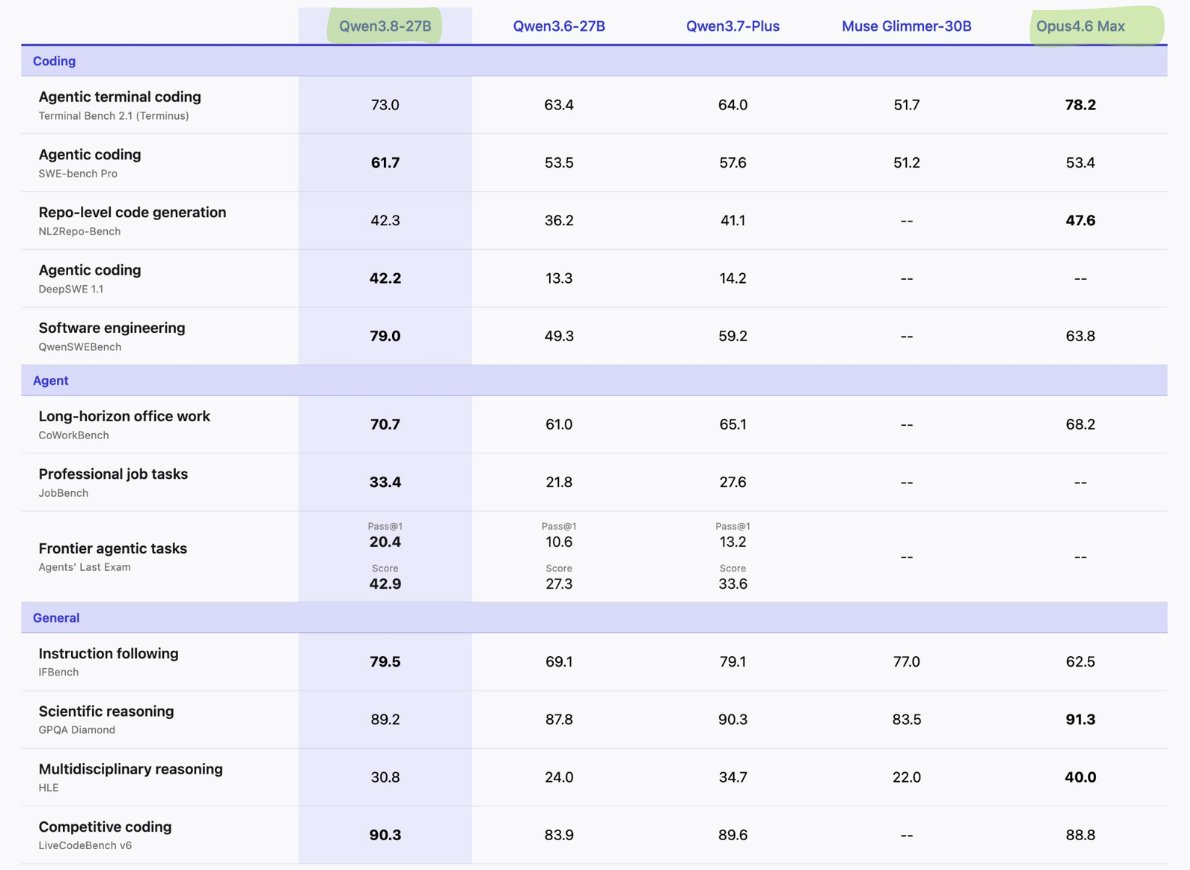
🚨Qwen3.8 27B benchmarks are ridiculous

How is a 27B model even putting up numbers like this

• SWE bench Pro: 61.7 • QwenSWEBench: 79.0 • CoWorkBench: 70.7 • LiveCodeBench: 90.3

It’s genuinely Opus 4.6 level while being small enough to run on a desktop😭

27B models should not be this good, what the hell did Qwen do

24
1
submitted 4 days ago* (last edited 3 days ago) by PumpkinDrama@reddthat.com to c/PumpkinDrama@reddthat.com

There was a bot on Discord I used before called Socrates, based on Flipper and I wanted to build something like that. Mine is using data from my fanfiction archive so it won't give proper recommendations until a few users like a few fics. After that it should get better the more it's used.

Forum post
Code repository
Link to a Discord channel to use the bot in this server
Link to connect Discord bot to a server
Telegram group to use the bot
Matrix room to use the bot

What it does

It's a companion bot for that self-hosted archive — think "your own AO3" that can also import/scrape from other sites. The bot gives you fanfic recommendations right in Discord, Socrates-style:

  • Recommendations from your reading history!recs, !fresh, !gems, !roll, with pagination (!next / !prev / !page 3)
  • Cross-platform taste: AO3, fanfiction.net, and RoyalRoad are unified into one works model, so your history on one site feeds recommendations across all of them. No "500 favs limit" wall.
  • Slash commands for search, quotes, downloads: /search, /ask (ask a question about a fic's content in natural language), /quote, /download (EPUB/MOBI/PDF straight to Discord)
  • Library commands: bookmark, rate, kudos, block/unblock, updates on followed fics
  • Community stuff: fic requests board, roadmap voting, links back to your web profile

The honest limitation

The recommendation engine learns from what people like on the archive — and right now my site has zero users. So "personalized" recs won't be proper until a few people like a few fics. The more people actually use it, the better it gets. Once there's real taste data to learn from, the recs should beat what you got from Socrates, because it's learning from actual engagement, not just what's popular.

So, what would you want?

If you were going to invite a fanfic bot to your Discord server, what would make you actually use it?

  • Recs based on what? (fandoms you're active in, specific pairings, tone/vibe, length?)
  • What's the one feature that would make it your default rec source?
  • How do you feel about bots that track your reading history and suggest you what to read next vs. ones that give more generic suggestions?
  • Anything Socrates used to do that you miss and wish existed elsewhere?

I'm building this solo and want to make something the community actually wants, not just what I think is cool. Fire away.

discord bot,fanfiction,recommendations,reading history,ao3,fanfiction.net,royalroad,self-hosted,archive,cross-platform,search,quotes,downloads,epub,mobi,pdf,bookmarks,kudos,fandom,pairings,community feedback,feature requests

25
1
view more: next ›

PumpkinDrama

60 readers
14 users here now

founded 8 months ago
MODERATORS