[-] atomicStan@programming.dev 2 points 3 months ago

I (mostly) agree. I believe that bootc might have played a role in EU_OS' decision to pick Fedora over openSUSE. Back then, it wasn't possible to use it outside of Fedora's ecosystem. But Bootcrew has since released bootc images for other distros; including openSUSE. So hopefully they will reconsider it.

[-] atomicStan@programming.dev 2 points 3 months ago

Great answer. Thank you!

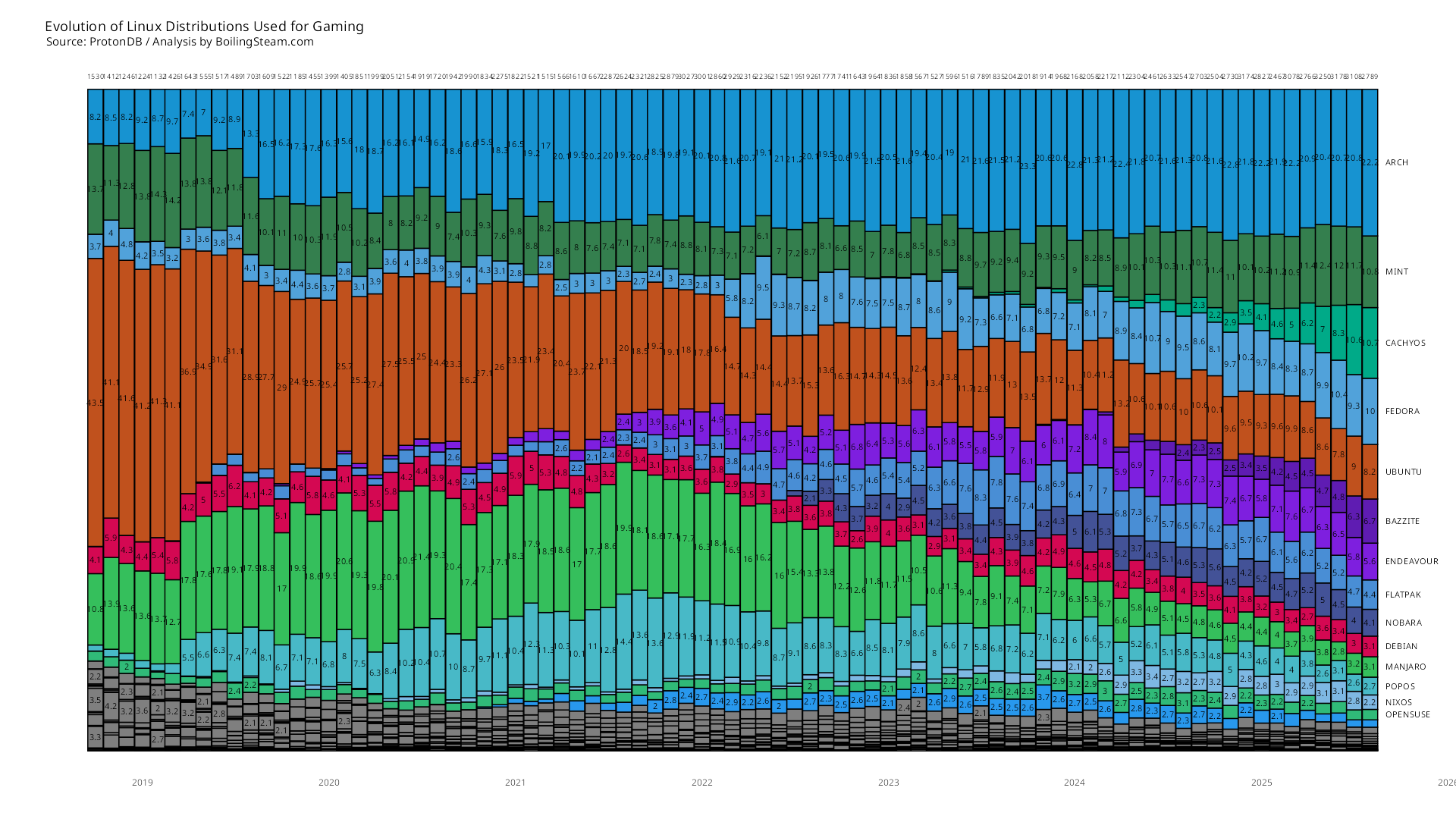
I hope openSUSE will eventually get around and enjoy some much deserved momentum. I feel it isn't quite reaching its full potential as a project, because it (somehow) fails to attract a bigger audience. Don't get me wrong, it's definitely doing well and it holds its own admirably. But, (going off of ProtonDB's data) where Fedora (together with its derivatives) managed to effectively increase its market share by at least 400%, openSUSE^[It's the green colored bar found right under Manjaro] -despite Tumbleweed making more sense for gaming- was only able to keep what it had...
[-] atomicStan@programming.dev 1 points 3 months ago

If I may, would you seriously consider switching to openSUSE Slowroll if Manjaro's situation doesn't improve? Or, are there reasons beyond its beta status that hold you back?

[-] atomicStan@programming.dev 2 points 3 months ago* (last edited 3 months ago)

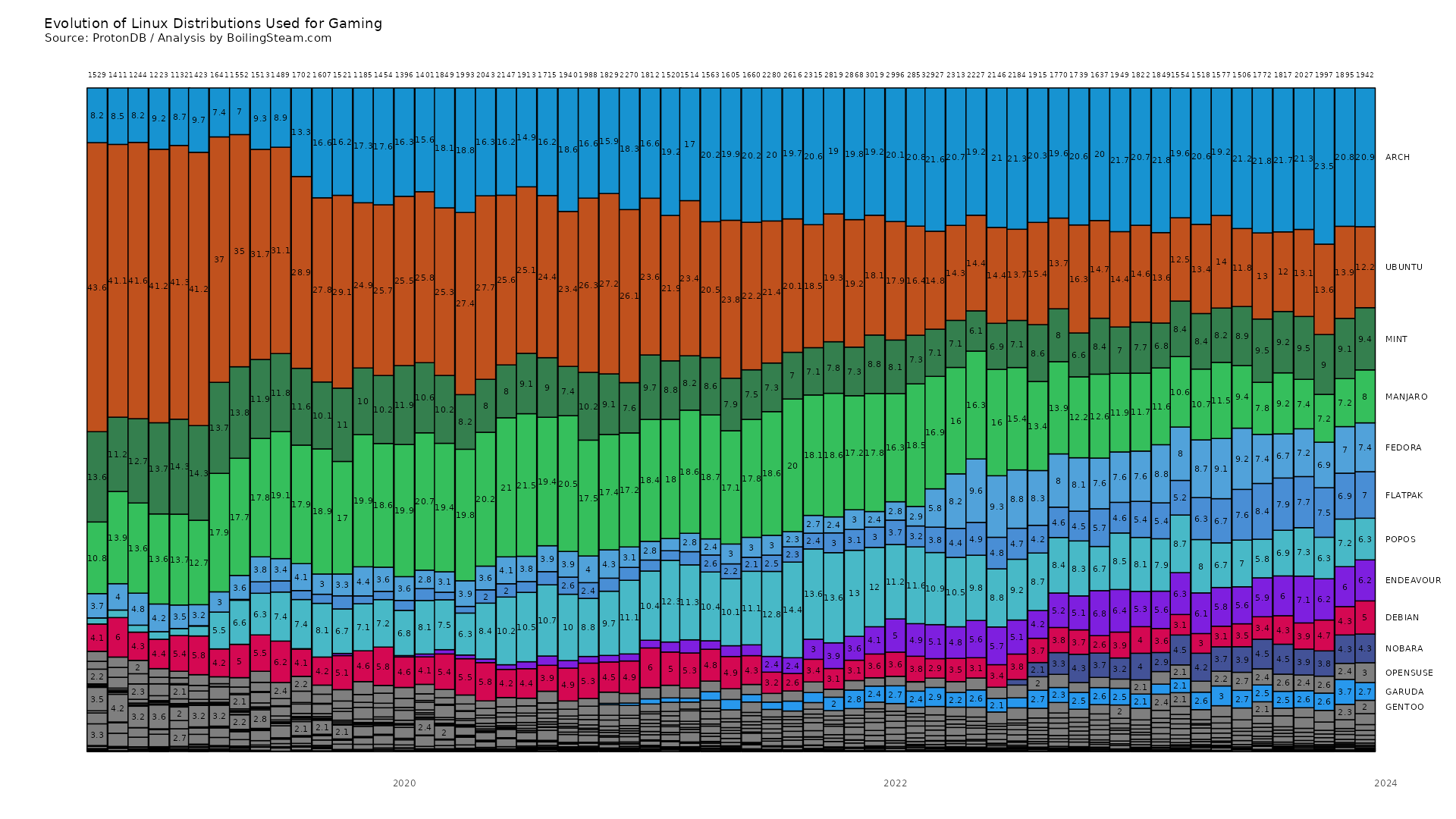
My apologies for inserting this "akshually ☝️", but I'm almost 100% sure that the distro that just didn't make the cut -the one represented in green, right under Manjaro- is openSUSE. It's possible to deduce this from an earlier report of Boiling Steam and its respective graph.

But, perhaps unsurprisingly, I don't ever recall seeing Slackware in any of these.


FWIW, similarly, we can deduce the grey one right below openSUSE to be Gentoo from this report and its respective graph. And, finally, the blue one below Gentoo to be Garuda from the respective graph of this report.

The last distro I was able to identify is Solus. Unfortunately, it's only relevant in the very beginning. It used to be the best performing grey one. See this report and its respective graph.

[-] atomicStan@programming.dev 2 points 3 months ago* (last edited 3 months ago)

Perhaps I should have been more clear. My apologies. I wanted to draw attention to the fact that -in the case of Fedora Atomic- layering remains a necessity (for most users). This thread goes over it in more detail.

flatpak

Technically speaking, the flatpak format isn't even as limited as some make it out to be. For example, software like Bottles have offered CLI/TUI functionality through it. But Flathub, its most popular storefront, does put a limitation on submissions. Which means that it's effectively not even competing with other package managers that (conventionally) try to offer a broader set of software.

Furthermore, even if the flatpak package exists, not all functionality is retained. For example, the situation around native messaging is still a mess. This prevents e.g. your flatpak browser from communicating with your locally installed password manager. While a(n ugly) workaround exists, it’s quite maddening that it hasn’t been resolved in all these years 😅.

distrobox/toolbx

This is actually a mess. See this comment elsewhere under this post for a bit more elaboration.

[-] atomicStan@programming.dev 2 points 3 months ago

IIRC, historically, it was (one of) the first to do so. It took a significant time for (most^[Slackware, famously, continues to not have a dependency resolver. Though, they got their reasons.]) others to catch up.

still

Maybe. I honestly don't know either.

[-] atomicStan@programming.dev 3 points 3 months ago
  • Step 1. Upgrade to proactive security. Projects like HotCakeX' offer a streamlined method of attaining it.
  • Step 2. Commit to best practices. There's a long list of this, but the short of it would be:
    • Uphold a strong backbone of secure software that has proven to be committed to safe practices.
    • Ensure that your system and/or software is always up-to-date.
    • Don't visit unsafe/untrusted websites. Don't click on shady/untrusted links.
    • Don't execute untrusted/unsafe files. Especially not with administrator's rights.
    • Sandbox all activities. So that even if you're compromised, that the adversary can only access very little beyond the binary/program/software itself.
[-] atomicStan@programming.dev 2 points 3 months ago* (last edited 3 months ago)

First of all, I’m sorry I can’t provide you with a video; I tried attaching it to the post but won’t let me attach any other than photos.

Gifs work. There are some pointers over here.

view more: ‹ prev next ›

atomicStan

joined 3 months ago