62
submitted 2 years ago* (last edited 2 years ago) by thelastaxolotl@hexbear.net to c/indigenous@hexbear.net

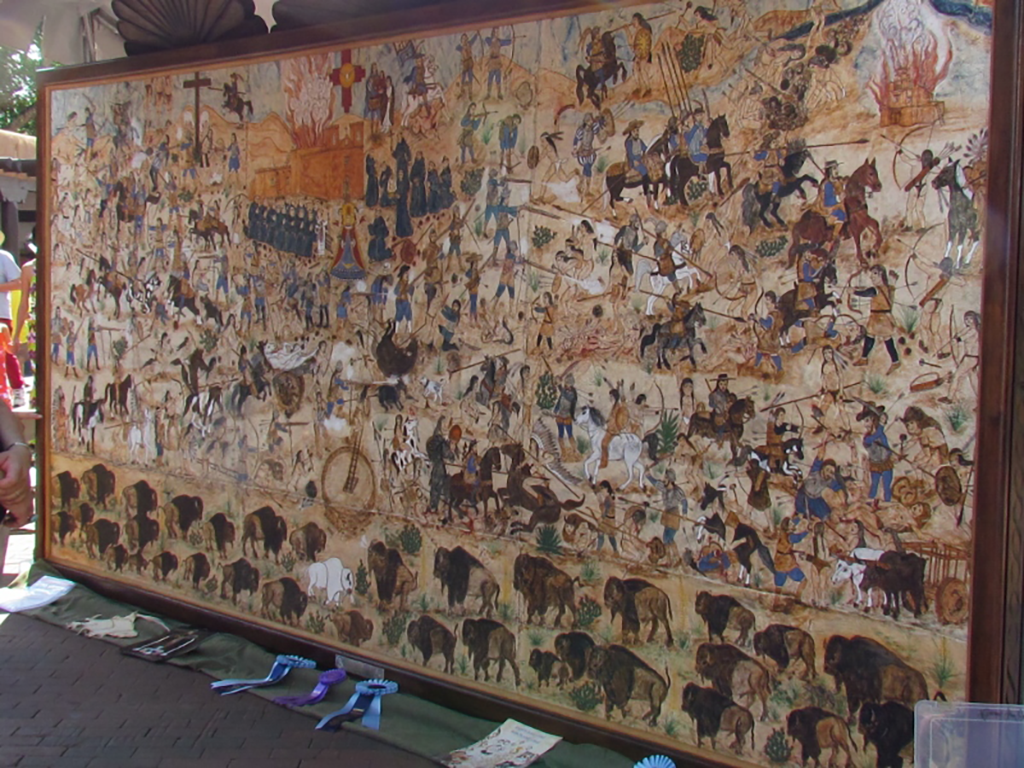
The Great Pueblo Revolt, or Pueblo Revolt (1680–1696), was a 16-year period in the history of the American southwest when the Pueblo people overthrew the Spanish conquistadors and began to rebuild their communities. The events of that period have been viewed over the years as a failed attempt to permanently expel Europeans from the pueblos, a temporary setback to Spanish colonization, a glorious moment of independence for the Pueblo people of the American southwest, or part of a larger movement to purge the Pueblo world of foreign influence and return to traditional ways of life. It was no doubt a bit of all four.

The Spanish first entered the northern Rio Grande region in 1539 and its control was cemented in place by the 1599 siege of Acoma pueblo by Don Vicente de Zaldivar and a few score of soldier colonists from the expedition of Don Juan de Oñate. At Acoma's Sky City, Oñate's forces killed 800 people and captured 500 women and children and 80 men. After a "trial," everyone over the age of 12 was enslaved; all men over 25 had a foot amputated. Roughly 80 years later, a combination of religious persecution and economic oppression led to a violent uprising in Santa Fe and other communities of what is today northern New Mexico. It was one of the few successful—if temporary—forceful stoppages of the Spanish colonial juggernaut in the New World.

Life Under the Spanish

As they had done in other parts of the Americas, the Spanish installed a combination of military and ecclesiastical leadership in New Mexico. The Spanish established missions of Franciscan friars in several pueblos to specifically break up the Indigenous religious and secular communities, stamp out religious practices and replace them with Christianity. Active efforts to convert the Pueblo people to Christianity involved destroying kivas and other structures, burning ceremonial paraphernalia in public plazas, and using accusations of witchcraft to imprison and execute traditional ceremonial leaders.

The government also established an encomienda system, allowing up to 35 leading Spanish colonists to collect tribute from the households of a particular pueblo. Hopi oral histories report that the reality of the Spanish rule included forced labor, the seduction of Hopi women, raiding of kivas and sacred ceremonies, harsh punishment for failing to attend mass, and several rounds of drought and famine.

Growing Unrest

While the Pueblo Revolt of 1680 was the event that (temporarily) removed the Spanish from the southwest, it was not the first attempt. The Pueblo people had offered resistance throughout the 80-year period following the conquest. Public conversions didn't (always) lead to people giving up their traditions but rather drove the ceremonies underground. The Jemez (1623), Zuni (1639) and Taos (1639) communities each separately (and unsuccessfully) revolted. There also were multi-village revolts that took place in the 1650s and 1660s, but in each case, the planned revolts were discovered and the leaders executed.

The Pueblos were independent societies before Spanish rule, and fiercely so. What led to the successful revolt was the ability to overcome that independence and coalesce. Some scholars think it was a millenarian movement, and have pointed to a population collapse in the 1670s resulting from a devastating epidemic that killed off an estimated 80% of the Indigenous population, and it became clear that the Spanish were unable to explain or prevent epidemic diseases or calamitous droughts. In some respects, the battle was one of whose god was on whose side: both Pueblo and Spanish sides identified the mythical character of certain events, and both sides believed the events involved supernatural intervention.

Nonetheless, the suppression of Indigenous practices became particularly intense between 1660 and 1680, and one of the main reasons for the successful revolt appears to have occurred in 1675 when then-governor Juan Francisco de Trevino arrested 47 "sorcerers," one of whom was Po'pay of San Juan Pueblo.

Leadership

Po'Pay (or Popé) was a Tewa religious leader, and he was to become a key leader and perhaps primary organizer of the rebellion. Po'Pay may have been key, but there were plenty of other leaders in the rebellion. Domingo Naranjo, a man of African and Indigeneous heritage, is often cited, and so are El Saca and El Chato of Taos, El Taque of San Juan, Francisco Tanjete of San Ildefonso, and Alonzo Catiti of Santo Domingo.

Under the rule of colonial New Mexico, the Spanish deployed ethnic categories ascribing "Pueblo" to lump linguistically and culturally diverse people into a single group, establishing dual and asymmetric social and economic relationships between the Spanish and Pueblo people. Po'pay and the other leaders appropriated this to mobilize the disparate and decimated villages against their colonizers.

August 10–19, 1680

After eight decades of living under foreign rule, Pueblo leaders fashioned a military alliance that transcended longstanding rivalries. For nine days, together they besieged the capital of Santa Fe and other pueblos. In this initial battle, over 400 Spanish military personnel and colonists and 21 Franciscan missionaries lost their lives: the number of Pueblo people who died is unknown. Governor Antonio de Otermin and his remaining colonists retreated in ignominy to El Paso del Norte (what is today Cuidad Juarez in Mexico).

Witnesses said that during the revolt and afterward, Po'Pay toured the pueblos, preaching a message of nativism and revivalism. He ordered the Pueblo people to break up and burn the images of Christ, the Virgin Mary, and other saints, to burn the temples, smash the bells, and separate from the wives the Christian church had given them.

Revitalization and Reconstruction

Between 1680 and 1692, despite the efforts of the Spanish to recapture the region, the Pueblo people rebuilt their kivas, revived their ceremonies and reconsecrated their shrines. People left their mission pueblos at Cochiti, Santo Domingo and Jemez and built new villages, such as Patokwa (established in 1860 and made up of Jemez, Apache/Navajos and Santo Domingo pueblo people), Kotyiti (1681, Cochiti, San Felipe and San Marcos pueblos), Boletsakwa (1680–1683, Jemez and Santo Domingo), Cerro Colorado (1689, Zia, Santa Ana, Santo Domingo) There were many others.

The architecture and settlement planning at these new villages was a new compact, dual-plaza form, a departure from the scattered layouts of mission villages. Liebmann and Pruecel have argued that this new format is what the builders considered a "traditional" village, based on clan moieties. Some potters worked on reviving traditional motifs on their glaze-ware ceramics, such as the doubled-headed key motif, which originated fro, 1400–1450.

New social identities were created, blurring the traditional linguistic-ethnic boundaries that defined Pueblo villages during the first eight decades of colonization. Inter-Pueblo trade and other ties between Pueblo people were established, such as new trade relationships between Jemez and Tewa people which became stronger during the revolt era than they had been in the 300 years before 1680.

Reconquest Attempts by the Spanish to reconquer the Rio Grande region began as early as 1681 when the former governor Otermin attempted to take back Santa Fe. Others included Pedro Romeros de Posada in 1688 and Domingo Jironza Petris de Cruzate in 1689—Cruzate's reconquest was particularly bloody, his group destroyed Zia pueblo, killing hundreds of residents. But the uneasy coalition of independent pueblos wasn't perfect: without a common enemy, the confederation broke into two factions: the Keres, Jemez, Taos and Pecos against the Tewa, Tanos, and Picuris.

The Spanish capitalized on the discord to make several reconquest attempts, and in August of 1692, the new governor of New Mexico Diego de Vargas, initiated his own reconquest, and this time was able to reach Santa Fe and on August 14 proclaimed the "Bloodless Reconquest of New Mexico." A second abortive revolt occurred in 1696, but after it failed, the Spanish remained in power until 1821 when Mexico declared independence from Spain.

Ysleta del Sur Pueblo

The Tribal community known as "Tigua" established Ysleta del Sur in 1682. After leaving the homelands of Quarai Pueblo due to drought, the Tigua sought refuge at Isleta Pueblo and were later captured by the Spanish during the 1680 Pueblo Revolt and forced to walk south for over 400 miles. The Tigua settled and built the Ysleta del Sur Pueblo and, soon after, the acequia (canal) system that sustained a thriving agricultural-based community.

A BRIEF HISTORY OF THE PUEBLO REVOLT

Megathreads and spaces to hang out:

reminders:

  • 💚 You nerds can join specific comms to see posts about all sorts of topics
  • 💙 Hexbear’s algorithm prioritizes comments over upbears
  • 💜 Sorting by new you nerd
  • 🌈 If you ever want to make your own megathread, you can reserve a spot here nerd
  • 🐶 Join the unofficial Hexbear-adjacent Mastodon instance toots.matapacos.dog

Links To Resources (Aid and Theory):

Aid:

Theory:
(page 3) 50 comments
sorted by: hot top controversial new old
[-] AlicePraxis@hexbear.net 12 points 2 years ago

reading Mary Shelley's Frankenstein for the first time and y'all... so it turns out Frankenstein's dad married his best friend's daughter, and now Frankenstein wants to marry his adopted sister?? kinda sus...

[-] Frank@hexbear.net 11 points 2 years ago

Nah, shit like that used to happen all the time. Conceptions of incest have changed very rapidly over the last century or two.

Also my favorite Frankenstein fact is that Shelley needed an excuse to escape Byron's boorishness and dude's rock bullshit so she hid somewhere and invented science fiction.

load more comments (1 replies)
[-] ItsPequod@hexbear.net 12 points 2 years ago

I've been growing a mustache and one side curls perfectly, just the way I want, while the other side sags and turns towards my mouth, much to my aggrievement grumpy-lizard

load more comments (1 replies)
[-] BirdBrained@hexbear.net 12 points 2 years ago
load more comments (2 replies)
[-] Pisha@hexbear.net 11 points 2 years ago

What annoys me about the liberal parts of the Internet -- one thing at least -- is the idea that intellectual property benefits creative workers and piracy hurts them. It's just so simplistic and removed from actual money flow. People seem to imagine that when you go to the book store and pay your 20 € for a copy, 10 % of it goes directly to the author or something. In reality, at least as I understand it, royalties like these basically don't matter because they only come in after the advance has been covered by the sales. And whether one of the oligopolistic publishers buys a manuscript and for what amount is based on inscrutable calculations including how much prestige it will bring to the brand, separate from the profit it will make. So I don't think there's a direct economic incentive to publish truly literary work and therefore I don't think royalties matter for good writing. Coming back to the main point: Authors who decry piracy are just redirecting the righteous hatred of the artistry-destroying oligopoly toward the readers, who are comparatively powerless and unwilling participants in the publishers' money-making scheme. Besides, some of the best writers today publish their work for free and take money via Patreon or some such, which is a slightly more ethical corporation.

Thanks for coming to my TED talk, I'll be here all week.

load more comments (1 replies)
[-] AnarchaPrincess@hexbear.net 11 points 2 years ago

Camino de Santiago Quest 2023: Day 25

A SPECTACULAR DAY

I woke up this morning secure in my new mentality that this is no longer a fun social adventure but now an extreme physical endurance test. Which is also good! Once I’d reframed things positively in this manner I stopped feeling bad about walking alone. In fact, I embraced it. I put my head down and blazed down the camino as hard as I could. At one point I slowed to talk with someone but then decided you know what? Fuck it. We ride.

I also finally did some of that spiritual reflection pilgrimage business. I put on an audio recording of my favorite poem, Walt Whitman’s “Crossing Brooklyn Ferry,” and considered it while I walked. Whitman talks a lot about how scenes and experiences endure across time, connecting everyone around the world and throughout history without our realizing it. He describes vividly all the scenes of his day, just so we in the future will recognize the experiences of the past as real and evocative.

I thought about pilgrims back in Saint-Jean and Roncesvalles, just now beginning their travels. Or those days ahead of me at Santiago and Finisterre, just now ending theirs. All of us walk the same path yet have such wildly disparate experiences—and yet ultimately they’re just expressions of the same experience, aren’t they? You could say this about the medieval pilgrims as well, all those many centuries ago yet nevertheless following this trail as I do today. As will be the case for many hundreds of years into the future.

It took me back to the first thought I ever had on mushrooms lol. Life is the same A to B for everyone, and all of us ultimately live similar, interconnected lives. We must by necessity live together and are never, can never truly be alone. Yet also we must each individually learn and relearn the same lessons, think the same thoughts, feel the same feelings, as those before us and those yet to come. We’re on the same path, together, but we walk it for ourselves, alone. The interplay between this, between self and society, is what shapes life’s experiences.

“The simple, compact, well-join’d scheme. Myself disintegrated, everyone disintegrated, yet part of the scheme…”

Alright.

I had the WILDEST hostle tonight. I wound up at this strange little place in the middle of nowhere, run by a single weird guy who doesn’t speak any English. He serves dinner but not like actual pilgrim dinner. The dude fucking drives into town and buys takeout for us. He does this multiple times per day. Otherwise he sits in his garden and smokes for hours with his weird old man friend. He makes a lot of bizarre jokes and this whole place is just very off-kilter. I like it.

This is supposed to be one of the busiest parts of the whole Camino yet there’s only three of us here tonight: a German, an Austrian, and me. We’ve turned the bunk bed room into our own private hotel and made big plans to wake up together at 3am and watch shooting stars as we leave. These two are both fantastic. Austria is planning to be in Santiago the same day as me and we’ve agreed to go out for drinks to celebrate. So yay, I won’t be alone in the final city!

One last HUGE deal. I spent two hours doing mapping/research and plotted out my daily kilometers for the rest of the trip. I also booked the final seat on an August 16th bus to the Madrid airport. I put everything into place. It’s all sorted and the logistics have been resolved after weeks of uncertainty. I know exactly how I will complete the Camino and how I will get home.

Now the only thing left to do is walk it. FORTY-SEVEN KILOMETERS (almost 30 miles!) tomorrow beginning at 3:30am. Only 200km left between me and the Atlantic Ocean.

lets-fucking-golets-fucking-golets-fucking-go

load more comments (1 replies)
[-] GorbinOutOverHere@hexbear.net 11 points 2 years ago

Watching this isekai slop where this fat kid who is horribly mistreated by everyone just for being fat stumbles on a doorway to your standard isekai realm in his grandpa's house. In it he finds all kinds of overpowered shit, levels up, and his physical appearance changes with his stats and shit so now he's slim and strong and beautiful and in possession of phenomenal cosmic power

Anyway, I can't imagine having all that and being like 😔😔😔 gotta go back to SCHOOL😔😔😔 like come on my dude you can do literal magic what do you care about this fucking field trip for, lol

[-] wtypstanaccount04@hexbear.net 9 points 2 years ago

Gotta love how isekai is always like "wow thank god i'm not fat anymore, fat people suck" instead of "wow, in this world, people like me for who I am!" Really selling eating disorders to the general public huh. I've seen this with both boy and girl characters, so this isn't exclusive to one gender either.

load more comments (3 replies)
[-] WhyEssEff@hexbear.net 11 points 2 years ago
load more comments (3 replies)
[-] Dolores@hexbear.net 11 points 2 years ago
[-] Parsani@hexbear.net 11 points 2 years ago

Seeing the average rents around me has given me real doomer vibes today. Thank god I have rent control rn, but if I ever have to move I'm fucked.

load more comments (4 replies)
[-] forcequit@hexbear.net 11 points 2 years ago
load more comments (1 replies)
[-] hexaflexagonbear@hexbear.net 11 points 2 years ago
load more comments (1 replies)
[-] thelastaxolotl@hexbear.net 11 points 2 years ago

One of the best accounts on tiktok is the dude that posts clips from nature documentaries and prehistoric planet, always makes my day

[-] BeamBrain@hexbear.net 10 points 2 years ago

I wanna write a work of sci-fi that takes place in a multiplanetary society where characters say "what in the worlds" in the same manner that so many fantasy characters in stories with pantheons say "oh my gods"

[-] VHS@hexbear.net 10 points 2 years ago

probably my own fault for browsing reddit-logo for hobby subs, but if i try to open any i.r*ddit.com image in new tab to make it bigger, it directs me to this dead /r/funny post(CW: possible transphobia[?]) from 11 years ago? no matter what image i click on. broken ass website

load more comments (3 replies)
[-] Rojo27@hexbear.net 10 points 2 years ago

So today I had a conversation with my co-worker, the pro-union one, about the Ukraine war and he's the first person IRL that I've been able to talk about it without them going "Putin is a maniac, heh". We talk about NATO and its role in pushing Russia towards war. I might actually be able to have reasonable political discussions with someone at workquagsire-pog-crusty

[-] forcequit@hexbear.net 10 points 2 years ago
[-] Dolores@hexbear.net 10 points 2 years ago

she parlez on my vous till i anglais

[-] hexaflexagonbear@hexbear.net 10 points 2 years ago

I recently thought that it's nice a few outlets from over a decade ago are still around thanks to Patreon or other forms of direct funding, as any sort of media that isn't CNN or NYT seems to be dying. But then I realized all the ones I could think of were either video games or tech stuff? Some are left wing political shows, but without the resources to do anything deeper than interviews. I guess you can't create a thriving media space based on donations from hardcore fans alone lol.

[-] BirdBrained@hexbear.net 10 points 2 years ago

I should not have been allowed to pick my own name lmao

I can't decide and I keep changing it like once every 3-9 months, I'm on name like 5 or 6 right now and I'm thinking about changing it again

load more comments (2 replies)
[-] Zodiark@hexbear.net 9 points 2 years ago

I miss the PS Vita. The one I have has its directional buttons malfunctioning :(

load more comments (1 replies)
load more comments
view more: ‹ prev next ›
this post was submitted on 10 Aug 2023
62 points (100.0% liked)

indigenous

4 readers
1 users here now

Welcome to c/indigenous!

Please read the Hexbear Code of Conduct and remember...we're all comrades here.

Post memes, art, articles, questions, anything you'd like as long as it's about Indigenous peoples.

founded 2 years ago
MODERATORS