927
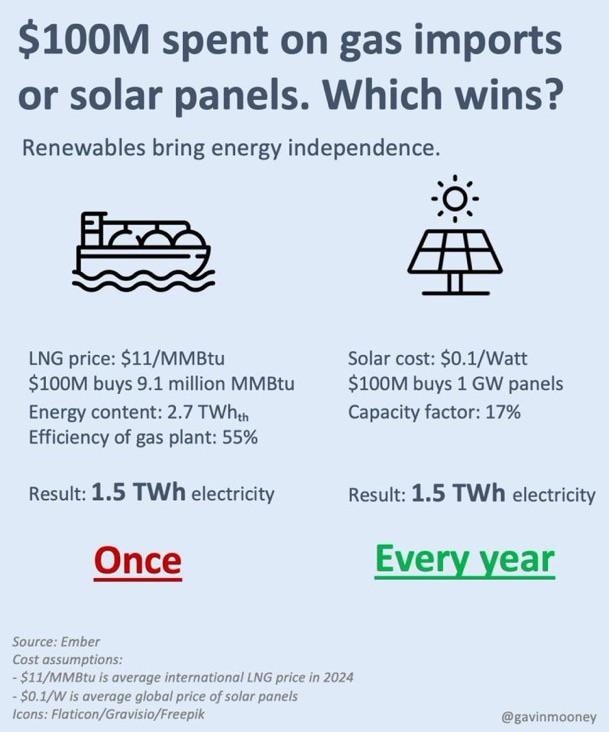
Gas imports or solar panels?
(slrpnk.net)
Discussion of climate, how it is changing, activism around that, the politics, and the energy systems change we need in order to stabilize things.
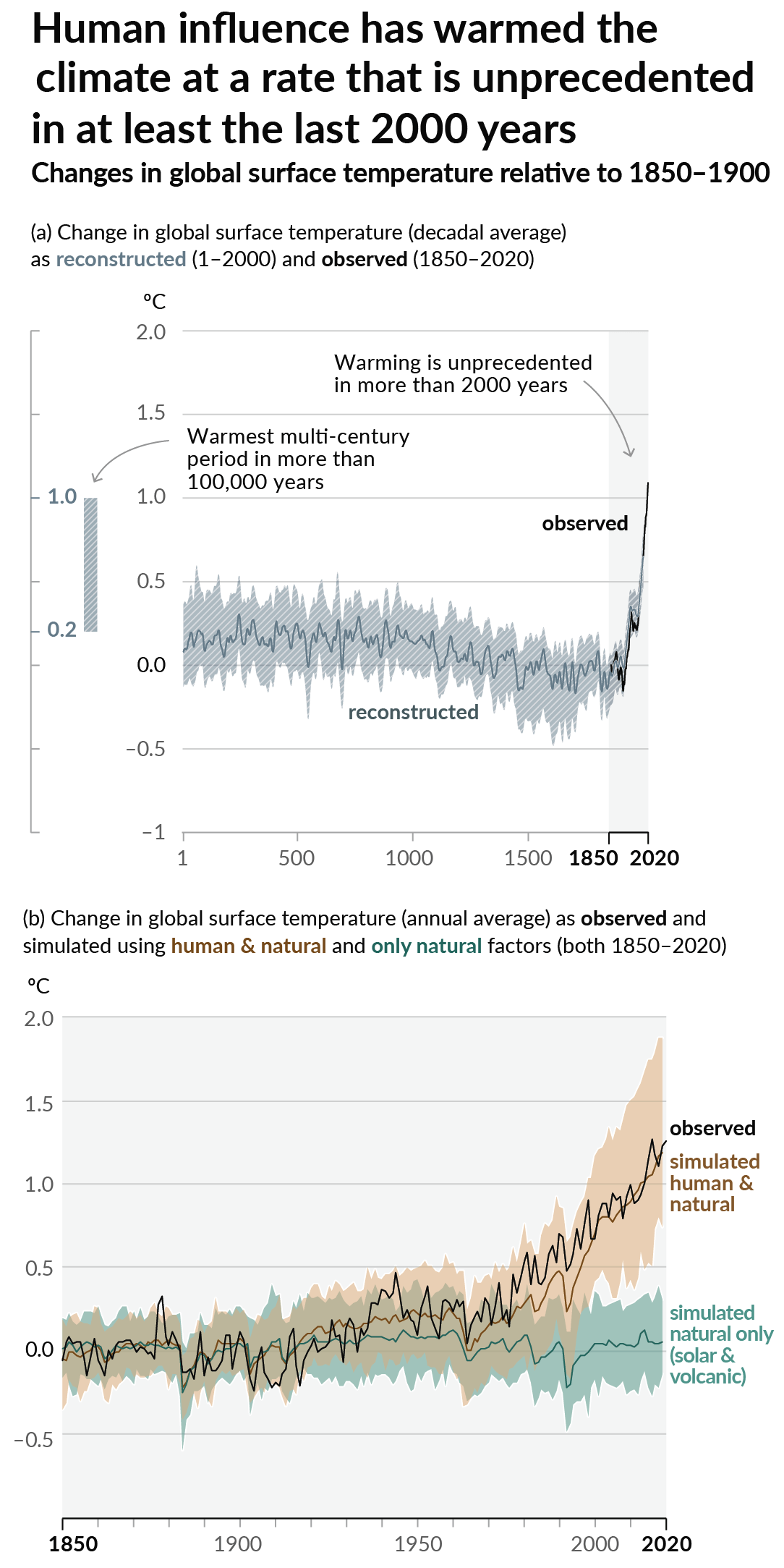
As a starting point, the burning of fossil fuels, and to a lesser extent deforestation and release of methane are responsible for the warming in recent decades:
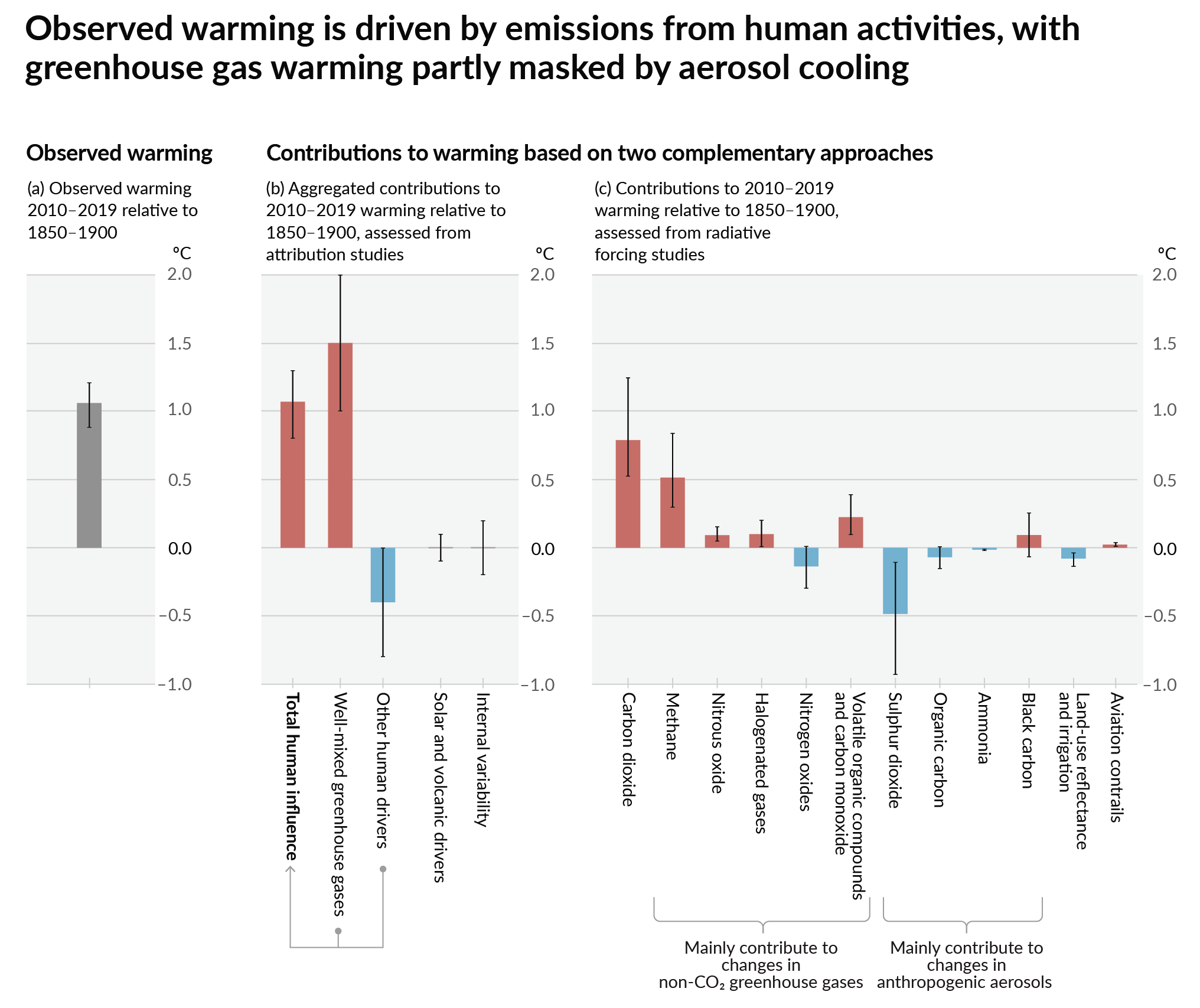
How much each change to the atmosphere has warmed the world:
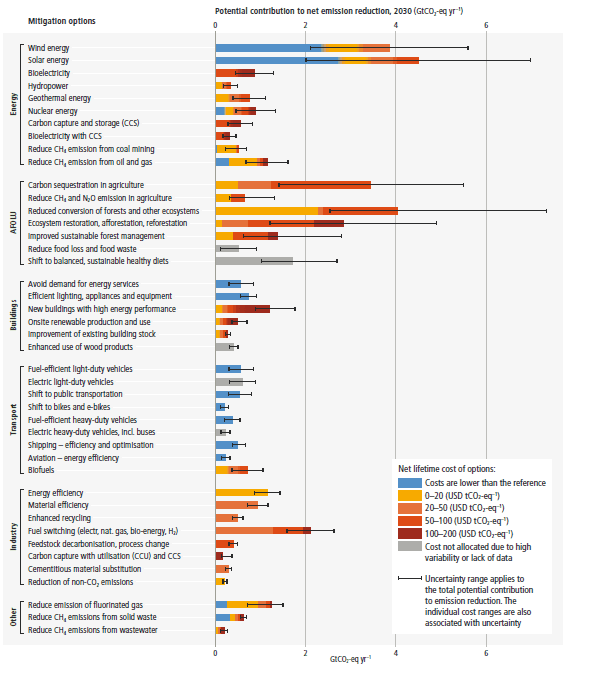
Recommended actions to cut greenhouse gas emissions in the near future:
Anti-science, inactivism, and unsupported conspiracy theories are not ok here.
I don't know, man. What if its cloudy?
Me shouting the answer, but you can't hear it over the bombs exploding across the Straight of Hormuz
You can use batterys
I mean yes, but also then the investment gets a lot bigger too.
In my country (Estonia), if we did solar + batteries only, the batteries would have to be large enough to withstand electricity consumption being smaller than production for the entire summer (which at its peak has 18 or 19 hours of sunlight per day and most people don't have AC so our summer electricity usage is smaller than winter).
And also from about october to march, there's almost no sunlight, and electricity consumption is through the roof because heat pumps have been pretty common in new builds and renovations for like 2 decades now, replacing mostly solid fuel furnaces rather than resistive electric heaters.
Which is not to say we should abandon solar, but it'd be incredibly cost-prohibitive to go renewables-only here. In the summer our electricity prices often go negative already (still zero + network fees for consumers, not really negative prices -.-), but in winter I've seen 5 euros per kilowatthour at peak times.
Now I googled the cost of a terawatt hour of battery capacity and Google's AI was happy to report to me that a terawatthour is a million kilowatt hours and thus at ~80€/kWh it would be 80 million euros. That's peanuts! Just 640 million would get us enough battery capacity to store a year's worth of energy, that should surely get through a winter!
Trouble is, I was taught slightly different values for the SI prefixes and back when I went to school, tera was a billion kilos. So if it still functions that way, we're talking hundreds of billions instead. Our national budget for the year is 20 billion. But if every person with a job paid just a million extra euros in tax, we could afford to do it!
So obviously, solar alone + batteries won't do it at such a high latitude. Wind power helps a ton, but that's still unpredictable. And after everyone on a flexible-price plan saw a 5x increase on their power bill for january (1000+ euros being pretty common), I don't think the people will settle for "works most of the time". We actually need a nuclear power plant and we need it to be built before December 2025.
Till then we'll continue burning dirty ass coal and (yay, even worse) shale. Which I fucking hate, but the economic reality of our country is that this is what we can afford right now, with a gradual buildout of solar + wind.
But funnily enough, if we got the hundreds of billions worth of batteries magically out of thin air, the cost of buying enough solar panels to produce the entire country's annual electricity consumption every year... Would be in the hundreds of millions range or a bit over a billion at most if this meme/infographic is to be believed, even if adjusting the capacity factor, which is more like 10-15% here due to our nasty winter. Chump change pretty much for a country like ours.
This is the funny AI response that says both millions and billions for the cost of a terawatt hour of battery capacity. For my own calculations I actually went to the source at Bloomberg and took a number that was on the lower side, but not the minimum, of the range they provided for 2024.
I don't think we have to worry about AI developing the I part of AI anytime soon.
Also, in 2024 we roughly doubled our peak solar output from 600 MW to 1300 MW! (2025 unfortunately saw a LOT less new solar installation).
But our winter peak consumption is 1600 GW, so this is still a bit under 0.1% of that. And peak production is in the summer :/
Not sure if you were taught wrong or misremembering, but giga is the standard notation for billion, and tera is trillion. Kilo, mega, giga, tera, ~~quad, quin~~, peta, exa.... They go on much farther than that, but at that point, just use exponential notation.
E: wrong notation form
If tera is trillion and kilo is thousand, tera is a billion times kilo.
I don't remember quad or quin, we had peta and exa here.
Derp, I knew that too.
Look at flowers and talk to people until it's sunny?
You can generate hydrogen from electrolysis.
Electrolysis efficiency is about 70% and you can store the hydrogen in pressurized underground caverns for a year or longer using another 0.12 kWh per kWh of hydrogen stored, which makes a total efficiency of around 0.6 kWh of hydrogen generation and storage for every kWh of electricity that you put in. (Source)
So if your electricity costs 6 ct/kWh (current LCOE of solar in many places), then hydrogen is gonna cost 10 ct/kWh to generate and store with current technology.
Currently, natural gas is around 5 ct/kWh, so solar would have to become a little bit cheaper to make it economically competitive.
Edit: to clarify, the 5 ct/kWh for natural gas is the gas alone; electricity from natural gas is more expensive than that (around 12 ct/kWh) and more expensive than solar.
What are you going to store hydrogen in to make this remotely viable? You lose like 60% of hydrogen within 7 days with current tanks and seals.
The new sodium batteries make this completely pointless from a cost and efficiency context
Hydrogen can be stored for years.
Hydrogen’s small molecular size facilitates permeation through many conventional materials, leading to leakage and potential embrittlement of metals. These characteristics create "unique" (read: expensive) engineering challenges.
And if you store it as a liquid that's when you enter the whole cryogenic problem, seeing it needs to be cooled to over - 225c
Even with advanced insulation, liquid hydrogen storage experiences unavoidable boil-off at rates of 0.3-3% per day, creating both economic and safety challenges.
And if you could make hydrogen via electrolysis, even with some uber wunderful unobtanium catalyst then you're still just waiting electricity that we can store far more efficiently in batteries (and with sodium batteries hitting the market there is going to be a huge revolution in battery economics and tech that will make lithium look like a drop in the ocean.
The problems are mostly solved already. You wouldn't use metals known for hydrogen embrittlement. Often times, you'd use something else, like HDPE or fiberglass that avoids this issue. Storage facilities can even be naturally occurring geological features, like salt caverns.
You would only use LH2 for specific cases, specifically where you are expected to use up the hydrogen quickly. But even this is changing, as self-refrigerating systems are being developed, allowing for very long-term LH2 storage.
We already can make hydrogen via electrolysis. This is a long-solved problem. Efficiency is not that relevant. The main limitation of batteries is that you simply cannot make enough of them. There are huge resource limitation problems. Meanwhile, hydrogen can be made from water and is effectively unlimited as a resource.
is home hydrogen a thing? i was wondering before, if it works in cars, why is it not in houses?
hydrogen scales well if you use big industrial setups, both for generation and for storage.
basically, bigger tanks are cheaper (consider higher volume/surface area ratio) and in fact the best tanks might simply be naturally occurring underground caverns. you can't have these at home.
Technically it could work. However, traditional batteries make a lot more sense. Hydrogen makes some sense for a vehicle because it can be more energy dense (it actually only makes sense for large trucks). However, it has to be stored at cryogenic temperatures. In a place where you probably don't care about mass or space much, other battery technologies are far better, without the added cost of cryogenic cooling and having to deal with hydrogen, which leaks through anything.
You would store it as a pressurized gas in this scenario. You would only use liquid hydrogen in specific situations.
Hydrogen gas is really hard to store. It is tiny, so it's basically always leaking, no matter how good your seal is.
Underground caverns can store it for years. This is simply not true.
What do you mean it isn't true? It's a well known fact. It's just a proton and an electron, so it's absolutely tiny. There is almost no way to seal it perfectly, especially in gaseous form. It's always going to leak. Even for rockets this is an issue. You can make that amount relatively small, but it pretty much always has some loss.
Caverns may make sense for large-scale solutions, because the quantity is so large compared to the loss. Most people don't have massive caverns under their house though, nor do they have a need for that large of a quantity.
Even in tank form, you can store it for months. It is not much different than CNG.
Large-scale solutions matter too. The utility companies can utilize such a thing.
The question was specifically about home hydrogen. Yes, it makes sense for utility companies, as well as large vehicles, as I said before. It's a great solution to turn renewables into a shipable commodity. Home use though doesn't make sense. A regular battery has much better properties for home use.
The same applies for home hydrogen storage too. Compressed hydrogen is good for months. Another option would be metal hydrides which apparently last a long time too. The problem is that you simply cannot power your house entirely with batteries alone.
There's a engineer that did it in his backyard. I'll see if I can find it when I get home.
https://www.youtube.com/watch?v=djg_l7cEtWg
https://hydrogenhouseproject.org/index.html
That sounds cheaper than battery storage (which at latitudes bigger than yours can get very expensive since there's little to no sun in the winter), and I'd assume more environmentally friendly than mining all that lithium as well.
How expensive is it to build out said caverns for this use, particularly if there aren't many natural ones available?
basically the caverns that are being considered/used for this are the same caverns that natural gas was extracted out of in the first place ... they clearly held some sort of gas fine for millions of years, so certainly they're gonna store a bit of hydrogen too.
Not to rain on your parade, but hydrogen and natural gas aren't really comparable for storage. The natgas molecule is 8x heavier and MUCH larger than a molecule of hydrogen. Just on the size alone, hydrogen can slip through just about everything and needs to be stored at cryogenic temperatures. I don't think rock is going to be as good of a storage media as you'd assume.
sure it's gonna leak but if the rate of leakage is slow enough, you can ignore it :)
Oh that makes sense.
We just don't have any natural gas production in Estonia lol. Perhaps the shale mines could be used. Unfortunately the biggest one had its permit extended till 2049 recently. Also I think they get filled with water naturally (they pump out a lot of dirty water), so I suppose the walls aren't actually completely sealed naturally.
yeah, geological availability might vary