1
3
cross-posted from: https://lemmygrad.ml/post/11336110
Rage Against the Woke Machine with Veteran Intelligence Professionals for Insanity
Three years after the death of Lyndon H. LaRouche, Jr. (1922–2019), the infamously kooky American “small-time Hitler,” the Russian invasion of Ukraine breathed new life into his political cult, which even tried to spearhead a pro-Russian “anti-war” movement in the United States. Three years later, the LaRouchians have drifted toward irrelevance again, but with Trump back in the White House, Tulsi Gabbard installed as Director of National Intelligence, and Kash Patel running the FBI, they are hoping for another rebound. It could depend on a certain group of “VIPs.”
The Veteran Intelligence Professionals for Sanity (VIPS), which consists of former US intelligence officers, formed in 2003 to call out the Bush-Cheney administration’s “Cooking Intelligence for War in Iraq.” VIPS wrote its first public memorandum to George W. Bush on February 5, 2003, the day that his Secretary of State Colin Powell made a warmongering presentation to the UN Security Council. One year and ten VIPS memos later, the group was said to have “produced some of the most credible, and critical, analyses of the Bush Administration’s handling of intelligence data in the run-up to the March 2003 invasion of Iraq.”
The main face of VIPS is co-founder Ray McGovern, a charismatic retired CIA officer and famous anti-war activist. He served 27 years in the Central Intelligence Agency, which he joined under John F. Kennedy. Whereas the LaRouchians fed information to various officials in the Reagan administration and its National Security Council, McGovern directly briefed Ronald Reagan and his national security advisors on a daily basis. In 2006, to protest the CIA’s role in the Bush-Cheney torture program, McGovern returned the Intelligence Commendation Medal that the CIA awarded him upon retiring from the Agency in 1990.
By the late 1990s, according to investigative journalist Chip Berlet, the LaRouchians “solicited contacts with a number of critics of U.S. foreign policy and intelligence agency practices, sometimes with surprising success.” McGovern only warmed up to the LaRouchians in recent years, after their tentacles were wrapped around his organization.
✍︎“2025: Nuclear Doom or New Paradigm with Ray McGovern and Helga Zepp-LaRouche”
The first VIPS member wooed by LaRouche appears to have been Mike Gravel (1930–2021), the former Senator and Democratic presidential candidate. Gravel got the Pentagon Papers into the Congressional record in 1971, and apparently joined the VIPS steering group in 2014. Gravel mentioned LaRouche while running for president in 2007. “We dismiss people,” the former Senator from Alaska said in an interview. “What’s his name, Lyndon LaRouche. I dismissed him, never gave him any credibility. Well I went to hear him speak at the urging of some friends. He does shoot himself in the foot but some of his ideas are great.”
In 2015, Gravel declared himself the newest member of LaRouche’s “cadre” at a conference held by the Schiller Institute, which is an important organization in the international LaRouchian network. “And this didn’t come to me naturally or quickly,” Gravel admitted to the audience. “I want to say that this lady up front, Anita Gallagher, has been beating on me for a decade, and calls me.” (Gallagher, a former associate of LaRouche, was sentenced to almost 40 years in prison for securities fraud in the early 1990s.) “And I got to tell you, I have been captured. I am now part of the team, and will work towards the goal.”
When Mike Gravel half-heartedly ran for president again, his teenaged campaign managers downplayed his association with the LaRouchians — luckily for them, Lyndon Larouche just died — but the Executive Intelligence Review renewed the call to “exonerate” its recently departed leader, now with an endorsement from a 2020 presidential candidate.
About a month before Gravel filed with the Federal Elections Commission, Virginia State Senator Richard Black, a relatively new VIPS member, announced that he would not be seeking re-election in 2020. He also mourned the loss of his constituent, Lyndon LaRouche, “one of the greatest minds in American history” and “by far the most adept political economist since Alexander Hamilton.” What’s more, “He got the Gestapo treatment from British Liberals in the [Washington] swamp, compelled to do so by their British masters.”
Colonel Richard Black, a far-right Republican and former career military officer, spoke at a 30th anniversary Schiller Institute conference in 2014, two years after his election to the Senate of Virginia. This might have been the first of many LaRouchian events for Black. His electoral district included the counties of Prince William and Loudoun, where Lyndon LaRouche lived since 1983.
The Washington Post has reported that Black is “known for a conservative grass-roots following and a history of inflammatory remarks about social issues.” That includes “not taking a position for or against marital rape” (2014), arguing that polygamy is “more natural” than homosexuality (2013), and alleging “there is a tendency to encourage homosexual activity” within public schools (2005). Another article said, “He has argued that abortion is a worse evil than slavery. And once, to demonstrate why libraries should block pornography on their computers, Black invited a TV reporter to film him using a library terminal to watch violent rape porn.”
Black’s controversial trips to Syria and meetings with Bashar al-Assad in 2016 and 2018 could have been arranged by the LaRouchians. Dennis King said they “have a special affinity for regimes that are tottering” — for example, Panama’s General Manuel Noriega, a discarded CIA asset that Lyndon LaRouche “praised … as a leader in the war on drugs.” As Black once told a group of politicians from the far-right Alternative for Germany (AfD) party, “I’m not some left-wing pacifist.” In 2019, he became a United Nations representative of the Schiller Institute and the Executive Intelligence Review, pillars of the LaRouche Organization.
In 2020, the LaRouchians accused “Black Lives Matter” of fomenting a “color revolution” and military coup against Donald Trump. During the George Floyd protests, Colonel Black recalled that as the former head of the US Army’s Criminal Law Division at the Pentagon, “I played a key role in deploying the 7th Infantry Division to quell the 1992 LA riots.” Despite being a political nut-job with no apparent background in intelligence, Black joined VIPS in 2018.
With signatories listed in alphabetical order, Black’s name subsequently appeared at the top of VIPS memos, second only to NSA whistleblower William Binney, who also endorsed the call to “Exonerate LaRouche” by 2019. That being said, Binney and Black haven’t signed the latest VIPS memos from this and last year.
Jason Ross, a former science advisor to Lyndon LaRouche who dropped out of college to join his cult (and now is secretary-treasurer of the LaRouche Organization), conducted separate interviews with Ray McGovern and William Binney in the spring of 2017. Later that year, Donald Trump urged his CIA director Mike Pompeo to meet with Binney after he spearheaded a VIPS memo to Trump: “Was the ‘Russian Hack’ an Inside Job?” Former NSA whistleblowers Bill Binney and J. Kirk Wiebe joined VIPS by 2014, and both of them got involved with the LaRouchians.
A week after LaRouche died in February 2019, the Schiller Institute held its “first U.S.A. national conference in over fifteen years.” Special guests included Binney and a pair of Russian UN officials. A year later, on the eve of the COVID-19 pandemic hitting the United States, the Schiller Institute hosted “A Conversation with NSA Whistleblowers: Rescuing the Republic from the Surveillance State.” Helga Zepp-LaRouche said at the start of this event with Bill Binney and Kirk Wiebe, “I am appealing to all of you to join the fight for the exoneration of Lyndon LaRouche, and the implementation of his ideas.”
During the summer of 2020, the Schiller Institute hosted multiple webinars with Bill Binney to make his case that there was no Russian hack of the Democratic National Committee, because as VIPS contended to Trump, “data was leaked (not hacked) by a person with physical access to a DNC computer.” In July, after two such events in a week, this former Technical Director of the NSA participated in an online Schiller Institute conference about “Lyndon LaRouche’s Battle for Justice.”
This webinar started with an eight minute video of Lyndon LaRouche from the 1990s in which he mentions Ukrainian Nazi death camp guard John Demjanjuk, someone that LaRouche determined to be an innocent victim. “What we’re going to do today,” explained the moderator of the webinar, “is to give you a chance to hear from some of the people who went through … the persecution and prosecution of LaRouche in the 1980s, so that you might … get a better understanding of what has confronted the current President of the United States in the hoax called Russiagate.”
Some people have questioned why Bill Binney is doing this with the Schiller Institute and members of the Lyndon LaRouche Organization, and so on, and the answer is, because we do the work. Because the rest of you, who should be doing it, aren’t doing it.
Later on, panelists indicated support for Trump threatening military force against Black Lives Matter protesters, “to stop the insurrection by these Jacobin mobs … [that are] part of the effort to bring down the president, part of the coup,” according to convicted LaRouche associate Michael Billington. As his co-panelist Helga Zepp-LaRouche told it, George Soros funded Black Lives Matter, and “if you look at the method of using civil rights kooks, of using NGO kinds of organization, it is the method of the color revolution … to try to destroy the sovereign nation state.”
Before moving to these matters, Binney told the LaRouchians that “I have been feeding information” to the Trump administration’s Department of Justice investigation into the FBI’s probe of “Russian interference” in the 2016 election. Without naming names, Binney said that “hopefully they will put these [anti-Trump] criminals in jail, and I mean a lot more than have been discussed publicly. I mean, this is much deeper, and it goes much, much further into all these agencies, and the politicians involved, so they all need to go to jail, and there’s evidence to do that.” A month later, LaRouchePAC hosted a Q&A with Binney in which he again claimed that “I was feeding stuff in through different channels” to Attorney General Bill Barr and Special Counsel John Durham about “finding information inside the NSA databases and so on.”
Someone asked, “What does Bill know about QAnon and does he believe it to be real?” Binney didn’t really answer the question, but said “I’m not involved in QAnon.” At some point in the run up to the election, Roger Stone’s social media strategist, Jason Sullivan, put his “very good friend” Bill Binney in touch with Ron Watkins, who was suspected of being “Q” — the mysterious online figure behind the QAnon conspiracy movement. According to the 2021 HBO documentary Q: Into the Storm, “Working together with Bill Binney, Sullivan had developed a tool that gamed Twitter’s algorithms, allowing for anyone of his choosing to massively amplify their message.” The film included a scene of their pre-election call with Ron Watkins, in which Sullivan says,
This is not a sales call. This is just to … get an introduction and see if there is … anything we can do to help the cause of the Great Awakening. If Q is trying to utilize or optimize abilities on Twitter, we can make them better. We’ve got proprietary tools that can help recruit their armies and get everybody on the same sheet of music to where we’re all disseminating together, and our splash in the pond is getting bigger and bigger every time we drop something. Ron’s the chief admin that’s creating 8kun, and that’s [the website] where Q is dropping stuff, so it looks like these two are working together in some way, shape or form … I want to help the President of the United States get his word out.
In September 2020, LaRouchePAC streamed a webinar with VIPS members Binney, Black, and Wiebe titled, “Use the Truth to Stop the Insurrection Against the Presidency.” Later that month, Colonel Black did a LaRouchian-moderated Q&A about the “coup against Trump” with members of TheDonald.win, “an online forum favored by some of the most zealous and militant Trump supporters.” According to the journalist Justin Hendrix, “The Donald [.win] is notable because of the sheer amount of detailed coordination, planning, and logistics it hosted” for January 6.
A couple weeks before the election, Kirk Wiebe told a LaRouchePAC webinar with Bill Binney, “We’re in a civil war. It’s already started. Civil wars don’t typically begin with gunshots. They begin with vehement visceral disagreements about essential things.” In the aftermath of the election, LaRouchePAC hosted a “fireside chat” with Wiebe on “DEFEATING ELECTION PSY-OPS … The New American Revolution with Donald Trump or Fascism with Sleepy Joe.”
Two weeks later, Wiebe and Binney participated in another “fireside chat” (which LaRouche used to hold in his Virginia mansion): “Overturn U.S. Election Fraud to Defeat a Green, Global Bankers’ Dictatorship.” The Schiller Institute maintained in December that “Donald Trump could yet be inaugurated President in January 2021,” if only he gave Edward Snowden, Julian Assange, Bill Binney and other whistleblowers the necessary platform “to reveal how the surveillance state has nearly mortally wounded the American electoral process.” They could expose that “British Intelligence, Not Russia Or China, Is The ‘Foreign Actor’.”
After the Capitol riot, nobody from Veteran Intelligence Professionals for Sanity seemed eager to associate with the LaRouchians for a while. Helga-Zepp LaRouche even distanced her LaRouche Organization (Schiller Institute and Executive Intelligence Review) from the militantly pro-Trump “LaRouchePAC.” But then in June 2021, Ray McGovern spoke at a Schiller Institute event alongside Richard Black and the director of the Russian International Affairs Council, a think tank established by the Russian government.
Later that summer, McGovern and Binney took part in a LaRouchian conference to mark the 20th anniversary of the 9/11 attacks. In the meantime, a 77-year old retired Colonel angrily denounced the Loudoun County School Board at one of its meetings. “It’s absurd and immoral for teachers to call boys ‘girls,’ and girls, ‘boys.’ You’re making teachers lie to students, and even kids know that it’s wrong!”
Richard Black continued until his microphone cut out: “This Board has a dark history of suppressing free speech. They caught you with an enemies’ list to punish opponents of Critical Race Theory. You’re teaching children to hate others because of their skin color, and you’re forcing them to lie about other kids’ gender! I am disgusted by your bigotry and your depravity!” Black’s future Youtube co-host Jon Tigges got arrested that day, for which he later appeared on Tucker Carlson Tonight to tell his side of the story.
As 2021 came to an end, the Executive Intelligence Review interviewed Graham E. Fuller, who spent 20 years in the CIA, and joined VIPS by 2015. According to the New York Times, Fuller wrote “a ‘think piece’ [that] circulated in the intelligence community in May 1985,” which was “instrumental in persuading some top-ranking Reagan Administration policy makers to begin considering covert contacts with Iranian leaders. It eventually led to the covert sale of United States weapons to Tehran in what became the Iran-Contra affair.” Chip Berlet wrote in 1999,
Many reporters in the mid 1980’s were contacted by LaRouchians who offered assistance and documents to help research the Iran-Contra story. This assistance was accompanied by their relentless peddling of typical LaRouchian distortions regarding vast conspiracies. … Over the past few years the LaRouchites have solicited contacts with a number of critics of U.S. foreign policy and intelligence agency practices, sometimes with surprising success. In many cases, it is the LaRouchian intelligence network that serves as a broker for information flowing between left-wing and right-wing groups. LaRouchians appear to have first penetrated the left in recent years when they began to trade information on covert action and CIA misconduct. The LaRouchians were early critics of the Oliver North network. In the early 1980’s, LaRouche intelligence operatives such as Jeffrey Steinberg maintained close ties to a faction in the National Security Council which opposed Oliver North’s activities. At the same time the LaRouchians quietly began providing information to mainstream and progressive reporters and researchers.
It’s easy to imagine that courting VIPS has long been a goal of 21st century LaRouchians. The Schiller Institute interviewed Ray McGovern again in early 2022. The day before Russia attacked Ukraine, Graham Fuller signed a LaRouchian petition to “Convoke an International Conference to Establish a New Security and Development Architecture for All Nations.”
✍︎Just yesterday the LaRouchians published another interview with Graham Fuller
Roughly 48 hours later, during a Youtube livestream on “The British vs. the American System: To Prevent War, Exonerate LaRouche,” former NSA whistleblower Kirk Wiebe discussed “a couple realities we have to deal with to achieve the vision that Lyndon LaRouche has put forth … a world with land bridges and sea lanes.” This VIPS member said, “That goal is noble, and it’s absolutely the right thing to do … We need to redefine the relationships along economic lines and fair trade as Lyndon LaRouche has put forth … That is the path, if done with integrity.”
That summer, the National Security and Defense Council of Ukraine’s Center for Countering Disinformation (CCD) published a list of “Speakers who promote narratives consonant with Russian propaganda.” A large number of them were LaRouchians, VIPS, or had participated in Schiller Institute events. The first five names on the list included Graham Fuller, Helga Zepp-LaRouche, Richard Black, and Ray McGovern. The CCD also tried to blacklist US politicians (Rand Paul and Tulsi Gabbard), and one of the world’s most famous economists (Jeffrey Sachs), journalists (Glenn Greenwald), and political scientists (John Mearsheimer).
The LaRouchians were among the first to conflate the CCD list with Myrotvorets, the Ukrainian government-linked database of “enemies of Ukraine.” This is a criminal “blacklist website,” explains political scientist Ivan Katchanovski, but not Ukraine’s official “hit list,” as many have described Mytrotovrets and later the CCD. Thanks to an outfit of Ukraine’s National Security and Defense Council, the LaRouche Organization made some new friends in 2022.
“Shut Down the Ukrainian Hit List Targeting Americans and International Voices of Opposition,” declared a LaRouche Organization livestream in September 2022. Special guests from the CCD “Hit List” included Dragana Trifkovic, the director of the Serbian Center for Geostrategic Studies, and two former US military analysts, David Pyne and Scott Ritter.
✍︎Dragana Trifkovic was once photographed with Alexey Milchakov (seen on the right with a Nazi flag), the leader of the Rusich Group, a small neo-Nazi unit that has fought for Russia in Ukraine over the past decade.
Pyne wrote some controversial articles about the war in Ukraine for the realist-conservative publication, The National Interest, and later he advised the far-right 2024 presidential candidate Vivek Ramaswamy. Pyne participated in a few more LaRouchian livestreams that year, and said he was “grateful to EIR [Executive Intelligence Review] for coming up with a number of peace proposals.”
Former UN weapons inspector Scott Ritter joined VIPS in the 2000s. He became a prominent alternative media commentator on the war in Ukraine. Ritter’s theatrics and pro-Russian rhetoric escalated as the war dragged on. By early 2023 he flaunted meetings with Russian officials, and declared that “Ukraine is a rabid dog.” In early 2024 he visited Chechnya and addressed thousands of Ramzan Kadyrov’s fighters in broken Russian. Ritter appears to have only warmed up to the LaRouchians after they both appeared on the CCD “hit list.” Since then he’s done numerous interviews, webinars, and events with them.
Over two years ago, I wrote something about the hypocrisy of LaRouchians trying to lead an anti-war movement against US involvement in Ukraine. That was before their efforts largely culminated in a bizarre “Rage Against the War Machine” (RATWM) rally that took place in Washington around the one year anniversary of Vladimir Putin declaring his “special military operation.”
One of the main speakers at that event, which promoted an alliance of the Left and Right, turned out to be the next Director of National Intelligence. The organizers later tried and failed to have another rally against the “Deep State,” but now the LaRouchians are counting on Tulsi Gabbard and Kash Patel to drain the swamp.
✍︎Tulsi Gabbard at the RATWM rally (with a LaRouche banner and Russian flag behind her)
Jose Vega, a 2024 LaRouchian Congressional candidate in New York City, was one of the speakers at the 2023 RATWM rally. In 2020, he moderated TheDonald.win Q&A with Richard Black about the “coup against Trump.” Two years later, when Vega and a friend heckled Alexander Ocasio-Cortez as a “war hawk” who supports Nazis in Ukraine, he said “Tulsi Gabbard has shown guts where you’ve shown cowardice.”
Gabbard had just announced her departure from the Democratic party. She soon responded to this viral clip, and “the fact that she [AOC] was so dismissive of them,” in a Fox News interview. “One of the main reasons why I left this Democratic party of today is because they have become the party of war hawks,” Tulsi Gabbard explained. “You hear these young men saying ‘nothing else matters if we are all destroyed’ in a nuclear war…” Gabbard also appeared on that year’s Ukrainian CCD list (as well as Myrotvorets), probably for speaking about US “biolabs” in Ukraine, a “corrupt autocracy” in Kyiv, and “Russia’s legitimate security concerns.”
Nick Brana, the chairman of the practically non-existent “People’s Party,” started to associate with the Schiller Institute in late 2022, around the time that he began to organize the RATWM coalition with Libertarians, LaRouchians, and others. He continued to join LaRouchian webinars after the February 2023 rally.
Brana introduced Jose Vega at the RATWM event and announced that Vega would be training rally-goers how to stage their own “interventions,” which is what the LaRouchians have called their tactic of heckling politicians and other famous people to make viral video content. Brana, the former National Political Outreach Coordinator for the 2016 Bernie Sanders presidential campaign, did an “intervention” on his old boss just before the 2022 midterm elections: “You were supposed to start a political revolution, instead you’re sending money to Nazis in Ukraine. You’re starting a Third World War, Bernie!”
People’s Party champion Jimmy Dore, a comedian and online political commentator, was another speaker at the RATWM event. Since then, Dore and others from the “Jimmy Dore Show” have embraced the LaRouchians, and Jose Vega in particular. Just recently, a year after Vega announced his 2024 Congressional run on their Youtube show, Dore’s sidekick (Kurt Metzger) recommended reading a book by Lyndon LaRouche: “It turns out that guy knew a lot of stuff. … Remember when we had a LaRoucher on and … I thought it was some crazy guy? They call him a cultist — no it isn’t! That guy knows a lot of history.” At that point Jimmy Dore chimed in, all of the “LaRouchies” that he knows are great.
Jackson Hinkle, another divisive RATWM speaker and provocative online political figure, started to flirt with the LaRouche cult in 2022. They appear to have gone their separate ways since his circle of “MAGA Communists” got more serious about establishing their own cult under the guise of the “American Community Party.” Hinkle, it just so happens, joined a surf session with then-presidential candidate Tulsi Gabbard in 2019. The following year, Gabbard was assigned to the US Army Civil Affairs and Psychological Operations Command.
✍︎Jackson Hinkle reacting to a LaRouche clip, sharing a LaRouche book on Twitter, and attending a Schiller Institute conference dedicated to defeating “Green Fascism” (perhaps all in October 2022)
More serious speakers at the RATWM rally were ultimately self-sabotaged by LaRouchian banners and their fellow travelers waving Russian flags behind them. The latter came from another cult-like group that sponsored the event. Caleb Maupin, the sex scandal-plagued leader of the so-called “Center for Political Innovation (CPI),” might just see himself as Lyndon LaRouche’s spiritual successor. Sex scandal-plagued VIPS member Scott Ritter, who pulled out of the RATWM rally organized by the sex scandal-plagued Nick Brana, subsequently spoke at CPI conferences in DC, and Ritter has repeatedly participated in LaRouchian events since then.
Ray McGovern didn’t speak at the RATWM rally, but Jose Vega borrowed a line from McGovern that he had just used at a Schiller Institute webinar: “Know Where You Stand, and Stand There.” About 48 hours later, McGovern addressed an informal meeting of the UN Security Council that the Russians organized to highlight Seymour Hersh’s bombshell reporting about the destruction of the Nord Stream pipelines. The next day, McGovern joined the Schiller Institute to talk more about this. Later that spring, the LaRouche Organization conducted an interview with McGovern on “The Art of Intervention,” although the VIPS founder credited Jose Vega with coining this term. Ray McGovern, a “dear friend” according to Vega, ended up supporting his 2024 Congressional campaign.
✍︎Jose Vega and Ray McGovern, wearing a “Vega for Congress” hat on the right
Over a year later, Jose Vega’s Congressional bid culminated in an event that he described as the world’s first “hybrid classical concert/political rally.” Between various musical performances, speeches were made by Scott Ritter, Jimmy Dore, and longtime associates of Lyndon LaRouche. Angela McArdle, a Libertarian Party leader from the far-right Mises Caucus, who co-organized the RATWM rally with Nick Brana and also kept in touch with the LaRouchians, remotely addressed the audience. The event’s slogan was “Build a Peace Chorus Against the Ghouls of War.”
✍︎
Back in 2022, Helga Zepp-LaRouche referred to Tulsi Gabbard as one of the leaders of a new anti-war movement in the United States. Last month, the LaRouche Organization held a small rally in Washington to demand, “Confirm Gabbard and Patel to Stop Wars and Lies.” For New Year’s Eve, the LaRouchians livestreamed a conversation between Helga Zepp-LaRouche and Ray McGovern, titled “2025: Nuclear Doom or New Paradigm.” More recently, the Veteran Intelligence Professionals for Sanity published a memo to the new Director of National Intelligence, inviting her “to consider its advice” — but if certain VIPS get in bed with the second Trump administration, the LaRouchians might not be far behind.
NEXT UP: Another VIPS member, Hunter Biden’s laptop, and more…
The nuclear trajectories of India and Pakistan are rooted in their historical rivalry, emerging from the contentious partition of British India and the disputes that followed. Since Independence, this rivalry has generated a persistent sense of insecurity and vulnerability, accompanied by the recurring possibility of conflict. Both countries have sought to outmanoeuvre each other through arms accumulation and alliance-building, reflecting the realist and neo-realist view that security remains the primary driver compelling states to acquire nuclear weapons.
Within neo-realist thought, scholars are divided into optimists and pessimists based on their understanding of deterrence. Deterrence optimists argue that nuclear weapons, whether limited or expansive, can ensure stability by raising the costs of conflict to unacceptable levels. Viewed from this perspective, India’s nuclear trajectory, often justified as peaceful, was shaped by strategic concerns, particularly China’s nuclear test in 1964. The subsequent Chinese hydrogen bomb test in 1967 further accelerated India’s nuclear ambitions, leading to weapons design efforts at the Bhabha Atomic Research Centre (BARC) in Mumbai.
India’s scientific community promoted nuclear capability as a pathway to major power status. Nevertheless, achieving this objective through self-reliance proved difficult, prompting India to seek external assistance. In May 1998, India formally declared its nuclear status through a series of tests, soon followed by Pakistan, which embraced nuclear weapons as the ultimate guarantor of its security. This sequence entrenched a regional arms race that continues without meaningful restraint. Both states frame their strategic interests as vital, reinforced through nationalistic narratives, while recent political developments have further intensified regional tensions.
Understanding nuclear deterrence requires a careful examination of theoretical frameworks and empirical realities. Realist theory provides a useful lens for analysing nuclear dynamics, emphasising anarchy, security dilemmas, and competing national interests.
Deterrence optimists argue that nuclear weapons contribute to stability by preventing large-scale wars. The fear of mutual destruction raises the costs of conflict to unacceptable levels, thereby discouraging aggression. However, deterrence pessimists highlight the limitations and risks associated with nuclear deterrence. They contend that deterrence is inherently fragile, particularly in regions marked by intense rivalry and political tension. Nuclear weapons do not eliminate conflict; rather, they transform its character, often shifting it to lower levels of violence.
This dynamic is often described as the stability–instability paradox, first articulated by Glenn Snyder in the early 1960s. Nonetheless, as Rajesh Rajagopalan, professor at the School of International Studies, JNU, argues in the paper “What Stability-Instability Paradox? Subnational Conflicts and the Nuclear Risk in South Asia”, Snyder’s framework also implies that the threat of escalation by nuclear weapons can constrain lower-level violence. This tension underscores how nuclear deterrence is often interpreted in divergent ways.
Historical experience suggests that nuclear weapons do not necessarily prevent conflict. Limited wars, crises, and military standoffs have occurred in nuclearised environments, indicating that deterrence may prevent total war without ensuring broader stability. It rests on key assumptions, including rational decision-making, secure second-strike capability, and effective civilian control over nuclear forces. It also depends on psychological factors, particularly the fear of catastrophic consequences. In practice, yet, these assumptions are not always reliable. Human error, misperception, and domestic political pressures can undermine rationality and increase the risk of escalation.
From a moral standpoint, nuclear deterrence raises serious ethical concerns. The use of nuclear weapons would result in indiscriminate destruction, affecting both military targets and civilian populations. The notion of “unacceptable damage,” embedded in nuclear doctrines, implicitly includes civilian casualties, raising fundamental questions about the moral legitimacy of deterrence strategies.
In an era of expanding nuclear arsenals and advancing missile technologies, the logic of deterrence is increasingly under strain. The destructive capacity of nuclear weapons has increased exponentially since 1945, when the US dropped atomic bombs on Japan. Those bombs, though devastating, were far less powerful than modern thermonuclear weapons. For instance, the Tsar Bomba, the largest nuclear device ever tested, had a yield of 50 megatons and could destroy everything within a radius of 100 kilometres. Such enormous destructive potential raises a fundamental question: how many nuclear weapons are actually necessary to deter an adversary?
Unlike offensive realists, defensive realists like Kenneth Waltz argue that only a small number of nuclear weapons are sufficient to establish deterrence. Even a limited arsenal can inflict unacceptable damage, making aggression irrational. Fear, rather than numerical parity, becomes the foundation of deterrence. A single high-yield weapon, if deliverable, can deter a larger arsenal. North Korea’s nuclear capability, for instance, has functioned as a deterrent despite its relatively small size. This perspective challenges the logic of continuous expansion and suggests that arms races are driven as much by political and psychological factors as by strategic necessity.

Protesters rally against the restarting of the No. 6 reactor at the Kashiwazaki-Kariwa nuclear power plant, in front of Tokyo Electric Power Company Holdings headquarters in Tokyo on January 19, 2026. | Photo Credit: Eugene Hoshiko/AP
Despite this reasoning, nuclear-armed states have consistently pursued larger and more sophisticated arsenals, reflecting the logic of offensive realism associated with John Mearsheimer. Political leadership often equates security with superiority, leading to competition rather than restraint. Even during the Cold War, major powers resisted maintaining smaller arsenals despite the sufficiency of minimal deterrence. This indicates that perceptions of power, prestige, status, and vulnerability play a significant role in shaping nuclear policy.
In the South Asian context, India’s nuclear programme reflects the tension between sufficiency and expansion. India’s doctrine of “Credible Minimum Deterrence” and “No-First-Use” theoretically limits its arsenal, yet ambiguity surrounding what constitutes “minimum” allows for continued growth. India possesses significant fissile material and the capacity to expand its arsenal beyond current deployments, indicating a gap between declaratory policy and operational capability.
External partnerships have facilitated access to advanced technologies, often justified as necessary for balancing regional threats, particularly from China. However, India’s existing capabilities may already be sufficient to deter both China and Pakistan, raising questions about the necessity of continued expansion. Pakistan, despite more limited economic resources, has developed a credible deterrent, including ballistic missiles and nuclear-capable aircraft. Its proximity to India enhances the effectiveness of its deterrence posture even without a fully developed triad.
The destructive potential of modern nuclear weapons underscores the sufficiency of relatively small arsenals. The bombings of Hiroshima and Nagasaki demonstrated the catastrophic impact of even low-yield weapons. Contemporary warheads are significantly more powerful, and a limited exchange involving a few dozen weapons could produce mass casualties, environmental devastation, and long-term climatic consequences.
Given these realities, a relatively small number of nuclear weapons may suffice for deterrence in South Asia. Existing arsenals already exceed such thresholds, suggesting that continued expansion is driven less by strategic necessity than by competition, domestic politics, and perceptions of insecurity.
Technological advancements are reshaping deterrence dynamics. Missile defence systems, in particular, may undermine deterrence by creating perceptions of protection against retaliation. At the same time, improvements in delivery systems and targeting technologies risk lowering the threshold for nuclear use.
India has invested in Ballistic Missile Defence Systems (BMDS) to protect key urban centres such as New Delhi and Mumbai. Planned deployments in Alwar and Pali reflect this objective. Initiated by the Defence Research and Development Organisation (DRDO) in 1999, the programme represents a significant step towards an indigenous missile defence capability. The system incorporates a two-tier interception mechanism, engaging targets both within and beyond the atmosphere. It integrates long-range radar, developed with assistance from Israeli firm Elta, and a command network designed to track and intercept incoming missiles. Despite successful tests, the system’s effectiveness against large-scale attacks remains uncertain, particularly given the short missile flight times in the region.
Pakistan may respond by expanding its offensive capabilities and adopting strategies designed to overwhelm such defences, as reflected in the development of Multiple Independently Targetable Re-entry Vehicle-capable (MIRV) systems. From a security dilemma perspective, these developments risk intensifying regional instability. As William Perry, who served as a Secretary of Defence as well as the technology advisor to the US government, cautioned, no defence system can provide absolute protection against large-scale attacks.
A major challenge to nuclear stability lies in the risk of unintended escalation. Miscalculation, technical error, and misinterpretation of intent can all trigger crises. The short flight times between neighbouring states reduce decision-making windows, increasing the likelihood of error under pressure. Submarine-based nuclear forces, while enhancing survivability, introduce further risks. Communication constraints may compel commanders to act without direct authorisation. Historical incidents demonstrate that false alarms and technical failures have repeatedly brought nuclear-armed states close to catastrophe.
These structural and technological challenges necessitate a reconsideration of India’s nuclear doctrine. From the outset, states have recognised the fear-inducing power of nuclear weapons; it is now time to also acknowledge the imperative of rationality in their possession and use. While Kenneth Waltz largely overlooked the rationality dimension, rationality cannot be reduced merely to cautious behaviour in the handling of nuclear weapons. It requires a deeper reflection on whether the continuous upgrading of nuclear capabilities genuinely enhances India’s security. Though peace activists advocate the complete abolition of nuclear weapons, persuading entrenched nuclear establishments, often shaped by notions of politics, prestige, and power, remains a formidable challenge.
Nuclear-armed states, including India, train their militaries for the eventual use of these weapons should circumstances demand it, as do other nuclear powers. Some countries have developed advanced shelters and evacuation plans to mitigate the effects of a nuclear attack. Yet, these measures raise a troubling question: if states lack the capacity to adequately protect their populations from nuclear devastation, what is the strategic logic of maintaining such arsenals? In this sense, deterrence theory appears increasingly tenuous, and nuclear weapons risk being seen not merely as instruments of deterrence but as potential battlefield tools.

Defence Research and Development Organisation tests Phase-II Ballistic Missile Defence System, in New Delhi on July 24, 2024. | Photo Credit: ANI Photo
A limited yet qualitatively advanced nuclear arsenal can serve as an effective deterrent against China and Pakistan, both as nuclear-armed states. The pursuit of great power status does not necessarily depend on offensive nuclear capabilities. Rather, it rests on strong conventional forces, a robust economy, influential soft power, export-driven global engagement, effective diplomacy, research and technological advancement, a peaceful domestic environment, and stable relations with neighbours. While current decision-makers may credit the architects of India’s nuclear programme for strengthening national security, the broader global context reveals a persistent security dilemma.
For instance, some argue that had Iran possessed nuclear weapons, external military interventions by the US or Israel might have been deterred. Such perceptions can motivate non-nuclear states to pursue nuclear capabilities for security, a view echoed by scholars like Kenneth Waltz. However, despite its relatively limited conventional capabilities compared to the US and Israel, Tehran has prompted renewed scholarly attention to the role of advanced conventional weaponry in enhancing security.
Thus, security, not power, should remain the guiding principle. Upgrading nuclear weapons effectively incentivises adversaries to expand and enhance their own arsenals, thereby increasing their capacity to target larger segments of our population. India should prioritise addressing perceived threats rather than focusing solely on capability gaps with China, while Pakistan is likely to maintain its nuclear arsenal along similar lines in response to India. History suggests that continuous upgrading and modernisation of military capabilities often heighten tensions and increase the risk of conflict. Even if India cannot fully trust Pakistan or China to act with restraint, the reality remains that a nuclear war cannot be won.
As Ramesh Thakur, emeritus professor at the Australian National University and expert in international security, nuclear non-proliferation and disarmament, global governance, and the Responsibility to Protect (R2P) doctrine, has argued in Nuclear Weapons and International Security: Collected Essays, “a smaller evil cannot be justified by a greater good; it is still evil, and killing innocent non-combatants is murder.” Similarly, I argue that Pakistan’s conventional asymmetry with India, and India’s own conventional imbalance with China, cannot be offset by nuclear weapons.
However, there remains a serious concern that no nuclear-armed state’s military would readily accept a conventional defeat; in such circumstances, the resort to nuclear weapons could become a means of transforming battlefield loss into a humanitarian catastrophe. Interestingly, the decision by General Thomas Handy to authorise the use of atomic bombs against Japan reflects how military leadership can be inclined to employ the most advanced weapons available, prioritising overwhelming military superiority even at the cost of mass destruction. Therefore, limited nuclear weapons cannot be regarded merely as an option, but rather as a rational choice aimed at protecting populations from mass destruction.
Contemporary nuclear strategy reflects deep mistrust and evolving security concerns. While nuclear weapons are viewed as essential for national security, shifts in doctrine and capability may inadvertently increase the risk of conflict. The assumption of rational behaviour, central to deterrence theory, is often challenged by political rhetoric, historical grievances, and domestic pressures. The development of tactical nuclear weapons is particularly concerning, as it lowers the threshold for use and risks normalising nuclear conflict at the battlefield level.
Since the BJP came to power, Pakistan’s nuclear capability has increasingly been perceived within India as a bluff and a shield for cross-border terrorism. As a result, the No-First-Use policy has come under greater scrutiny, with calls for a shift towards a First-Use posture. While such debates carry implications for regional stability, India has largely relied on limited conventional responses, including the surgical strikes of 2016, the Balakot air strikes of 2019, and the air and missile strikes during Operation Sindoor of 2025. Under the nuclear shadow, the Cold Start Doctrine represents another strategic option aimed at addressing these challenges. These developments indicate that deterrence between India and Pakistan remains under strain.
Recent conflicts in West Asia highlight the risks posed by missile and drone warfare, as well as the limitations of defence systems under operational conditions. India’s reliance on systems such as the S-400 reflects an effort to strengthen defensive capabilities. Nevertheless, as William Perry has argued, credible deterrence ultimately depends on survivable second-strike capability rather than defensive systems alone. At the same time, he noted that political considerations have historically driven nuclear expansion.
India’s pursuit of major power status remains closely tied to its nuclear policy. Yet its deterrent appears less stable in practice than in theory. Persistent instability in South Asia reflects unresolved disputes, weak confidence-building mechanisms, and enduring mistrust. The risk of miscalculation remains significant, particularly given concerns over command and control on both sides.
At the same time, deterrence outcomes in South Asia continue to be shaped by mutual perceptions and strategic choices. The underestimation of adversary capabilities, coupled with the instrumental use of nuclear weapons for strategic signalling, risks eroding stability. As conventional and technological competition intensifies, the pressures for escalation are likely to grow.
In this context, deterrence in South Asia remains inherently fragile. Without sustained efforts to manage rivalry and build trust, the region risks edging toward a point where the very logic of deterrence may cease to hold.
Rameez Raja is a Non-Resident Fellow at the Indo-Pacific Studies Center, Melbourne, Australia. He is the author of India’s Nuclear Policy Since 1998: Perspectives and Challenges.
Also Read | Nuclear powers cannot afford the luxury of war
Also Read | Kirana Hills and the illusion of nuclear stability in South Asia
[

The widespread but false perception that Putin is an anti-Zionist secretly allied with Iran against Israel, which has been pushed for years by putative friends and undeniable foes alike, means that many folks the world over will likely fall for Ukraine’s latest information warfare provocation against Russia.
The Jerusalem Post cited “a source close to Ukrainian intelligence” to report on Monday that “Russian intelligence has provided Iran with a detailed list of 55 critical energy infrastructure targets within Israel”. This follows reports over the past month that Russia is helping Iran target the US’ regional assets, which were assessed here as believable, but it was also explained here why both the Kremlin and the White House are covering this up. The same cannot be said about this report, however, which is fake news.
For starters, the source is someone “close to Ukrainian intelligence”, thus immediately casting aspersions on whatever they claim about Russia due to Kiev’s obvious self-interest in dividing it and Israel. The context of arguably believable reports that Russia is helping Iran target the US’ regional assets lends false credence to the latest one that it’s now helping Iran target Israeli energy infrastructure too. All that Ukrainian intelligence had to do was find a journalist and outlet willing to launder this lie to the public.
There are several reasons why Russia didn’t do this, not least of which is that the location of Israel’s energy infrastructure is public knowledge and easily verifiable through open sources, so Iran doesn’t need Russia’s help with this. The second is that Putin once famously declared that “Russians and Israelis have ties of family and friendship. This is a true common family; I can say this without exaggeration. Almost 2 million Russian speakers live in Israel. We consider Israel a Russian-speaking country.”
It’s therefore improbable that he’d help Iran inconvenience, harm, and especially kill his fellow Russian speakers about whom he feels so strongly that he authorized the special operation in no small part to defend their rights in Ukraine. The Russian-speaking community in Israel holds a special place in his heart since Putin is a proud lifelong philo-Semite whose best friends from childhood till now are all Jews. He of course has non-Jewish friends too, but his longest-lasting friendships) are all with Russian Jews.
Readers who are unaware of Putin’s love for Jews and the State of Israel can review these quotes from the Kremlin website from 2000-2018 that completely debunk the false “Potemkinist” narrative pushed by Alt-Media charlatans alleging that he’s an anti-Zionist secretly allied with Iran against Israel. It’s precisely because of how widespread this lie about him has become due to it being spread by putative friends and undeniable foes alike that Ukraine’s latest infowar attack against Russia will likely dupe many.
Therein lies the genius behind it since this provocation takes maximum advantage of the misguided narrative tactic employed by “Non-Russian Pro-Russians” (NRPR) with the tacit approval of their “soft power supervisors” (SPS) in Russia. These SPS – members of its publicly financed Russian media, officialdom, and conference/forum organizers who are in touch with top NRPR influencers – never discreetly nudged these NRPRs in the direction of more accurately reflecting Russian policy.
Instead, it was seemingly concluded that making people like Russia on false premises was more important than them liking it on real premises despite the risk of them becoming despondent or even turning on Russia upon discovering the easily verifiable truth about its policies, which was a mistake. Top Russian expert Dmitry Trenin just bravely issued a clarion call to correct foreign policy misperceptions among his peers, so hopefully this leads to abandoning “Potemkinism” too, though it’s too early to tell.
[

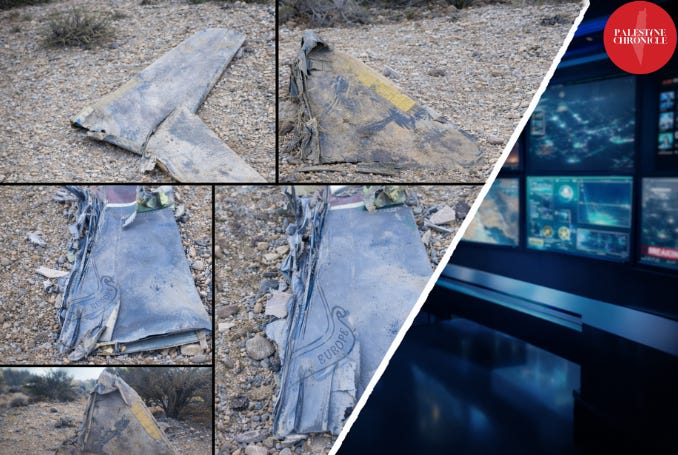
US admission of downed jet validates Iran’s claims, exposing contradictions in media narratives and reshaping the war’s strategic meaning.
The irony is striking.
At the very moment when US officials are acknowledging that a fighter jet has been shot down over Iran—thus validating earlier Iranian claims—an Arab military analyst, speaking on a major Gulf-based network, was busy casting doubt on the same story.
His argument rested on what he described as insufficient visual proof. The images circulated by Iranian media, he noted, focused largely on fragments—particularly a tail section—arguing that such material, on its own, does not conclusively demonstrate that an advanced aircraft like the F-35 was fully destroyed.
Technically, this may sound like a cautious, professional assessment. But politically, it reflects something far more consequential.
Because the same level of scrutiny is rarely applied to narratives flowing in the opposite direction.
Throughout this war, Arab media coverage—across much of its ecosystem—has consistently emphasized destruction inside Iran, the interception of Iranian missiles, and the supposed effectiveness of US and Israeli operations. Meanwhile, the missiles that do reach their targets, the infrastructure that is successfully hit, and now, critically, the downing of US aircraft, are treated with hesitation, doubt, or marginal attention.
This is not an isolated editorial choice. It is a pattern, and it is increasingly difficult to separate this pattern from the broader political positioning of Arab states themselves.
Indeed, there is a certain logic to this alignment.
Iran’s retaliatory strikes have not been confined to Israel. They have targeted US military bases and economic assets across the region, including in Arab countries. Under such conditions, the space for genuine neutrality narrows considerably. Media narratives begin to reflect not only journalistic judgment, but also national anxieties and strategic calculations.
Objectivity, in this context, becomes conditional. Yet even within these constraints, the refusal to fully engage with the implications of what has just happened remains striking.
Because what has just happened is not ambiguous: A US fighter jet has been shot down over Iran. US officials have confirmed the loss and acknowledged ongoing search-and-rescue operations for the crew. Multiple international outlets have reported the incident, marking the first such loss since the war began.
Whether the aircraft was an F-35, as Iran insists, or another advanced platform such as an F-15, as some Western reports suggest, does not fundamentally alter the strategic significance.
A US warplane has been downed in contested airspace. This matters, and matters greatly.
In fact, that alone is enough to dismantle weeks of confident assertions that Iran’s air defenses had been neutralized, that its skies were effectively open, and that US forces were operating with near-total impunity. Those oft-repeated claims can no longer be sustained.
But instead of confronting this contradiction directly, much of the discussion—particularly in Arab media—has been redirected toward technical doubt, fragment analysis, and speculative alternatives.
The more important questions are being avoided: If Iran is capable of shooting down advanced US aircraft—indeed, if it has done so twice within hours, as Iranian sources report—then what does this say about the actual balance of power in the skies?
What systems are being used?
Are these domestically developed capabilities, refined under years of sanctions and isolation? Are they the result of Chinese infrared detection technologies, as even skeptical analysts have hinted? Or do they represent a hybrid system, combining multiple technological inputs into a new, adaptive air defense network?
These are the questions that should dominate serious military analysis. Instead, the focus remains on whether a piece of wreckage is “sufficiently convincing.”
This is not an analysis. It is obviously a deflection, because to seriously engage with the implications of these developments would require revisiting one of the central claims of the war—that the United States had achieved early and overwhelming control over Iranian airspace.
It would mean acknowledging that this claim was, at best, premature. And at worst, fundamentally incorrect.
The downing of a US fighter jet—particularly one operating in what was assumed to be a permissive environment—suggests that Iran retains not only defensive capacity, but also the ability to impose costs on even the most advanced air forces in the world.
This is a strategic turning point.
It suggests that the war is not unfolding as a one-sided campaign of dominance, but as a contested confrontation in which assumptions are being tested—and, increasingly, overturned. And it raises broader questions about the direction of the conflict itself.
If US air superiority can be challenged, then escalation becomes far more unpredictable. The expectation of quick, decisive outcomes begins to erode – in fact, it already did. The risk of prolonged confrontation, with mounting costs and uncertain endgames, becomes far more real – in fact, it is.
Yet here, another contradiction emerges. While US media has been openly critical of the war—highlighting the lack of strategic vision, the absence of a coherent “day after” plan, and the haphazard nature of decision-making—much of Arab media has taken a different path.
Not necessarily pro-war. But certainly not opposed to it.
Reports have begun to indicate that several Gulf states, whether openly or discreetly, are supportive of an expanded US role in the conflict—effectively aligning with the broader strategic objectives of Israeli Prime Minister Benjamin Netanyahu, a wanted criminal, in the region.
Within this context, Arab media appear to be navigating a narrow and carefully managed space: maintaining an appearance of credibility and independence, while avoiding direct confrontation with prevailing state positions.
The result is a form of selective framing. The war is covered, but not fully interrogated. The consequences of the war are reported, but its underlying assumptions are left largely intact.
And developments that disrupt the dominant narrative—such as the downing of US fighter jets—are absorbed into a discourse of doubt rather than analysis.
This is not new. Arab media has rarely been truly independent, even when it has successfully projected that image.
For years, certain outlets positioned themselves between two worlds: the rigidity of state-controlled media and the biases of Western coverage. This positioning earned them credibility—particularly among audiences in the West searching for alternative perspectives.
But credibility, once established, can also function as a shield. A way of shaping narratives more subtly. More effectively.
Today, that subtlety is on full display. Not in the facts themselves, but in how they are framed.
As the downing of a US fighter jet becomes harder to dispute, much of Arab media has not denied the event—but has contained its meaning. What should register as a strategic rupture is reduced to technical debate and cautious language.
But this is not about a single incident.
Across the war, the pattern is consistent: facts are acknowledged, but their implications are restrained. Developments are reported, but rarely allowed to disrupt the broader narrative.
This is the real issue. Because independence is not measured by what is reported, but by what is allowed to matter.
Here, that boundary is clear.
Arab media is not simply describing the war—it is defining the limits of how the war can be understood, for reasons that speak for themselves.
(The Palestine Chronicle)
Thanks for reading! This post is public so feel free to share it.
Fake news, fake news history, and some fake history to boot. The lying mainstream media will pay.
Rules:
1.) I will ban you if you are evil.
2.) Label whether the post is #fakenews or #truthnuke in the manner of your choosing. This must be done in the title line!