1
21
submitted 1 week ago* (last edited 6 days ago) by wolfyvegan@slrpnk.net to c/fruit@slrpnk.net

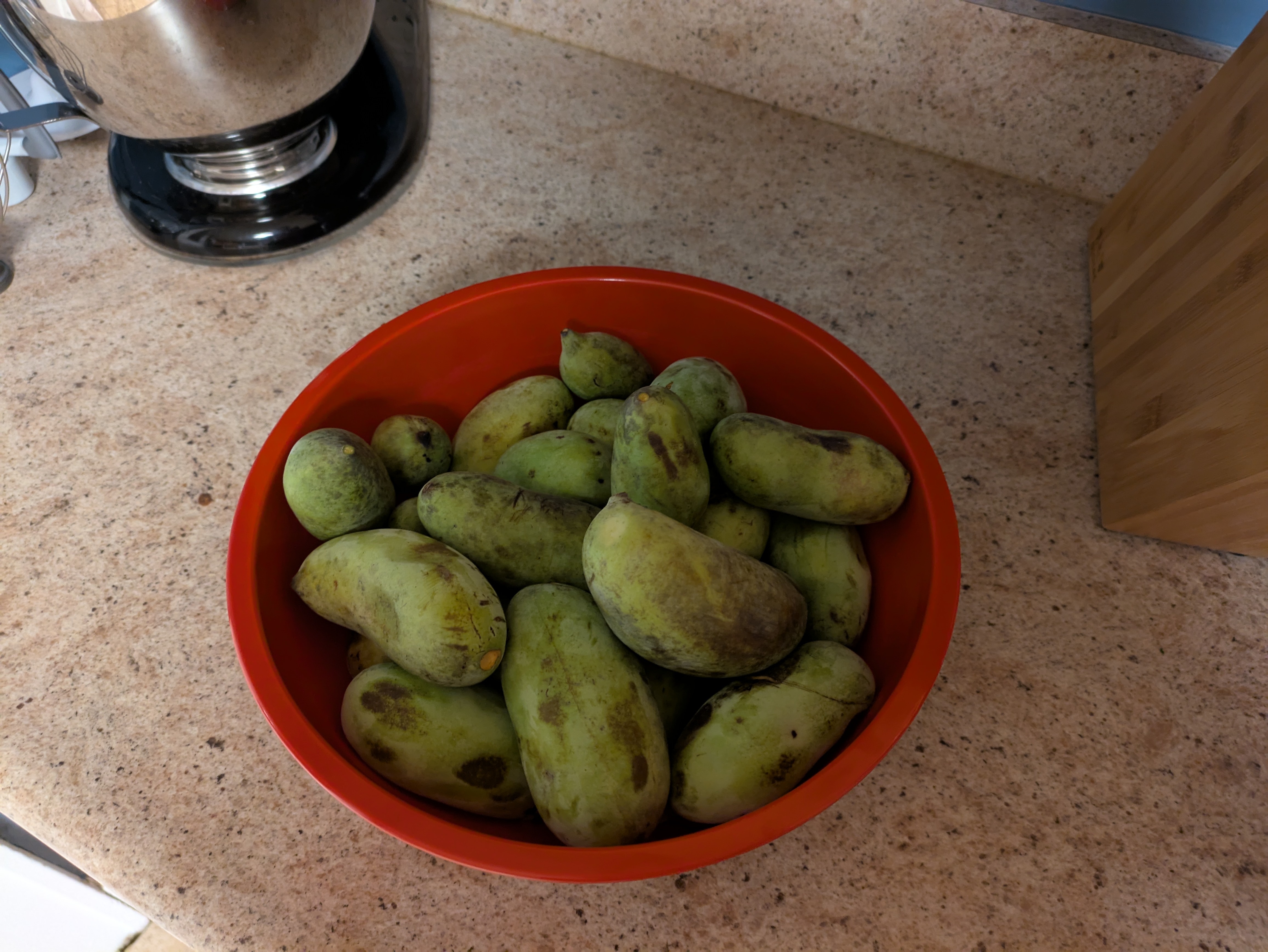
Found on the ground in the forest near Sumaco National Park, Ecuador. Probably fell unripe, as it was hard and there were no other fruits like this on the ground in the area. Anyone have any ideas what it could be?

EDIT: I have inquired about the inside of the fruit, and even as the outside was still green and hard, the inside was reportedly brown and mushy with no distinguishing features.

EDIT again: Upon further inquiry, I have found out that the inside looked more like solid segments than the goop of a passionfruit.

2
18
submitted 1 week ago by wolfyvegan@slrpnk.net to c/fruit@slrpnk.net

It's getting to be winter or summer, so what's ripening where you live? I have serious jackfruit production right now.

3
8
submitted 3 weeks ago by wolfyvegan@slrpnk.net to c/fruit@slrpnk.net
  • A recent study in Thailand finds that raising native tree seedlings inside repurposed bottle crates improves performance compared to standard methods in community-run nurseries.
  • Saplings grown in bottle crates had better root formation and superior growth when planted out in a deforested site, thanks to better air circulation for the roots.
  • Crating the saplings also saved on labor costs, which more than offset the cost of purchasing the crates.
  • Adoption of the new method could improve the quality of saplings grown in community nurseries, a benefit for reforestation projects where sapling survival is key to success.

archived (Wayback Machine)

4
11
submitted 3 weeks ago* (last edited 3 weeks ago) by wolfyvegan@slrpnk.net to c/fruit@slrpnk.net

They bloom at night, this was the first one (on the full moon) and hand-pollinated since there aren't many pollinators at night. Looks like it worked since the fruit is developing.

https://amazonrestore.codeberg.page/volunteer/finca-del-soul/

(Selenicereus megalanthus)

5
7
submitted 1 month ago by wolfyvegan@slrpnk.net to c/fruit@slrpnk.net

https://amazonrestore.codeberg.page/volunteer/finca-del-soul/

(I've never actually seen a passionfruit vine like this, so I find it fascinating.)

6
9
submitted 1 month ago by wolfyvegan@slrpnk.net to c/fruit@slrpnk.net

cross-posted from: https://slrpnk.net/post/29115239

  • Changing rainfall patterns due to climate change are posing threats to guava farming in South Asia, the global hub of the tropical fruit.
  • In recent years, rising temperatures and delayed monsoons have been affecting the flowering and fruiting of even the drought-tolerant guava varieties.
  • Experts in India, Pakistan and Bangladesh have identified links to climate change with vulnerabilities in guava farming and suggest solutions.

archived (Wayback Machine)

7
9
submitted 2 months ago by wolfyvegan@slrpnk.net to c/fruit@slrpnk.net

I posted this as a comment somewhere else, but people here might find it useful, so here it is.


Not only will an avocado seed not grow true, the seedling tree is not guaranteed to produce fruit at all, and the flowering of avocado is temperature-dependent, so if you (e.g.) plant a Hass avocado in the lowland tropical rainforest, the nights probably won't get cold enough to trigger proper flowering.

"The stigma of an avocado flower will normally have ceased to be receptive to pollen when it starts to release its own pollen. However, as a result of the mass flowering ... under ideal temperatures (maximum 25°C, minimum 20°C) there is theoretically some overlap from other flowers providing a small window of opportunity for what is termed close-pollination."

"But under cooler conditions (maximum 20°C, minimum 10°C), flower opening can be both delayed and extended. Type B flowers may be delayed so much that the female stage may not be detected, with the flower appearing to open only as a functional male. Also, the male phase of type A flowers may be so delayed that they remain open over-night and into the next morning."

https://www.agric.wa.gov.au/spring/growing-avocados-flowering-pollination-and-fruit-set?page=0%2C1

Equatorial lowlands would most likely not experience the cold conditions mentioned above, and with multiple flowering avocado trees in close proximity to each other, close-pollination could provide an adequate avocado yield. However, high temperatures can also interfere with flowering, pollination, and fruit set:

"Under a tropical temperature regime of 33°C day and 23°C night the trees of the cultivars Fuerte and Hass had fewer flowers and a shorter flowering period than under temperature conditions of 25°C day and 15°C night."

"In the Fuerte cultivar daytime temperatures above 30°C or below 20°C were found to disrupt flowering ... High temperatures appeared to stimulate vegetative growth at the expense of reproductive development and flowers and developing fruit were shed from the plant."

"The problem was particularly marked amongst Mexican and Guatemalan type cultivars; less so in West Indian types."

https://www.avocadosource.com/WAC1/WAC1_p042.pdf

"West Indian cultivars flower well in tropical climates, but often flower poorly in the subtropical climate of Southern California. On the other hand, Guatemalan and Guatemalan x Mexican hybrids flower poorly in tropical climates, but flower profusely in California."

"Flowering in ‘Hass’ and the other subtropical avocado cultivars is induced by a period of low temperature. ‘Hass’ did not flower when kept at temperatures of 30/25, 25/20 or 20/5 [degrees] C (day/night), but did flower when exposed to 3-4 months of 15/10, 18/15, 20/15 and 23/18 [degrees] C (day night). Under the two last temperature regimes the flowering was delayed and sparse"

https://ucanr.edu/sites/alternativefruits/files/166371.pdf

Here one can see the differences in yield when avocado trees flower within or outside of the optimal temperature range:

https://www.avocadosource.com/WAC1/WAC1_p045.pdf

8
24
submitted 2 months ago by wolfyvegan@slrpnk.net to c/fruit@slrpnk.net

To eat, I mean. Just curious what people here think.

9
131
submitted 2 months ago* (last edited 2 months ago) by stabby_cicada@slrpnk.net to c/fruit@slrpnk.net

Text reads: "at some point in your life you will be boiling fruit, water, sugar, and lemon juice in a pot to make a syrup or jam. The instructions will tell you to simmer for a certain period of time. Your timer will go off and you will look at the pot and go "hm this doesn't look thick enough, maybe I'll let it go for another 10 minutes". This is the devil speaking. It's only so liquid right now because it's at boiling point. It will thicken when it cools down. Learn from the follies of my youth and do not let this happen to you."

10
26
submitted 2 months ago by wolfyvegan@slrpnk.net to c/fruit@slrpnk.net

A decade of organizing has turned trash-strewn lots into edible parks. Now Boston is expanding food forests as part of its climate action plan.

“Edible forests” are popping up in Boston. Scattered across the city, once-empty lots have been overtaken by fruit trees and berry-filled bushes. Open to the public, they are forage-friendly pockets in the urban grid.

archived (Wayback Machine)

11
16
submitted 2 months ago by wolfyvegan@slrpnk.net to c/fruit@slrpnk.net

Despite federal roadblocks, an ambitious agroforestry program is feeding people, cleaning the air, and helping offset climate change.

archived (Wayback Machine)

12
16
submitted 2 months ago by wolfyvegan@slrpnk.net to c/fruit@slrpnk.net

books, websites, video tutorials, some guy who met Jim West one time, whatever reference you use

13
34
submitted 2 months ago* (last edited 2 months ago) by wolfyvegan@slrpnk.net to c/fruit@slrpnk.net

I am not OP but this is cool.

cross-posted from: https://lemmy.world/post/36126832

It is an odd fruit and not too widespread but boy is it good. Wiki

14
9
submitted 2 months ago* (last edited 2 months ago) by LibertyLizard@slrpnk.net to c/fruit@slrpnk.net

A chimeric citrus that should have greatly improved hardiness. Are there other fruits where this could have merit? They will need to be graft compatible and have species with differing hardiness. Also, they would need to have fruit that develop from different parts of the meristem than the rest of the plant. This is true with citrus but I have no idea for other plant groups.

I haven’t checked graft compatibility for all of these but here are some preliminary ideas of species that could have their cold hardiness improved with this technique:

Peaches: apparently only minor hardiness differences for some varieties, so likely not with the effort.

Almonds: early blooming might be problematic. Hardiness difference with other stone fruit is about 10F, so there is some benefit here.

Avocados: apparently quite narrow graft compatibility, only grafts with closely related species from similar environments. I couldn’t find much information on their environmental tolerances but it does not seem promising.

Black sapote or other tropical Diospyros: so many species here and most are not well tested, but apparently black sapote (hardy to 28F) is graft compatible with the very hardy American persimmon (-25F). This is a stunning 50 degree difference although it seems unlikely a chimera would be quite this hardy. What would happen with a chimera between an evergreen and deciduous species? Would dormancy, important for frost protection, be disrupted? American persimmon is also fairly heat and drought tolerant. This is the most promising yet, though having never tried black sapote, I don’t know if it’s worth the effort.

Tropical figs? Are any worth eating?

Mulberries—a few more tropical varieties exist

Any others that come to mind?

Could this technique also improve drought and heat tolerance?

15
10
submitted 3 months ago by wolfyvegan@slrpnk.net to c/fruit@slrpnk.net

Growing tall trees to provide shade for cocoa plantations in west Africa could sequester millions of tonnes of carbon, according to a new study.

archived (Wayback Machine)

16
4
submitted 3 months ago by wolfyvegan@slrpnk.net to c/fruit@slrpnk.net

Abstract

A sufficient intake of fruits can alleviate micronutrient deficiencies and reduces the risks of a number of associated diseases. In many parts of sub-Saharan Africa, however, the production and consumption of fruits are inadequate on average and in particular so in specific seasons. To better incorporate fruits into local food systems while addressing the challenge of seasonal availability, World Agroforestry (ICRAF) has developed a methodology based on “fruit tree portfolios” that selects socio-ecologically suitable and nutritionally important fruit tree species for farm production, to meet local consumption needs. We here present this approach and illustrate it with data from a case study involving Western and Eastern Kenya. The approach uses mixed methods to capture on-farm fruit tree diversity and seasonality at a household level (n = 600 in our case study), the months of household’s food security and insecurity (n = 600) and food consumption patterns at an individual level, to identify dietary gaps (n = 294 women and child pairs in our example). In our case study, 31 fruit tree species were reported on farms in our Western Kenya sample (9 of which were indigenous) and 51 (27 indigenous) in Eastern Kenya. In addition, the median number of food-insecure months per household was four (ranging from 0 to 9 months) in Eastern Kenya and three (0 to 12 months) in Western Kenya. Finally, using 24-h recalls the proportion of women that had consumed a fruit the day before the interview was around 55% in Western Kenya and 80% in Eastern Kenya, with consumption averaging 93 and 131 g, respectively. Using these parameters for each site and fruit tree phenology and food composition data sets, we derived context-specific recommendations that involve promoting 11 fruit tree species to address micronutrient gaps.

archived (Wayback Machine)

17
9
submitted 3 months ago by wolfyvegan@slrpnk.net to c/fruit@slrpnk.net
  • Malawian households with fruit trees on their farms consumed more vegetables, and each additional tree species increased fruit consumption by 5% over a 10-year study period.
  • Trees improve nutrition through direct consumption of fruits, ecosystem services that boost other crop production and potential income from sales, and they provide cooking fuel.
  • Despite trees’ benefits, fruit and vegetable intake dropped 42% and 25%, respectively, due to rising food prices, currency devaluation and climate change.
  • Researchers recommend including food-producing trees in Africa’s reforestation programs and shifting agricultural policies from focusing solely on staple grains to supporting diverse, nutritious crops.

archived (Wayback Machine)

18
21
submitted 3 months ago by wolfyvegan@slrpnk.net to c/fruit@slrpnk.net

Not my photos.

Some friends in the Amazon recently discovered a new native fruit growing near their place, and they are now planting it in their food forest. The fruits that they found were already damaged, but the one shown in the thumbnail photo was mostly okay, and they said that the flavour reminded them of sapodilla (Manilkara zapota) and mango. The outer layer of pulp is sweeter than the segments around the seeds.

Immediately after ripening the fruits, the tree is flowering again, which is very fortunate for ID purposes.

I'd say that it's Porcelia mediocris based on the photos. Those flowers are clearly Annonaceae, and the shape of the fruit resembles other Porcelia fruits that I've seen. I arrived at the ID using these sources:

Can anyone confirm? Does anyone think that it's something else?

19
7
submitted 3 months ago by wolfyvegan@slrpnk.net to c/fruit@slrpnk.net

Do you plant the seeds from fruits that you eat, or collect seeds from under mature trees in your area, or buy seeds from someone, or dig out plants that you find growing, or buy plants from a nursery, or trade with other fruit growers? Do you know of any excellent seed/plant sources that you're willing to share?

20
10
submitted 3 months ago by wolfyvegan@slrpnk.net to c/fruit@slrpnk.net

What are you doing, or what do you want to do, or what do you think that people should do, in order to achieve food security and avoid the most severe impacts of the worldwide trend toward cost-of-living crises, resource depletion, tariffs and trade wars, impediments to migration, accelerating climate change, and so on?

Are you currently producing your own food? Do you think that you're secure where you are, or that you will be in a few years, or do you plan to move somewhere else?

Do you forage? Dumpster dive? Do you share food with friends and neighbours? Do you trade services for food?

Just wondering who is out there and how they're managing...

21
14
submitted 3 months ago by wolfyvegan@slrpnk.net to c/fruit@slrpnk.net
  • Bananas make up one of the largest tropical fruit export chains, with 20 million metric tons of bananas exported annually; a whopping 100 billion bananas are eaten globally each year.
  • According to a recent study, the area suitable for export banana production in Latin America and the Caribbean could be reduced by 60% due to climate change and other factors, such as population density and distance from ports.
  • Research highlights that countries located in the Global South may find it more difficult to adapt to climate change than wealthier countries due to a lack of resources.
  • Although the study focuses on large, intensive banana plantations, researchers say small farmers could also be affected by climate change; however, they may be more resilient to climate shocks because they often use a production system that values crop diversity.

archived (Wayback Machine):


The researchers conclude that among the climatic factors they analyzed, temperature would be the only factor responsible for the loss of suitable areas, as the increasing temperatures will be harmful to banana yields. “This is particularly the case in dry regions, or regions which will become dry. In addition, extreme events such as hurricanes and storms can damage production, for example the Caribbean,” Bebber says.

The analysis is based on a scenario in which there would be no labor migration, port expansion or irrigation in the future. Therefore, the climate crisis will likely cause the areas most suitable for banana production to become more distant from regions that currently have sufficient irrigation and population density to guarantee labor, as well as becoming more distant from ports, which are essential infrastructure for the export chain. According to Bebber, “to continue production in these new suitable areas, we’ll have to ensure we have sufficient irrigation (in some places), workers, and transport infrastructure.”

From the abstract of the study:

We found that intensive banana production is constrained to low-lying, warm aseasonal regions with slightly acidic soils, but is less constrained by precipitation, as irrigation facilitates production in drier regions. Production is limited to areas close to shipping ports and with high human population density.

Areas at reasonable elevations with sufficient year-round rainfall will remain suitable for non-commercial banana production for many years to come. Continue planting bananas in your food forest... just don't rely on only one kind.

22
11
submitted 3 months ago by wolfyvegan@slrpnk.net to c/fruit@slrpnk.net

This page continues the explanation: https://rainforestsaver.org/how-to-and-the-science/

related information:

Syntropic food forests are the way to go. The forest produces abundance, if only we are willing to work with it.

23
12
submitted 3 months ago by wolfyvegan@slrpnk.net to c/fruit@slrpnk.net

I live in a "rustic" house made of wood that is not naturally termite-resistant and was apparently not treated before/during the construction. There are termites here. I know that borax works for termite-proofing wood, and it is possible to get borax in the big cities in this part of the world, but I would need to disassemble the house and treat each piece of wood. I would rather not do that. The borax is also prohibitively expensive.

The oil of Tectona grandis or Milicia excelsa or a similar tree would probably work for discouraging the termites if slathered all over the wood that they must climb in order to enter the house, but even if I can find the trees growing somewhere, processing the oil seems like a big hassle, so I am seeking a simpler solution.

I was wondering if there is a fruit (oily, perhaps) that I could apply to the wood in order to keep the termites away. Preferably with a tolerable smell, but I've lived with the smell of neem oil before, and I enjoy eating noni, so I can handle a lot. Would any of the "medicinal" fruits work for this? I live in a tropical rainforest climate, and I know people who grow fruits from all over the world, so I may be able to find something suitable if I know what to look for.

Thank you~

24
4
submitted 3 months ago* (last edited 1 month ago) by wolfyvegan@slrpnk.net to c/fruit@slrpnk.net

Pourouma cecropiifolia

It's an Amazon tree, but it's not a grape.

This tree grows very quickly and bears fruit at a young age, but it has the tendency to grow too tall to harvest and to get top-heavy, so it's susceptible to blowing over in a storm.

25
8
Garcinia livingstonei (tropical.theferns.info)
submitted 4 months ago by wolfyvegan@slrpnk.net to c/fruit@slrpnk.net

This seems like an excellent fruit tree to consider as climate change makes growing conditions in many places more extreme. It tolerates heat, cold, wind, salt, drought, heavy rain, coastal sand dunes, rocky highlands...

Growables has more info and pretty pictures.

view more: next ›

Fruit & Fruit Trees

230 readers
1 users here now

A community to discuss fruit trees, fruit forestry, fruitarianism, and all things fruit-related.

Post photos of your fruit trees or harvests, share growing information or interesting articles, ask questions, or just express your appreciation for fruit in general!

No anti-fruit posts/comments. Let's keep this a positive space!

Instance Rules

Banner photo of Pereskia aculeata by Lumicon (CC BY-SA 4.0)

founded 8 months ago
MODERATORS