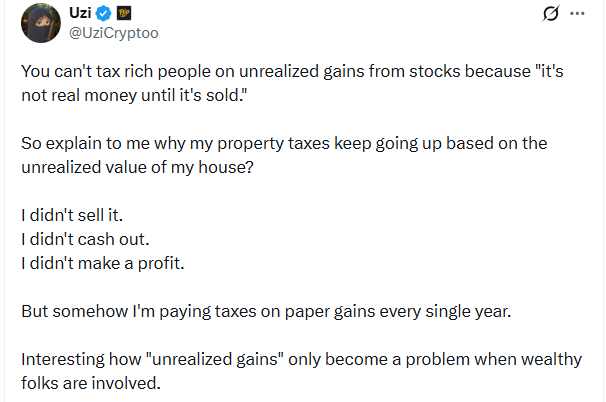
It wouldn't be so bad if you couldn't use the unrealized gains. But people can have a bunch of stock, get an untaxed loan, and have access to money without the tax burden. We should fix that.
Also property tax should probably be progressive
It wouldn't be so bad if you couldn't use the unrealized gains. But people can have a bunch of stock, get an untaxed loan, and have access to money without the tax burden. We should fix that.
Also property tax should probably be progressive
This was an interesting point I hadn't thought of before, so I wanted an alternate perspective since a Twitter meme is a little one sided, think of it what you will:
Property taxes are ancient — they predate modern stock markets by centuries. Land was the dominant form of wealth, and crucially, you can't hide a house from the assessor. Real estate is immobile, visible, and tied to a specific jurisdiction. Stocks are the opposite: mobile across borders, easy to hold through trusts or shell entities, and private holdings are genuinely hard to value year-over-year.
The other piece is who's collecting and why. Property taxes are local — they fund schools, fire, roads, the stuff that directly makes your property more valuable. There's a clean "benefit" logic: the city paves your street, your house is worth more, you pay for it. A share of Apple isn't enhanced by Seattle paving anything, so there's no equivalent local nexus.
Stocks also already get taxed, just at different moments rather than annually: capital gains when you sell, dividends when paid, corporate income tax on the underlying company, estate tax at death. The argument against an annual wealth-style tax is partly that the system already takes its cut, just not on a recurring basis.
A few countries (Norway, Switzerland, Spain) do tax financial wealth annually, but most that tried it abandoned it — capital flight and valuation headaches. In the US there's also a constitutional wrinkle: the federal government can't easily levy direct taxes on wealth without apportionment among states, which is why Warren/Sanders-style wealth tax proposals have to be carefully structured to survive a court challenge.
The system should take more of a cut, if that’s the argument we are going with.
Also? A new realization event should be defined: collateralization. When you take out loans against the value of your stock/bond/whatever holdings, you are realizing gains from those assets - you wouldn’t have gotten the line of credit otherwise.
People argue that this would prevent homeowners for taking equity lines of credit for improvements but that’s easily remedied by the collateral not being a real asset.
Also of interest: Taxes aren't paid on stock buybacks which is why they became popular.
Because that used to be illegal so there was no need to tax it
They’re not taxed because they used to be illegal and they shouldn’t ever be taxed because they should be made illegal again.
They're right: it is pretty complicated to tax the rich using the current tax code. And there's a very good reason for that: they made sure it's as complicated as possible.
I think the idea that taxing the rich is difficult or our tax code is too complicated feeds into the narrative around the problem being too hard to solve. I think the reality is more straightforward:
Bring back the previous top tax bracket of 39% that Republicans did away with. That will bring in a significant revenue.
Raise or add the top brackets on the capital gains taxes.
Add a new top tax bracket of you want to raise more revenue, e.g. 46% above X millions.
When you look at reports by the congressional budget office or independent budget groups, most of the other proposals are noise in the grand scheme of things. Even the buy, borrow, die strategy that gets a lot of airtime (because it rightfully violates most people's sense of fair play) only really accounts for something like 2% of the funds used by the ultra wealthy.
Most of the things like wealth taxes would require more complex legislation and be treated by the courts, certainly going to the supreme court. But the above three bullets would meaningfully raise revenues, are simple in terms of legislation, and have clear statutory authority and case law on their side.
The only thing hard is electing enough people who actually care about the budget and the people.
We need a tax system where the government figures out how much they need each year, and then just takes it proportional to net wealth above a certain amount.
You can bet Elon won't be declaring himself a trillionaire under that system.
We need a tax system where the government figures out how much they need each year, and then just takes it proportional to net wealth above a certain amount.
That's exactly how property taxes work if you replace "net worth" with "assessed property value."
(As opposed to what some people think, that rising property values on their own lead to rising property taxes)
So yeah, why the heck not do the same with other forms of wealth?
100% agreed. This has been going on for some decades, hand-in-hand with "The FED" being so complex that only bankers and their ilk can handle banking, so we must have bankers control their own banking and our dollar.
Banking is easy. You put money in the bank, they save it until you need it for a small fee. But they don't save it any more, you see. They have about one dollar for every 10 dollars deposited. The rest exists only in the banking system itself, and is not a tangible asset.
The complex part is their labyrinthine banking-created machinations to manipulate that one dollar into ten.
I'd get into it, but mods often think anything about The FED is a conspiracy. Don't be like them. Take The Fed at its word, note who serves and where they worked before and after their terms, and reach your own conclusions.
Property taxes are a thing.
Stocks are property.
It's not rocket science.
Twitter screenshot meme slactivism aside, it's because private land is a limited resource. The more you keep for yourself, the more you pay (generally).
A place to discuss positive changes that can make work more equitable, and to vent about current practices. We are NOT against work; we just want the fruits of our labor to be recognized better.
Our Philosophies:
Our Goals